Last updated: August 30, 2026
Teaching pronouns can be surprisingly tricky, especially when students mix up who/whom or confuse contractions with possessives. This lesson focuses on teaching pronouns with clear rules, kid‑friendly examples, and interactive practice to help students choose the right pronoun every time.
Jump to
Teaching Pronouns — Why This Skill Matters
Pronouns help students avoid repetition and write with clarity, but they can also create confusion when used incorrectly. Teaching pronouns explicitly gives students the tools to choose the right word, avoid common errors, and strengthen sentence flow.
Teaching Pronouns Mini-Lesson
Take some of the stress away from teaching endless rules for understanding pronouns with some of these fun hands-on activities. Try teaching pronouns using these posters as a classroom display for students to reference. Turn practice into game-like activities. Read fun books and play catchy songs. Finally, show videos that review rules. Your students will become experts in no time at all.
Mini-Lesson Overview
This short lesson helps students choose clear, correct pronouns and avoid common mistakes like confusing contractions with possessives or mixing up who/whom. It takes about 10 minutes and works well before any reading or writing activity.
Step 1Introduce the Rule
A pronoun is a word that takes the place of a noun. Students use pronouns to avoid repeating the same nouns over and over, but they must choose the pronoun that matches the noun it replaces.
You can anchor this with your webpage's core rule:
- Pronouns must match the noun they replace.
- Who / whoever = subject
- Whom / whomever = object
- Its = possessive
- It's = contraction
- Whose = possessive
- Who's = contraction
Step 2Show a Quick Example
Write this sentence:
Maria forgot Maria's backpack, so Maria asked Maria's friend for help.
Ask students what sounds wrong. Then show how pronouns fix it:
Maria forgot her backpack, so she asked her friend for help.
Explain that pronouns make writing smoother and clearer.
Step 3Try It Together
Give students this sentence:
The puppies wagged the puppies' tails because the puppies were excited.
Ask:
- Which pronouns could replace "puppies"?
- Does "they" fit?
- Does "their" fit?
Guide them to revise:
The puppies wagged their tails because they were excited.
Step 4Independent Practice
Give students a short sentence and ask them to replace repeated nouns with pronouns.
Example:
The teacher told the teacher's class that the teacher had a surprise.
Students revise:
The teacher told her class that she had a surprise.
You can also give a quick who/whom example:
____ will take the first turn? (Students choose Who because it's the subject.)
Step 5Connect to Writing
Ask students to revise a sentence from their journal by:
- replacing repeated nouns with pronouns
- checking that each pronoun clearly matches its noun
- fixing any unclear pronoun references
Jake told Sam that he lost his phone. → Jake told Sam, "You lost your phone."
This helps students immediately apply pronoun clarity to their own writing.
Teaching Pronouns Video with Organizer
This video is a great overview of several rules about pronouns. It includes definitions and examples for the following:
- pronoun uses
- subject-verb agreement
- rules and examples
- finding what is wrong in examples
The lesson pairs with a provided graphic organizer. Students listen to the first part of the video to hear the definition of pronouns. When instructed, students pause the video and complete their organizers. Finally, students watch the remainder of the video to check their answers.
Download free posters, the video organizer, and classroom handouts here.
Teaching Pronouns Activities
Activity #1 – Posters
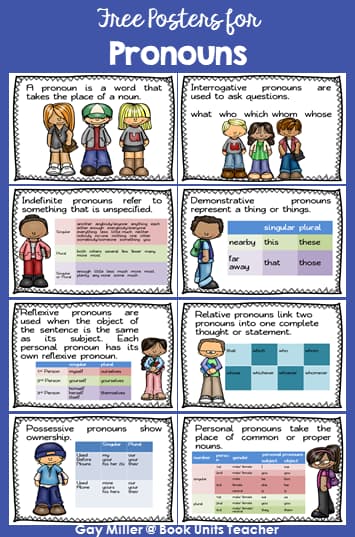
This set of mini-posters may be displayed in the classroom during the lesson for students to reference.
Do you need additional posters? The Teaching Ideas website provides both banners and posters.
Activity #2 – Schoolhouse Rock – “Rufus Xavier Sarsaparilla”
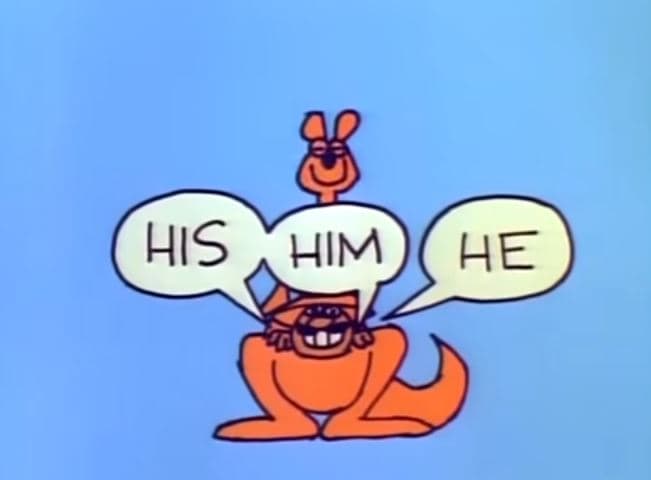
Bring music into grammar instruction with the classic Schoolhouse Rock song “Rufus Xavier Sarsaparilla.” It’s packed with examples and rhythm that sticks.
Activity #3 – Grammar Games
- Play games like “The Bag Game” where students build sentences from words drawn from paper lunch bags.
- Create cards with pronouns and their antecedents. Students match them correctly, then write a sentence using both.
- Create a “Pronoun Relay.” Students race to match sentence halves using the correct pronoun (e.g., “Maria saw the dog” + “She fed it”).
Activity #4 – Pronouns Anchor Chart

This anchor chart is loaded with definitions and examples. Including an anchor chart such as this one is a great reference guide for students.
Activity #5 – Practice Online: One Home Word Puzzle
Send students to this interactive logic puzzle where every word in the bank fits more than one sentence at first glance, but each one has exactly one correct home. Students place who/whom/whoever/whomever, it’s/its/who’s/whose, and there/their/they’re/your/you’re into the sentences where they truly belong, reasoning through grammatical clues instead of guessing by sound. A strong independent practice or homework follow-up to this lesson.
Teacher Section
Common Misconceptions
- Students often think “who” and “whom” are interchangeable, or avoid “whom” entirely because it feels overly formal.
- Students confuse “its” (possessive) with “it’s” (contraction) because the apostrophe rule for possession usually applies elsewhere (“Maria’s backpack”) but not with pronouns.
- Students sometimes think a pronoun just needs to “sound right” rather than checking that it clearly matches its antecedent.
Differentiation Tips
- Beginning: Focus on matching a pronoun to a single, clearly stated noun before introducing ambiguous-reference practice.
- Advanced: Push into who/whom and the contraction/possessive pairs (it’s/its, who’s/whose) once basic pronoun-noun matching is solid.
- Multilingual learners: Some languages mark gender or number differently than English pronouns do (or not at all) — pair pronoun practice with quick checks on gender/number agreement rather than assuming it transfers automatically.
Where This Shows Up in Student Writing
Watch for pronoun references that are technically grammatical but unclear in context, for example, “Jake told Sam that he lost his phone,” where “he” and “his” could point to either boy. This kind of ambiguous reference is one of the most common editing issues in student narrative writing, and it’s a natural next step once students have mastered simple pronoun-noun matching.
Quick Formative Check
Give students a sentence with an ambiguous pronoun reference (like the Jake/Sam example) and ask them to rewrite it so the meaning is clear. If they can explain why the original sentence is confusing, not just fix it by guessing. They’ve moved past simple matching into real pronoun clarity.
How It Shows Up on Tests
Standardized tests often test pronoun-antecedent agreement directly (fill-in-the-blank: “Each student should bring ___ own pencil”) and possessive/contraction pairs (multiple choice: its vs. it’s). Both question types reward students who’ve internalized the rule rather than relying on how the sentence sounds.
If you missed the link to the handouts, here it is again.
See the product that inspired this post.

Ready to dive deeper?
To look at how Teaching Grammar with Animated Shorts can transform your grammar lessons, visit my Teachers Pay Teachers store. You’ll find detailed lesson plans, interactive activities, and everything you need to bring grammar to life in your classroom!




1 comment
I am so impressed with all of your work. Thank you for sharing your ideas. I know my students will benefit from everything.
Teresa