Last updated: August 30, 2026

Verbs carry the action in every sentence, but students often struggle with tense shifts and vague wording. This lesson focuses on teaching verbs through simple explanations, engaging practice, and writing strategies that help students use precise, powerful verbs in grades 3–5.
Jump to
Teaching Verbs — Why This Skill Matters
Verbs carry the action in every sentence, and choosing the right tense helps students communicate clearly. When students understand how verbs work, their writing becomes more precise, more engaging, and easier for readers to follow.
Teaching Verbs Mini-Lesson
Mini-Lesson Overview
This short lesson helps students understand how verbs work, how verb tenses shift, and how choosing precise verbs strengthens writing. It takes about 10 minutes and works well before narrative, informational, or response writing.
Step 1Introduce the Rule
A verb shows action or state of being. Students need to understand that verbs change depending on when the action happens — past, present, or future — and that choosing a more precise verb makes writing stronger.
Anchor rules you can use:
- Verbs show what the subject does.
- Verb tense must match when the action happens.
- Strong verbs make writing clearer and more vivid.
Step 2Show a Quick Example
Write this sentence:
The dog ran across the yard.
Ask students:
- What is the verb?
- When did the action happen?
Then show how changing the verb changes the meaning:
- The dog runs across the yard. (present)
- The dog will run across the yard. (future)
Explain that verb tense helps readers understand the timeline.
Step 3Try It Together
Give students this sentence:
The students walk to the library yesterday.
Ask:
- Does the verb match the time word "yesterday"?
- What tense should it be?
Guide them to revise:
The students walked to the library yesterday.
Then ask:
- What is the subject?
- What is the verb?
- How did the verb change?
Step 4Independent Practice
Give students a short sentence with a mismatched verb tense and ask them to fix it.
Example:
She writes her report last night.
Students revise:
She wrote her report last night.
You can also give a "strengthen the verb" example:
The boy went to the store. → The boy raced to the store. → The boy strolled to the store.
This helps students see how verb choice affects tone and meaning.
Step 5Connect to Writing
Ask students to revise a sentence from their journal by:
- fixing any tense shifts
- replacing a vague verb with a precise one
- choosing a verb that matches the mood or action
I went to the game. → I cheered at the game. → I watched the game. → I played in the game.
This helps students immediately apply verb clarity and precision to their own writing.
Verbs are the engines of sentences. They show what is happening, what has happened, or what will happen. Helping students understand action, linking, and helping verbs (and their tenses) gives them the tools to write with clarity and power.
This post is packed with engaging activities, videos, games, books, posters, and free resources you can use to bring verbs to life in your classroom.
It’s a verb. It’s a verb.
It’s an action word.
You can do it. You can do it.
It’s a verb.
Teaching Video with Organizer
This video is a great overview of verb tenses. It includes definitions and examples for the following verb tenses:
- present, present perfect, and present progressive
- past, past perfect, and past progressive
- future, future perfect, and future progressive

The lesson pairs with a provided graphic organizer. Students listen to the first part of the video to hear the definition of verbs. When instructed to do so, students pause the video and complete their organizers. Finally, students watch the remainder of the video to check their answers.
Download free posters, the video organizer, and classroom handouts here.
Teaching Verbs Activities
Activity #1 – Posters

Mini-posters are a great reference tool for students during writing lessons. These cover definitions and examples of different verb types and tenses.
(Included in the free handout bundle.)
Activity #2 – Schoolhouse Rocks

Nothing sticks quite like a jingle. Try Schoolhouse Rock’s “Verbs,” a fun way to introduce or reinforce action words. Students often memorize the tune, which helps them remember key concepts.
Activity #3 – Grammar Charades
Play charades where students act out verbs and classmates guess the action. Add complexity by requiring students to name the tense or form (e.g., “past progressive”).
Teaching Tip: Use this as a warm-up before writing. It helps students visualize how verbs drive sentence meaning.
Verb Activity # 4 – Verb Sorting Challenge
Create cards with verbs in various tenses and forms. Students sort them into categories (e.g., “past perfect,” “helping verb,” “irregular verb”).
Teaching Tip: Turn it into a timed relay race for small groups. The fastest accurate sort wins!
Verb Activity #5 – “Verb or Not?” Game
Give students a mix of words and phrases. They must decide whether each is a verb and justify their reasoning.
Teaching Tip: Include tricky cases like gerunds and infinitives to stretch their thinking.
Verb Activity #6 – Sentence Surgery
Provide “broken” sentences missing verbs or with incorrect tense. Students “operate” by rewriting and correcting them.
Teaching Tip: Use color-coded markers to highlight the subject, verb, and object for visual reinforcement.
Activity #7 – Practice Online: One Home Word Puzzle
This interactive logic puzzle challenges students to place is/are/was/were, lie/lay/lain/laid, and rise/rose/raise/raised into their one correct sentence home, using tense and object clues rather than guesswork. A great capstone activity after the tense and irregular-verb work earlier in this lesson.
Activity #8 – Verb Anchor Chart
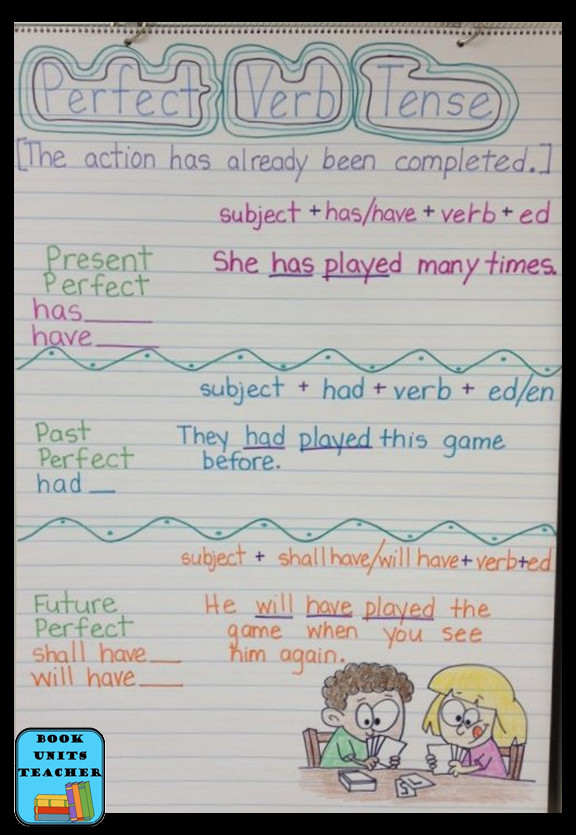
Anchor charts are a must-have for grammar lessons. This chart covers the perfect tenses with sample sentences so students can see patterns at a glance. Having examples visible makes it easier for them to use correct forms in their own writing.
Teacher Information
Common Misconceptions
- Students often think any word describing an action is automatically the verb, missing linking verbs like “is,” “seems,” or “became” that show state of being rather than action.
- Students confuse verb tense with how long ago something happened, assuming “walked” always means “a long time ago” rather than matching whatever time clue the sentence gives.
- Often, students think “lay” and “lie” (and their past forms) are interchangeable, since they sound similar and both involve reclining or placing something.
Differentiation Tips
- Beginning: Start with clear action verbs in simple past/present/future before introducing linking verbs or irregular forms.
- Advanced: Introduce tricky irregular pairs (lie/lay, rise/raise) and multi-tense practice (perfect and progressive forms) once simple tense-matching is solid.
- Multilingual learners: Some languages don’t mark tense through the verb itself the way English does — pair tense practice with explicit time-clue spotting (yesterday, right now, next week) to make the connection concrete.
Where This Shows Up in Student Writing
Watch for tense-shifting mid-paragraph in narrative writing. For example, a student might start a story in past tense and drift into present tense without noticing. This is one of the most common and most fixable issues in early narrative drafts, and connects directly back to this lesson’s Step 3 revision practice.
Quick Formative Check
Give students a sentence with a mismatched verb tense (like “She writes her report last night”) and ask them to both fix it and explain what clue told them which tense was needed. Explaining the clue, not just fixing the sentence, shows they understand the rule rather than guessing.
How It Shows Up on Tests
Verb tense and subject-verb agreement are staples of standardized editing questions, often framed as “which sentence is written correctly” or fill-in-the-blank tense selection. Irregular verb pairs (lie/lay, rise/raise) are a favorite trap on these questions specifically because they look so similar.
If you missed the link to the handouts, here it is again.
See the product that inspired this post.

Ready to dive deeper?
To look at how Teaching Grammar with Animated Shorts can transform your grammar lessons, visit my Teachers Pay Teachers store. You’ll find detailed lesson plans, interactive activities, and everything you need to bring grammar to life in your classroom!