Teaching Adjectives: A Simple Guide for Upper Elementary

Last updated: August 30, 2026
Teaching Adjectives

Ordering adjectives can feel like a mystery to students and even many adults. This lesson focuses on teaching adjectives with a memorable pattern, clear examples, and interactive practice that helps students build descriptive sentences with confidence.

Grade Level3–5
Skill FocusOrdering adjectives using a clear pattern
StandardsL.3.1g–5.1a • L.3.3–5.3 • L.3.4–5.4
FormatPrintable, Video, & Interactive Practice

Jump to

Teaching Adjectives — Why This Skill Matters

Adjectives help students add detail and description, but ordering them correctly can be challenging. Teaching adjective order gives students a simple pattern they can rely on, making their sentences clearer and more polished.

Teaching Adjectives Mini-Lesson

Mini-Lesson Overview

This short lesson helps students understand how adjectives work and how to order them correctly in sentences. It takes about 10 minutes and works well before descriptive writing, narrative details, or any sentence-expansion activity.

Step 1Introduce the Rule

Adjectives describe nouns. Students often know how to use adjectives, but ordering them can feel confusing. The good news is that English follows a predictable pattern.

Anchor rule you can use (matching your webpage):

Opinion → Size → Age → Shape → Color → Origin → Material → Purpose → Noun

Students don't need to memorize every category — they just need to know that adjectives follow a natural order.

Step 2Show a Quick Example

Write this sentence:

She adopted a small brown puppy.

Ask students:

  • Which word is the noun?
  • Which words describe it?
  • Why does "small brown puppy" sound right, but "brown small puppy" sounds wrong?

Explain that adjective order helps sentences sound natural and clear.

Then show a longer example:

He bought a beautiful old wooden chair.

Point out how the adjectives follow the pattern.

Step 3Try It Together

Give students this scrambled set of adjectives:

red · shiny · new · bicycle

Ask:

  • Which adjective shows opinion?
  • Which shows age?
  • Which shows color?

Guide them to build:

a shiny new red bicycle

Then ask:

  • What is the noun?
  • How did the order change the clarity?

Step 4Independent Practice

Give students a short list of adjectives and ask them to put them in the correct order before adding the noun.

Example:

wool · warm · blue · scarf

Students revise:

a warm blue wool scarf

You can also give a "choose the best adjective" moment:

The ____ kitten slept on the couch. (Students choose adjectives that fit the noun.)

Step 5Connect to Writing

Ask students to revise a sentence from their journal by:

  • adding one descriptive adjective
  • replacing a vague adjective with a specific one
  • ordering multiple adjectives correctly

I saw a bird. I saw a tiny black bird. I saw a tiny black hummingbird.

This helps students immediately apply adjective clarity and order to their own writing.

Step 1 of 5

Adjectives bring language to life, and teaching them should be just as colorful. This post offers eight classroom-tested activities to help students master adjective clauses, ordering rules, and comparative forms through literature, visuals, and sensory experiences.

Teaching Video with Organizer

This video is a great overview of several rules about adjectives. It includes definitions and examples for the following:

  • adjective clauses
  • ordering adjectives
  • comparative and superlative adjectives
Adjectives Video Lesson
Play Video about Adjectives Video Lesson

The lesson pairs with a provided graphic organizer. Students listen to the first part of the video to hear the definition of adjectives. When instructed to do so, students pause the video and complete their organizers. Finally, students watch the remainder of the video to check their answers.

Download free posters, the video organizer, and classroom handouts here.

Teaching Adjectives Activities

Activity #1 – Posters

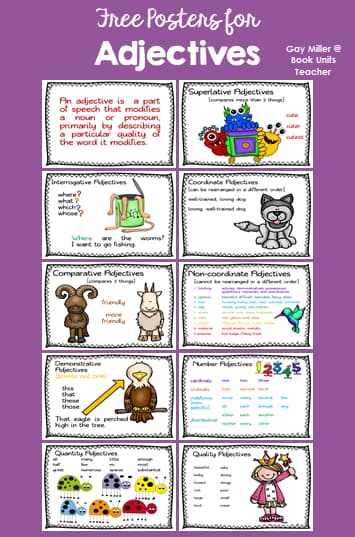
Adjectives Posters

This set of mini-posters may be displayed in the classroom during the lesson to emphasize the main points of the lesson.

Also, check out this free printable poster and banner at Teaching Ideas.

Activity #2 – Adjectives Bulletin Board Idea

Select a food item that students can sample in class. [I have done this activity with apples, popcorn, and Hershey kisses.] As students eat the food, have them complete a chart with rich describing words (adjectives) like the one below.

SeeHearFeelTasteSound


Next, provide students with one or two paper cut-outs of the food item you have selected for this activity. Each student will select the best word(s) from his/her chart and write one word per cut-out.

The cut-outs will then be arranged on the bulletin board in an attractive manner. For example, apples may spill out of a basket. Popcorn may be in a red and white striped box like those provided at the movie theater.

Activity #3 – Schoolhouse Rock

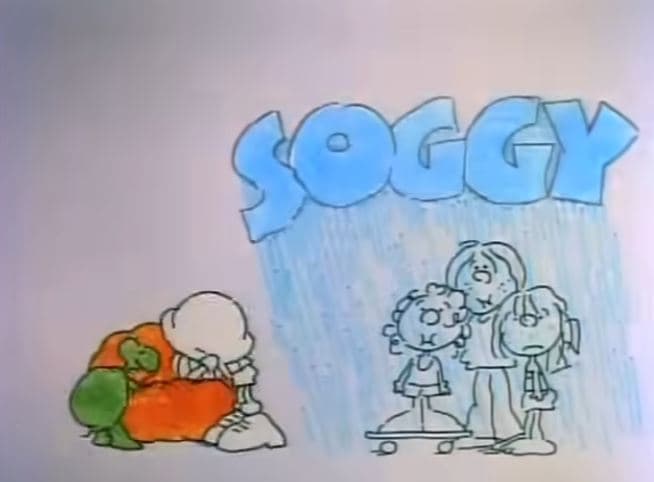
Schoolhouse Rock - Unpack Your Adjectives
Play Video about Schoolhouse Rock - Unpack Your Adjectives

YouTube has a number of videos on adjectives. Try “Unpack your Adjectives” from Schoolhouse Rock. You will find the lyrics at the Schoolhouse Rock site. Students love these catchy tunes.

Adjective Activity #4: Apples to Apples Game

Play a classroom version of Apples to Apples using adjective cards and noun cards. Students match descriptive words to objects and justify their choices.

Teaching Tip:

Add a twist: challenge students to use the adjective in a sentence that includes a simile or metaphor.

Activity #5 – Adjectives Anchor Chart

Anchor Chart on Ordering Adjectives

This anchor chart is interactive. Students use sticky notes with categories such as determiner, observation, and so on to identify each adjective in the sentence. The sticky notes can be removed, so the activity can be repeated with another group of students.

Activity #6 – Adjective Clause Challenge

Provide students with sentence starters and challenge them to expand each with an adjective clause (e.g., “The girl who wore a red scarf…”).

Teaching Tip:  Use color-coded sentence strips to highlight the clause and its function in the sentence.

Activity #7 – Practice Online: Adjective Round-Up

Send students to this interactive lesson-and-game combo: a step-by-step walkthrough builds the adjective order pattern one category at a time, then the Round-Up Game challenges them to wrangle full phrases into the correct order across two difficulty levels. Great for independent practice, a center rotation, or homework after the mini-lesson.

Teacher Section

Common Misconceptions

  • Students often think adjective order is random or a matter of personal preference, rather than following a predictable pattern native speakers use automatically.
  • Students may pile on adjectives without realizing that more isn’t always better — three or four well-chosen adjectives usually read more smoothly than a long descriptive string.
  • Students sometimes confuse adjectives with adverbs when a word describes how something looks versus how an action happens (e.g., “quick” vs. “quickly”).


Differentiation Tips

  • Beginning: Practice with just two adjectives (opinion + one other category) before building toward the full six-category order.
  • Advanced: Challenge students to write a sentence using four or more adjectives in correct order, then revise it down to the two or three that do the most work.
  • Multilingual learners: Adjective order varies by language — some place adjectives after the noun, or order categories differently. Comparing English’s pattern directly to a student’s home language can turn this into a genuinely interesting conversation rather than just a rule to memorize.

Where This Shows Up in Student Writing

Watch for strings of adjectives in the wrong order in descriptive writing (“brown small puppy” instead of “small brown puppy”) — this is a natural moment to point students back toward the Opinion–Size–Age–Shape–Color–Material pattern from the mini-lesson.

Quick Formative Check

Give students three or four scrambled adjectives and a noun, and ask them to arrange them in the correct order. If they can do it without needing a category-by-category prompt, they’ve internalized the pattern rather than just memorized the list.

How It Shows Up on Tests

Adjective order occasionally appears on standardized tests as a “which sentence sounds correct” multiple-choice question, since native intuition — not an explicit rule — is what most adults rely on. This lesson gives students an explicit tool for the moments their ear alone isn’t reliable yet.

📥 Downloadable Resources

All handouts, organizers, posters, and PowerPoint files are bundled for easy access.

See the product that inspired this post.

Ready to dive deeper?

To look at how Teaching Grammar with Animated Shorts can transform your grammar lessons, visit my Teachers Pay Teachers store. You’ll find detailed lesson plans, interactive activities, and everything you need to bring grammar to life in your classroom!

Gay Miller

Permanent link to this article: https://bookunitsteacher.com/wp/?p=1234

1 comment

    • Elizabeth on January 14, 2017 at 3:54 pm

    Thank you! Love this!

Comments have been disabled.