Last updated: August 30, 2026
Adverbs answer important questions about how, when, and where actions happen, but students often overlook them. This lesson focuses on teaching adverbs through visual examples, interactive practice, and writing strategies that help students add clarity and detail to their sentences.
Jump to
Teaching Adverbs — Why This Skill Matters
Adverbs help students explain how, when, and where actions happen. When students learn how adverbs work, they can add clarity, detail, and precision to their writing — especially in narrative and informational pieces.
Teaching Adverbs Mini-Lesson
Mini-Lesson Overview
This short lesson helps students understand how adverbs work and how they clarify action in sentences. It takes about 10 minutes and works well before narrative writing, sentence expansion, or any activity that focuses on adding detail.
Step 1Introduce the Rule
An adverb tells how, when, or where an action happens. Students often confuse adverbs with adjectives, so the key anchor rule is:
- Adverbs describe verbs.
- Many adverbs end in -ly, but not all.
- Adverbs answer questions about the action: How? When? Where?
Step 2Show a Quick Example
Write this sentence:
The dog barked loudly.
Ask students:
- What is the verb? (barked)
- What word tells how the dog barked? (loudly)
Then show a different type of adverb:
The dog barked outside. (where)
And another:
The dog barked yesterday. (when)
Explain that adverbs give readers important clues about the action.
Step 3Try It Together
Give students this sentence:
The girl danced.
Ask:
- How did she dance?
- Where did she dance?
- When did she dance?
Guide them to build:
The girl danced gracefully outside tonight.
Then ask:
- Which word is the verb?
- Which words are adverbs?
- What questions do the adverbs answer?
Step 4Independent Practice
Give students a short sentence and ask them to add one adverb that answers how, when, or where.
Example:
The students worked.
Students revise:
- The students worked quietly. (how)
- The students worked afterward. (when)
- The students worked outside. (where)
You can also give a quick "choose the best adverb" moment:
She ran ____ to catch the bus. (Students choose quickly, frantically, slowly, etc.)
Step 5Connect to Writing
Ask students to revise a sentence from their journal by:
- adding one adverb
- replacing a vague adverb with a specific one
- choosing an adverb that clarifies the action
I walked to class. → I walked to class slowly. → I walked to class quickly. → I walked to class silently.
This helps students immediately apply adverb clarity and detail to their own writing.
Adverbs can be so much fun to teach once students understand how they bring action to life! The trick is showing them how adverbs answer the questions how, when, where, and to what extent. With the right mix of songs, games, books, and visuals, students will start spotting adverbs everywhere. Below, you’ll find classroom-tested adverb activities, videos, printables, and free resources you can use right away.
Teaching Video with Organizer
This video is a great overview of several rules about adverbs. It includes definitions and examples for the following:
- types (How, When, Where, To What Extent)
- turning adjectives into adverbs
- irregular
- comparative and superlative forms

The lesson pairs with a provided graphic organizer. Students listen to the first part of the video to hear the definition of interjections. When instructed to do so, students pause the video and complete their organizers. Finally, students watch the remainder of the video to check their answers.
Download free posters, the video organizer, and classroom handouts here.
Teaching Adverb Activities
Activity #1 – Posters
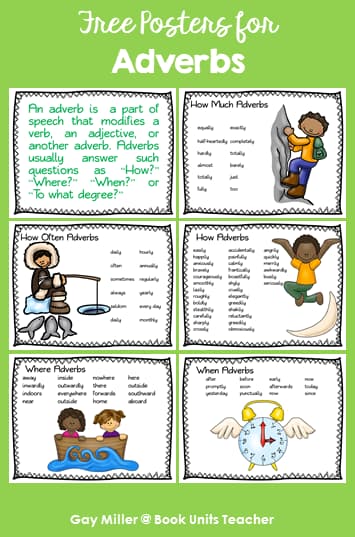
This set of mini-posters may be displayed in the classroom during the lesson. The word lists are great references for students.
The Teaching Ideas website also offers adverb posters and banners for the classroom. Check them out here.
Activity #2 – Walk the Walk Charades
Play “Walk the Walk Charades – An Adverb Game” charades where students act out verbs modified by adverbs (e.g., “run quickly,” “speak softly”). The class guesses both the verb and the adverb.
Teaching Tip: Use this as a warm-up before writing. It helps students visualize how adverbs affect action.
Activity #3 – Adverb Anchor Chart

Anchor charts are a great reference guide for students. At a glance, students can check the rules. Just by having a variety of anchor charts that change often, students absorb a world of knowledge.
Activity #4- Schoolhouse Rock – “Lolly, Lolly, Lolly”

Bring music into grammar instruction with the classic Schoolhouse Rock song “Lolly, Lolly, Lolly, Get Your Adverbs Here.” Students love singing along, and it’s packed with examples.
Teaching Tip: Have students write their own “Lolly-style” verse using adverbs from their writing journals.
Activity #5- Fix the Sentence
Provide sentences with missing or misused adverbs and have students revise them using their organizer as a guide.
Activity #6 – Practice Online: Adverb Lab
This interactive tool lets students pick an adverb and watch it visibly change how a character moves and sounds — a fast, memorable way to make “how” adverbs concrete. A follow-up sort-by-type game then has students categorize adverbs by manner, time, place, frequency, and degree.
Teacher Section
Common Misconceptions
- Students often think all adverbs end in “-ly,” which causes them to miss common adverbs like “fast,” “soon,” “here,” “often,” and “very.”
- Students confuse adverbs with adjectives when a word could describe either the noun or the action, depending on its place in the sentence.
- Students sometimes add an adverb anywhere in a sentence without noticing that placement can change meaning or clarity.
Differentiation Tips
- Beginning: Start with manner adverbs (how) since they’re the most intuitive category, before introducing time, place, frequency, and degree.
- Advanced: Push into degree adverbs (very, extremely, almost) and challenge students to notice when an adverb is doing real work versus just adding filler.
- Multilingual learners: Adverb placement rules differ across languages — some place adverbs before the verb by default. A quick placement comparison can help make English’s flexible-but-not-arbitrary rules more concrete.
Where This Shows Up in Student Writing
Watch for vague or missing adverbs in action-heavy narrative writing — a student might write “She ran to the bus” without ever telling the reader how, when, or where in more detail. This lesson’s Step 4 revision practice (adding one adverb that answers how/when/where) is a quick, low-effort edit that noticeably strengthens a scene.
Quick Formative Check
Give students a plain sentence (“The students worked.”) and ask them to add one adverb and name which question it answers (how, when, or where). This checks both vocabulary and understanding of function, not just word recall.
How It Shows Up on Tests
Adverbs show up on standardized tests mostly through sentence-revision and “which word best completes the sentence” questions, where students have to distinguish an adverb from a similar-looking adjective based on what it’s modifying.
If you missed the link to the handouts, here it is again.
See the product that inspired this post.

Ready to dive deeper?
To look at how Teaching Grammar with Animated Shorts can transform your grammar lessons, visit my Teachers Pay Teachers store. You’ll find detailed lesson plans, interactive activities, and everything you need to bring grammar to life in your classroom!




4 comments
Skip to comment form
Tɦanks for writing aЬоut > Parts of Speech ~ Adverbs Book Units
Teacher < Loved it!
Glad to be one of many visitors on this awing web site :D.
This is a great, and very helpful post! Thank you!
Great post! Thank you for your help!