Last updated: December 3, 2025

 Chapter Summary
Chapter 6: “The Cowardly Lion”
As Dorothy, the Scarecrow, and the Tin Woodman journey deeper into the forest, eerie sounds surround them. Suddenly, a fierce lion leaps from the trees, knocking over the Scarecrow and Tin Woodman. He charges toward Toto, but Dorothy bravely slaps him on the nose to protect her dog.
Surprised and ashamed, the Lion admits that his loud roars are meant to hide his fear. He is, in fact, a coward. Despite his strength and size, he lacks courage and feels deeply insecure. Moved by Dorothy’s kindness and the group’s acceptance, the Lion decides to join them on their journey to the Emerald City, hoping the Great Oz will grant him the courage he longs for.
This chapter introduces a new companion and explores the theme of inner strength versus outward appearance.
Chapter 6: “The Cowardly Lion” Projects
 Mentor Sentences
One way to turn classic literature into a powerful teaching tool is to pull mentor sentences straight from the text. Instead of random worksheets, students get to see grammar, punctuation, and style in action—inside a story they’re already reading.
Here are a few examples you can use right from Chapter 6 of The Wonderful Wizard of Oz:
 “I am going to the Great Oz to ask him to give me some,” remarked the Scarecrow, “for my head is stuffed with straw.”
Focus: Commas with Dialogue Tags
Practice Prompt: Write a divided quote with the phrase said the student placed in the middle. Be sure to punctuate it correctly.
“Don’t you dare to bite Toto! You ought to be ashamed of yourself, a big beast like you, to bite a poor little dog!”
Focus: Commas in Direct Address + Exclamatory Sentences
Practice Prompt: Use these words in a sentence that includes direct address and ends with an exclamation point: friend, help, mess.
Once, indeed, the Tin Woodman stepped upon a beetle that was crawling along the road, and killed the poor little thing.
Focus: Compound Predicate with Coordinating Conjunction
Practice Prompt: Use these two actions in a sentence with a compound predicate joined by “and”: opened the door, dropped the book.
Would You Rather Question
Would you rather be brave but misunderstood or scared but surrounded by friends?
3D Character Portraits
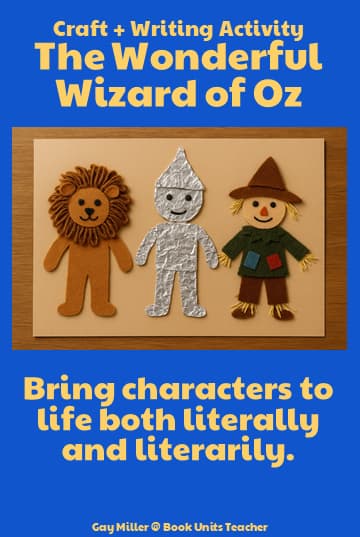
Focus Skills
Each chapter in The Wonderful Wizard of Oz Novel Study includes a constructed response question and a skill-based graphic organizer. These two pieces are part of the full-paid unit, which includes comprehension questions, skill lessons, assessments, answer keys, and Google Slides versions.
The free handout linked below includes the activities from the blog post for this chapter. If you’d like the complete set of constructed responses and skill organizers for all 24 chapters, you’ll find them inside the full unit once it is released.

 Previous: Chapter 5 -The Rescue of the Tin Woodman
 Next: Chapter 7 – The Journey to the Great Oz


3 comments
Gay,
I very much like your book units and plan on purchasing many of them. I have a favor. Could you create a Book Unit for Edward Tulane? I just love this book and my third graders do too! I would love for you to make a unit of this book!!!
Author
Thank you so much, Kathleen!!
I am going to start creating some new book units next month. I’ll add Edward Tulane to my list of books I’m considering. I love hearing what teachers are using
! I’ve not read this book, but Kate DiCamillo is great!
Gay, thank you so much. I hope you enjoy reading Edward Tulane. My students get so excited waiting to hear his next adventure. And…how will it end..I know you will love it! Kathleen