Making Connections with Text Lessons

Last updated: August 7, 2026

Making Connections with Text Lessons

Let’s face it—getting students to connect deeply with a text can sometimes feel like trying to get them to connect with their math homework on a Friday afternoon. But when they do make those connections? That’s when reading becomes real, personal, and powerful.

In this post, I’m sharing three free lessons that help students make meaningful connections—between the text and themselves, among other texts, with the world around them, and even with their favorite movies or songs. These lessons are low-prep, high-impact, and come with everything you need to get started.

Grade Level4th–6th
Skill FocusMaking Connections
Activities3 Included
FormatPrintable

Jump to Section

Why Making Connections Matters

Strong readers don’t simply remember what they read—they connect new ideas to what they already know.

Making meaningful connections helps students:

  • activate prior knowledge before reading
  • understand characters and events more deeply
  • remember information longer
  • make stronger predictions and inferences
  • engage more personally with texts

When students learn to connect texts to themselves, other texts, and the world around them, comprehension naturally becomes deeper and more meaningful.

Before Students Can Make Meaningful Connections

Students often think any personal story counts as a connection.

Before beginning these activities, help students understand that good connections should deepen understanding—not interrupt it.

Ask questions like:

  • How does this remind you of something you’ve experienced?
  • Does this connection help explain the character or situation?
  • Does it help you understand the author’s message?
  • What evidence from the text supports your thinking?

Teaching students to explain why a connection matters is just as important as making the connection itself.

📥 Before we dive in, go ahead and grab the free printables. You’ll get everything you need for three print-and-go lessons, plus links to editable Google Slides.

Activities for Making Connections

✨ Activity #1: Introduce the Four Types of Connections

Making Connections with Text - 3 Lessons

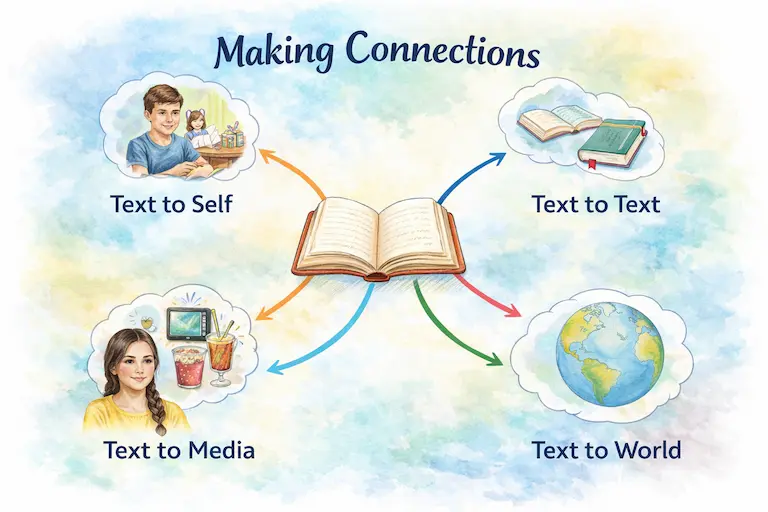
This lesson introduces students to the four types of connections:

  • Text to Self – “This reminds me of something in my life…”
  • Text to Text – “This reminds me of another book I’ve read…”
  • Text to Media – “This reminds me of a movie, show, or song…”
  • Text to World – “This reminds me of something happening in the world…”

Infographic showing four types of text connections: self, text, media, and world

Start by modeling each type of connection using sentence frames and examples. Then, guide students through a class discussion using prompts (included in the handout) to help them make their own connections.

🖍️ Want students to start making connections independently?

  • Use the included Graffiti Notes organizers! These visual tools combine drawing, writing, and color to activate both sides of the brain. They’re interactive, notebook-friendly, and come in both color and black-and-white versions.

Choose from

  • a 3-connection version (for more traditional text-to-text/self/world)
  • a 4-connection version (great if you want to include media like songs or video games)

✨ Activity #2: Practice Making Meaningful Connections

Making Connections with Text - 3 Lessons

Now that students have a grasp of the different types of connections, it’s time to put that knowledge to use! In this lesson, we’ll dive into a classic fable, a favorite novel, and some real-world data to help students explore these concepts even more.

What’s Included:

  • a short version of The Town Mouse and the Country Mouse
  • excerpts from Charlie and the Chocolate Factory
  • Venn diagrams for character and story comparisons
  • a handout with statistics about wealth in America

Students will:

  • make connections to the fable using sentence prompts
  • compare themselves to a character using a Venn diagram
  • analyze similarities between the fable and Charlie and the Chocolate Factory
  • use real-world data to make text-to-world connections

It’s a great way to blend literature, writing, and even a little social studies—all in one lesson.

✨ Activity #3: Apply the Skill with a Complete Story

Making Connections with Text - 3 Lessons

Time to bring in a little magic. In this final lesson, students read a three-page version of The Adventures of Aladdin (included and public domain—yay!). It’s perfect for upper elementary or middle school, with a readability level around grade 6.

What makes this lesson shine:

  • Vocabulary and idioms are built in.
  • Students make connections as they read.
  • You can compare the text to a modern film version, such as Aladdin (2019), for a fun text-to-media activity.

This story is perfect for sharing out loud or for independent reading by students! It sparks engaging discussions and encourages thoughtful connections.

Common Mistakes Students Make

Students often:

• tell unrelated personal stories instead of meaningful connections

• make text-to-self connections that don’t improve comprehension

• stop after identifying a connection instead of explaining it

• rely only on text-to-self connections and overlook text-to-text or text-to-world thinking

Remind students that strong readers use connections to better understand the text—not simply to talk about themselves.

Questions That Encourage Deeper Thinking

  • How did this connection help you understand the character?
  • Would another reader make the same connection?
  • Which type of connection helped you most?
  • How did your background knowledge affect your understanding?
  • Did this connection change your prediction or inference?

📥 Grab the Free Resources

All three lessons come with:

  • printable handouts
  • editable Google Slides
  • graphic organizers
  • discussion prompts
  • and everything you need to make “making connections” a breeze

Helping Students Read More Thoughtfully

Making connections is more than remembering a similar experience.

As students connect texts to their own lives, to other books, and to the world around them, they become more thoughtful readers who actively construct meaning as they read.

Best of all, this strategy naturally supports prediction, inference, drawing conclusions, determining theme, and analyzing the author’s craft, making it one of the most valuable comprehension tools students can learn.

📥 Download the free lesson handout to access all three lessons, printable organizers, editable Google Slides, and discussion prompts featured in this post.

Want More Reading Skill Practice?

If you’re looking to go beyond making connections and build a strong foundation in comprehension, check out my Reading Skills Bundle. It includes 12 complete units covering:

  • Text Structure
  • Story Elements
  • Main Idea & Details
  • Cause & Effect
  • Compare & Contrast
  • Inference
  • And more!

Each unit comes with printables, graphic organizers, and engaging activities that make reading skills stick.

Gay Miller

Permanent link to this article: https://bookunitsteacher.com/wp/?p=4443

2 comments

    • Christine on June 6, 2017 at 12:21 am

    The graphic says that it is a freebie. I would love to have a copy. How do I get one?

    1. Here is the link: http://www.bookunitsteacher.com/blog/may2017/connections.pdf

Comments have been disabled.