Tag: Informative Writing
Informative writing teaches students how to explain ideas clearly, support claims with evidence, and organize information logically. This tag brings together lessons on thesis statements, summarizing, hooks, formal vs. informal language, firsthand and secondhand accounts, audience awareness, and other essential skills for writing strong explanatory essays. Use these resources to help students move from basic paragraph writing to polished, well‑structured informational pieces aligned to CCSS W.4–6.2.
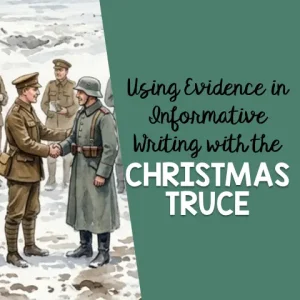
The Christmas Truce of 1914 is one of the most remarkable moments in World War I. For a few hours on Christmas Eve and Christmas Day, soldiers on both sides of the Western Front paused the fighting, stepped out of their trenches, and met peacefully in No Man’s Land. This powerful historical event is more …
Continue reading
Permanent link to this article: https://bookunitsteacher.com/wp/?p=33715
Some students naturally switch between formal and informal language; others need explicit practice and lots of examples. This post shares six classroom‑tested activities to help students recognize, sort, and use formal vs informal language in their own writing and speaking. You can grab the printable handout that goes with these activities and use it for …
Continue reading
Permanent link to this article: https://bookunitsteacher.com/wp/?p=3960

Have you ever noticed that newspaper articles don’t waste time with suspense? They hit you with the most important facts right away. Boom—who, what, when, where, why, and how—all in the first few lines. That’s not laziness; it’s strategy. It’s called the Inverted Pyramid, and it’s the writing style journalists have been using for over …
Continue reading
Permanent link to this article: https://bookunitsteacher.com/wp/?p=5817
Teaching middle schoolers to write a thesis statement can feel like trying to convince them that comma rules actually matter or that no, emojis do not count as textual evidence. It’s one of those uphill climbs where clarity meets resistance, and every lesson feels like a mix of grammar boot camp. But once students crack …
Continue reading
Permanent link to this article: https://bookunitsteacher.com/wp/?p=336
Let’s face it—terms like retell, recount, and summarize are tossed around in ELA standards like confetti, but their meanings can blur. If you’re an upper elementary teacher, you’ve likely scratched your head wondering, “Aren’t these all basically the same thing?” Short answer: not quite. Let’s unpack each term, explore the skills students need at different …
Continue reading
Permanent link to this article: https://bookunitsteacher.com/wp/?p=2688

Let’s face it: teaching summarizing can feel like trying to teach a cat to fetch. Sure, it might happen eventually—but it’s going to take patience, creativity, and possibly snacks. Summarizing is one of those deceptively tough skills. It sounds simple—“just tell me the important stuff”—but getting students to actually condense a text without turning it …
Continue reading
Permanent link to this article: https://bookunitsteacher.com/wp/?p=5612
Let’s talk audience. No, not the kind clapping politely at a school talent show while someone’s recorder squeaks out “Hot Cross Buns.” I’m talking about the kind of audience your students should be thinking about every time they put pencil to paper or fingers to the keyboard. Getting kids to shift their tone and style …
Continue reading
Permanent link to this article: https://bookunitsteacher.com/wp/?p=8116

