French Settlements
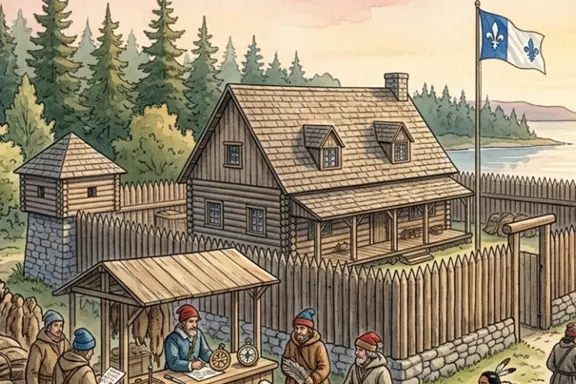
Fast Facts: French Settlements
French Settlements
- Time Period: 1600s–1700s
- Main Purpose: Expand the fur trade, build alliances, control waterways
- Key Features: Trading posts, small settlements, alliances with Native peoples
- Regions: St. Lawrence River, Great Lakes, Mississippi River Valley
- Result: France built a large trading empire in North America

French Settlements at a Glance
- France built trading posts instead of large towns.
- Quebec and Montreal became major French settlements.
- The fur trade brought wealth and encouraged exploration.
- French settlers formed strong alliances with Native peoples.
- France controlled major rivers and waterways.
French Settlements
France built settlements in North America to support the fur trade and strengthen its claims to the land. French settlements were found along the St. Lawrence River, the Great Lakes, and the Mississippi River Valley. These locations made it easier for French traders and explorers to travel, trade, and build relationships with Native peoples.
Quebec and Montreal
Two of the most important French settlements were Quebec and Montreal. Quebec, founded by Samuel de Champlain in 1608, became the center of the French fur trade. Montreal grew into another major trading center. Both settlements were busy places where French traders exchanged goods such as metal tools, cloth, and weapons for valuable beaver furs.
Trading Posts
Most French settlements were trading posts, not large towns. French traders, called coureurs de bois, traveled deep into the forests to trade directly with Native peoples. Because the French focused on trade instead of farming or building big cities, their settlements stayed small and spread out along rivers and lakes.
Alliances with Native Peoples
The French formed strong alliances with Native peoples, especially the Huron and Algonquian nations. They traded goods, shared knowledge, and sometimes fought as allies in conflicts. These alliances helped the French survive harsh winters, learn travel routes, and expand their trading network.
Expansion into New Lands
French explorers traveled along major rivers and claimed new lands for France. Robert de La Salle explored the Mississippi River and claimed the entire Mississippi River Valley, naming it Louisiana. This expanded France’s territory and increased its influence in North America.
Impact of French Settlements
French settlements spread French language, religion, and culture throughout the region. They strengthened France’s power in North America, but they also brought changes to Native communities through new trade goods, shifting alliances, and conflicts with rival European powers.
Word Match
Drag the vocabulary words to their correct definitions!
Vocabulary Words
Definitions
Lesson 8 — French Settlements Quiz
Activities & Extensions
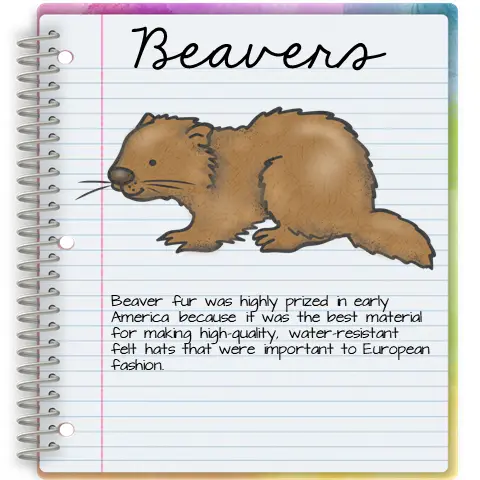
Students learn about the beaver’s physical traits and why its fur was so valuable to the French fur trade. Instead of relying on external links, students create a simple illustrated mini-book to record what they learn.
How to Do It: Students fold a sheet of paper into a mini-book with four sections: What a beaver looks like, How a beaver survives, Why beaver fur was prized, and What the French made from beaver pelts. They draw a picture and write 1–2 sentences for each page.
Materials:
- Paper
- Colored pencils
- Stapler (optional)
Optional Extension: Students research how beaver populations changed during the fur trade and explain why.

Students create a simple beaver tail bookmark to connect with the importance of beavers in the French fur trade. This craft is quick, fun, and classroom-friendly.
How to Do It: Students cut a bookmark-shaped strip from brown cardstock and draw a crisscross pattern to mimic the texture of a beaver’s tail. They may add a small paper beaver head or googly eyes for fun. On the back, students write one fact about the fur trade.
Materials:
- Brown cardstock
- Scissors
- Markers
- Optional: googly eyes
Optional Extension: Students write a short explanation of how beaver pelts were turned into felt hats in Europe.
Students map the major French settlements and waterways that supported the fur trade. This activity reinforces how geography shaped French life in North America.
How to Do It: Students use a blank map of eastern North America to locate and label Quebec, Montreal, the St. Lawrence River, the Great Lakes, the Mississippi River, and Louisiana. They add small icons such as canoes, beavers, or trading posts to show how the French used waterways for travel and trade.
Materials:
- Blank map
- Colored pencils
- Ruler
Optional Extension: Students draw arrows showing how goods moved from Native nations to French traders and then to Europe.

Early European Explorers Navigation
Explore the Full Early European Explorers Unit

This complete history unit includes research passages, organizers, writing tasks, quizzes, activities, and website research — all in printable and digital formats. Everything you need to teach Early European Explorers with confidence.
View the Full Unit on TPT