Christopher Columbus: A Voyage That Changed History
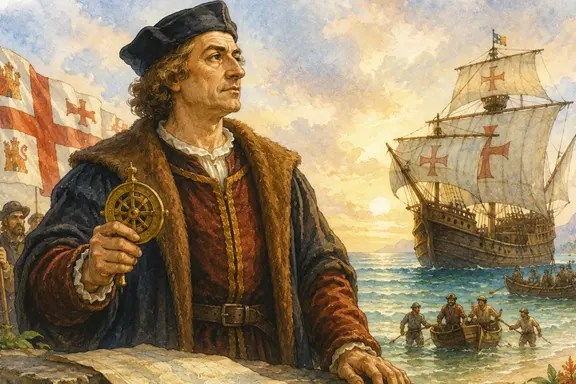
Fast Facts: Christopher Columbus
Christopher Columbus
- Time Period: 1451–1506
- Sponsor: Spain
- Goal: Find a western sea route to Asia
- Voyage Date: 1492
- Result: Reached the Caribbean; began lasting contact between Europe and the Americas

Columbus at a Glance
- Columbus believed he could reach Asia by sailing west.
- Spain agreed to support his voyage.
- In 1492, he landed in the Caribbean, not Asia.
- His voyages led to lasting contact between Europe and the Americas.
- His arrival had major effects on Native peoples.
Christopher Columbus
In the late 1400s, Christopher Columbus wanted to reach Asia by sailing west across the Atlantic Ocean. At the time, Europeans traded with Asia by long land routes or by sailing around Africa. Columbus believed he could find a shorter route by crossing the Atlantic. He asked Spain to support his plan, and King Ferdinand and Queen Isabella agreed to pay for his voyage in hopes of gaining wealth and new lands.
The First Voyage
In 1492, Columbus sailed with three ships: the Nina, the Pinta, and the Santa Maria. After many weeks at sea, the crew spotted land in the Caribbean. Columbus believed he had reached islands near Asia, but he was actually in a New World. He explored several islands and met Native peoples, whom he mistakenly called “Indians” because he thought he was near India.
Four Voyages Across the Atlantic
Columbus made four voyages across the Atlantic between 1492 and 1504. He explored islands in the Caribbean and parts of Central and South America. His voyages helped create lasting contact between Europe and the Americas. However, his arrival also had major effects on Native peoples. European diseases spread quickly, and conflicts increased as Europeans claimed land and resources.
A Lasting Impact
Although Columbus never found a sea route to Asia, his voyages encouraged more exploration and changed world history. After his journeys, Spain and other European nations sent more explorers, claimed new lands, and began building colonies. Columbus’s voyages connected two parts of the world that had been separate for thousands of years, beginning a period of great change for both Europeans and Native peoples.
Word Match
Drag the vocabulary words to their correct definitions!
Vocabulary Words
Definitions
Lesson 3 — Christopher Columbus Quiz
Activities & Extensions
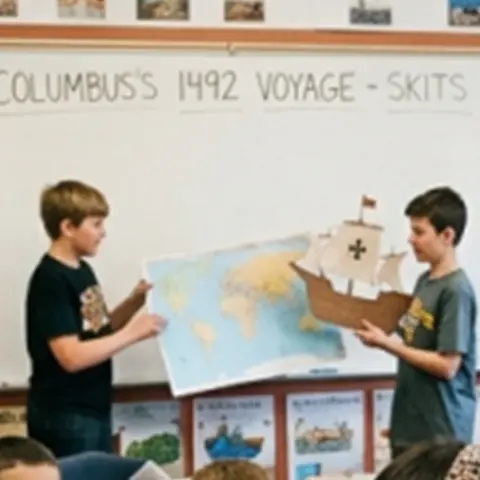
Students learn a short poem about Columbus’s 1492 voyage to build background knowledge and practice fluency. After practicing the poem, students perform it in small groups using gestures or simple props to show the three ships, the ocean, and the idea that many Europeans still believed the world was flat.
Optional Extension: Students illustrate one line of the poem and create a class poetry booklet about Columbus’s voyage.
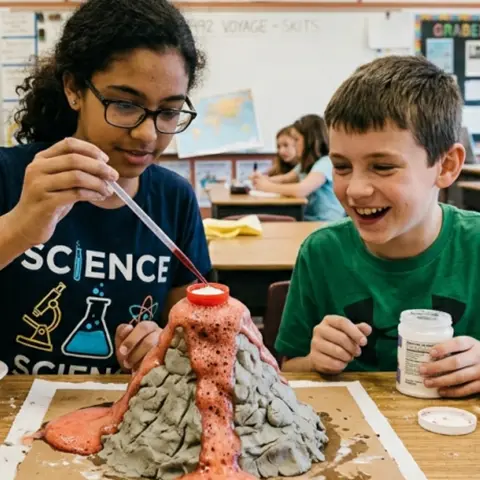
During Columbus’s first voyage, his ships passed by an erupting volcano. Students create a simple model volcano to explore this dramatic moment in history.
How to Do It: Shape a volcano from salt dough and place a bottle cap at the top. Fill the cap with baking powder, then drip red-tinted vinegar onto it using a straw. The mixture foams and “erupts,” flowing down the sides of the volcano.
Materials:
- Salt dough
- Bottle cap
- Baking powder
- Vinegar
- Red food coloring
- Drinking straw
Optional Extension: Students research volcanoes in the Caribbean and locate them on a map.
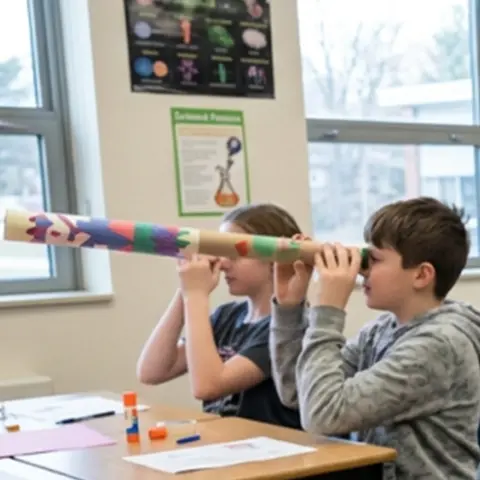
Students build a basic telescope to understand how explorers observed land and sea during long voyages.
How to Do It: Use two paper towel tubes, sliding one slightly crushed end into the other and taping them together. Cover the outside with construction paper and decorate it. For a more realistic touch, tape a magnifying glass to the viewing end.
Materials:
- Two paper towel tubes
- Masking tape
- Construction paper
- Paint or markers
- Optional: magnifying glass
Optional Extension: Students test their telescope by observing objects at different distances and recording what they can and cannot see clearly.

Students explore the types of foods Columbus stored on his ships for the long voyage. They examine (and optionally taste) foods such as raisins, almonds, biscuits, chickpeas, lentils, beans, rice, honey, and cheese.
Optional Extension: Students sort the foods into categories such as fresh, dried, preserved, and long-lasting, then explain why each type was useful on a months-long voyage.
Early European Explorers Navigation
Explore the Full Early European Explorers Unit
This complete history unit includes research passages, organizers, writing tasks, quizzes, activities, and website research — all in printable and digital formats. Everything you need to teach Early European Explorers with confidence.
View the Full Unit on TPT