Early Explorers: The Race to Reach Asia
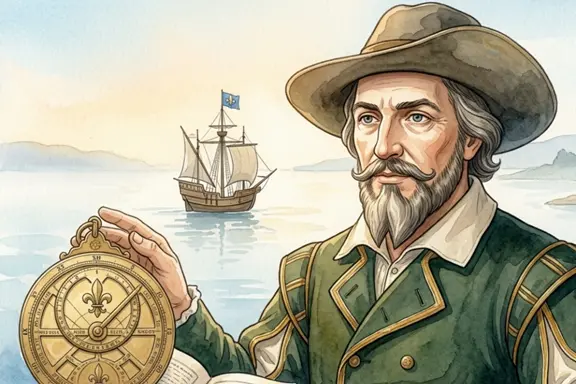
Fast Facts: Early Explorers
Early Explorers
- Time Period: 1200s–1500s
- Main Purpose: Find new trade routes to Asia
- Key Figures: Prince Henry, Dias, da Gama, Magellan, Vespucci
- European Goal: Reach Asia by sea
- Result: Opened the door to global exploration

This map first appeared in Münster's Cosmographia in the 1540s. It is considered the first map to show the entire continents of North and South America.
Early Explorers at a Glance
- Prince Henry encouraged exploration along the coast of Africa.
- Dias reached the southern tip of Africa.
- Da Gama sailed around Africa to India.
- Magellan’s crew completed the first trip around the world.
- Vespucci realized the Americas were a “New World.”
This map first appeared in Münster's Cosmographia in the 1540s. It is considered the first map to show the entire continents of North and South America.
Early Explorers
Before Columbus sailed across the Atlantic, many European explorers were already searching for a faster way to reach Asia. They wanted valuable Asian goods such as spices, silk, and precious metals. European nations hoped to find a sea route that would make trade easier and help them grow wealthier and more powerful.

Prince Henry
Prince Henry of Portugal encouraged exploration during the early 1400s. He opened a school for sailors where experts taught navigation, mapmaking, and shipbuilding. Prince Henry sent ships along the west coast of Africa to search for a sea route to Asia. His support helped begin the Age of Exploration.

Dias
In 1488, Bartholomeu Dias reached the southern tip of Africa, a place he named the Cape of Good Hope. His voyage proved that ships could sail around Africa toward the Indian Ocean. Although Dias turned back before reaching Asia, his journey showed that a sea route to Asia was possible.

Da Gama
Ten years later, Vasco da Gama continued Dias’s route. He sailed around Africa and reached India, becoming the first European to find a direct sea route from Europe to Asia. His successful voyage opened new trade opportunities and brought great wealth to Portugal.

Magellan
In 1519, Ferdinand Magellan tried to reach Asia by sailing west across the Atlantic. His crew crossed the Pacific Ocean after a long and difficult journey. Even though Magellan died in the Philippines, his crew became the first to circumnavigate the world, proving that the Earth could be sailed around.

Vespucci
Amerigo Vespucci explored the coast of South America. He realized that the lands Columbus reached were not part of Asia but a New World. His discoveries helped mapmakers understand the size and shape of the continents. North and South America were later named in his honor.
These early explorers helped Europeans learn more about the world, encouraged future voyages, and set the stage for later exploration by Spain, France, and England.
Word Match
Drag the vocabulary words to their correct definitions!
Vocabulary Words
Definitions
Lesson 2 — Early Explorers Quiz
Activities & Extensions
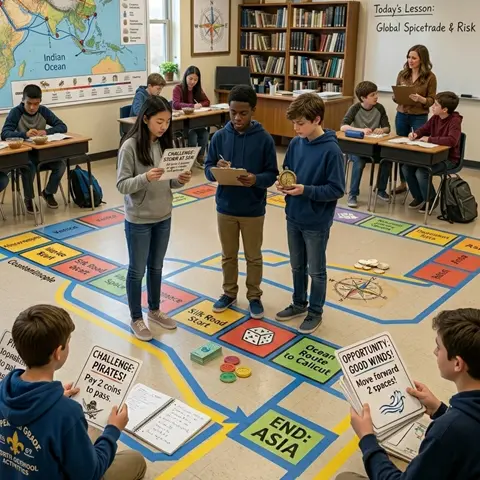
Students simulate the long, dangerous journey from Europe to Asia by moving along a classroom “trade route.” This activity helps students understand why Europeans wanted a faster route to Asia.
How to Do It: Create a path using tape or arrows. Along the route, place event cards such as storms, pirates, calm seas, or good winds. Students roll a die to move forward and draw a card each time they land on a marked space.
Materials:
- Tape or paper arrows
- Event cards
- Die
Optional Extension: Students write a journal entry from the perspective of a merchant traveling the spice route.
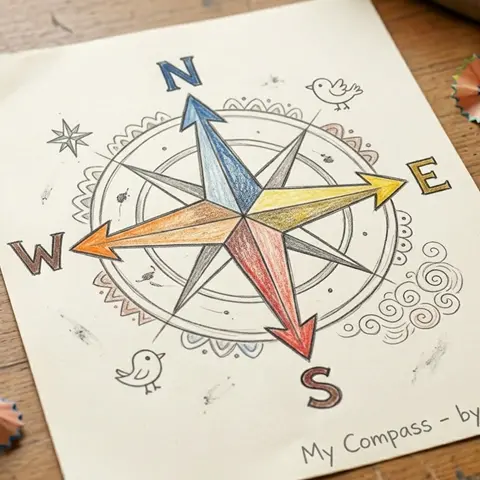
Students create a decorative compass rose to understand how explorers navigated during the race to reach Asia.
How to Do It: Students cut out a circle, divide it into eight points, and label N, NE, E, SE, S, SW, W, and NW. They decorate the compass rose with colors and patterns inspired by medieval maps.
Materials:
- Paper
- Ruler
- Markers
- Scissors
Optional Extension: Students add a short explanation of why navigation tools were essential for reaching Asia.

Students map the known world before Columbus and trace the routes explorers attempted to reach Asia.
How to Do It: Students use a world map to trace overland Silk Road routes, Portuguese routes around Africa, and attempts to sail west across the Atlantic.
Materials:
- World map
- Colored pencils
Optional Extension: Students compare which route they think was the most dangerous and explain why.

Students examine samples or pictures of Asian goods that Europeans wanted, such as spices, silk, porcelain, and jewels. This activity helps students understand why reaching Asia was so important.
How to Do It: Set up small stations with items or images. Students rotate through stations and record why each item was valuable.
Materials:
- Spices or spice jars
- Fabric samples
- Printed images
Optional Extension: Students rank the goods from most valuable to least valuable and justify their choices.
Early European Explorers Navigation
Explore the Full Early European Explorers Unit
This complete history unit includes research passages, organizers, writing tasks, quizzes, activities, and website research — all in printable and digital formats. Everything you need to teach Early European Explorers with confidence.
View the Full Unit on TPT