If you’re looking for Hatchet teaching ideas, Gary Paulsen’s survival novel is one of the most engaging and impactful books you can use with upper elementary and middle school students. Year after year, Hatchet ranks at the top of my students’ favorite‑novel lists. Its fast pacing, vivid imagery, and step‑by‑step survival details make it unforgettable. This post includes activities and a free printable to help you build a powerful novel study.
⭐ About the Book
Hatchet tells the story of thirteen‑year‑old Brian Robeson, who becomes stranded alone in the Canadian wilderness after a plane crash. With only a hatchet gifted to him by his mother, Brian must learn to survive using patience, observation, and ingenuity. He builds shelter, finds food, learns to fish, and faces dangers such as wild animals, storms, and hunger.
As Brian adapts to his environment, he also confronts emotional challenges — loneliness, fear, and the secret about his parents’ divorce that weighs heavily on his mind. Paulsen’s writing is rich with sensory detail, allowing readers to experience Brian’s triumphs and setbacks as if they were right beside him. The novel explores themes of resilience, problem‑solving, and the power of determination.
⭐ Why Students Love Hatchet
Hatchet is consistently one of the top‑ranked novels in my classroom — often earning the number‑one spot. Here’s why students love it:
Fast‑paced action keeps them hooked. Paulsen’s use of sentence fragments and vivid figurative language builds suspense. Students feel the intensity of each moment — the crash, the storms, the hunger, the breakthroughs.
Incredible survival detail. Paulsen’s step‑by‑step descriptions teach students real wilderness skills. They can explain how to build a fire, construct a bow and arrow, make a fishing spear, and more. I once read a newspaper article about a teen who survived being lost in the woods using techniques learned from Hatchet. That’s how realistic the book is.
Strong emotional connection. Brian’s backstory and internal struggles help students understand his motives and fears. They root for him because they feel what he feels.
Vivid imagery. Paulsen paints each scene so clearly that students can visualize the lake, the shelter, the animals, and the dangers Brian faces.
This combination of action, emotion, and survival knowledge makes Hatchet a classroom favorite year after year.
⭐ Book Details
| Publication Date | 1989 |
| Reading Level | Lexile 1020L • Scholastic Guided Reading Level R |
| Interest Level | Grades 6–8 |
| Major Awards | 1988 Newbery Honor |
| Length | 192 pages (approx. 58,560 words) |
| Estimated Reading Time | About 3 hours and 54 minutes (at 250 words per minute) |
| Audiobook Length | 3 hours, 42 minutes |
| Genre | Young adult fiction • Realistic fiction |
| Setting | Canadian wilderness near a small lake |
| Point of View | Third person, from Brian’s perspective |
| Themes | Survival • Loneliness |
| Memorable Quote | “Patience, he thought. So much of this was patience — waiting, and thinking and doing things right.” |
| First Line | “Brian Robeson stared out the window of the small plane at the endless green northern wilderness below.” |
Activities for Hatchet
Hatchet Unit Samples
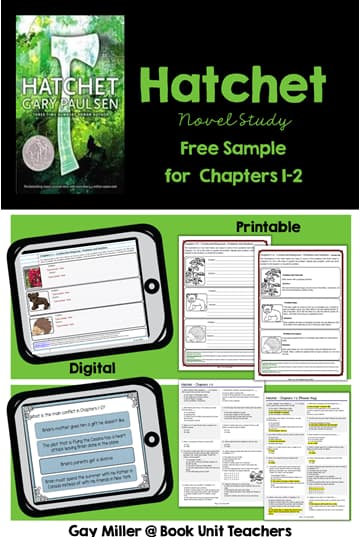
Grab a free sample of the Hatchet Novel Study. This download includes the printable version for Chapters 1-2.
Raspberry Hot Chocolate
One of Brian’s biggest challenges in Hatchet is finding food. First, he discovers chokecherries. Brian knows these berries are not poisonous because the birds eat them. They are extremely bitter, but with pangs of hunger, Brian is forced to eat them. Later in Chapter 7, Brian locates a raspberry patch. What a find! Even with the threat of a bear who also likes raspberries, Brian gathers enough berries to eat some and save some for later. After reading about Brian’s discovery, my students made raspberry hot chocolate.
Click for the recipe.
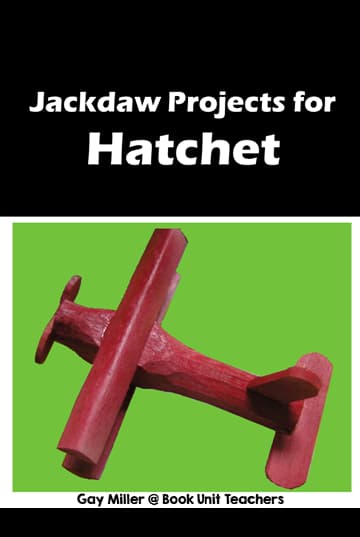
Jackdaw Projects for the Novel Hatchet
The term jackdaw comes from the British name for a relative of the crow that picks up brightly colored objects and carries them off to its nest. Our ‘jackdaw’ is a collection of artifacts from the story Hatchet.
Photos of Jackdaw Projects
Here is the PDF – Letter Explaining the Project and Grading Rubric.
Flip Organizer – What did Brian do to Survive?
This staggered flip organizer requires students to list details, reasons, and evidence (proof from text) of what Brian must do to survive. An answer key with 9 examples is also included.
You can download the printable organizer here.
Cloze Writing Exercise
This writing prompt says that Brian finds a small package of Hershey Kisses in his pocket. Students add adjectives and verbs to the cloze story to create a descriptive paragraph about Brian’s discovery and consumption of chocolate. The finished product can be printed.
Click here to go to this webpage.
I hope your students enjoy Hatchet as much as my students!
See the product that inspired this post.
With the full version, you will receive not only the Boom Learning Decks but activities for Google Slides and Forms. Boom Learning is used for multiple-choice, short answer, and matching questions. Google Slides contain open-ended questions such as the constructed response questions. In addition to digital files, the full printable resource is also included with the full novel study.