The Road to World War I
Fast Facts: The Road to World War I
Rising Tension in Europe
- Major Issue: European nations competed for power.
- Key Leader: Kaiser Wilhelm II ruled Germany.
- Old Conflict: France wanted Alsace and Lorraine back.
- Growing Problem: Alliances increased distrust.
- Warning Sign: Europe was called a “powder keg.”
At a Glance
- European nations feared each other’s growing armies.
- Germany wanted more influence and power.
- France distrusted Germany after losing land.
- Alliances divided Europe into two major sides.
- Leaders worried that even a small crisis could start a war.
Growing Tension in Europe
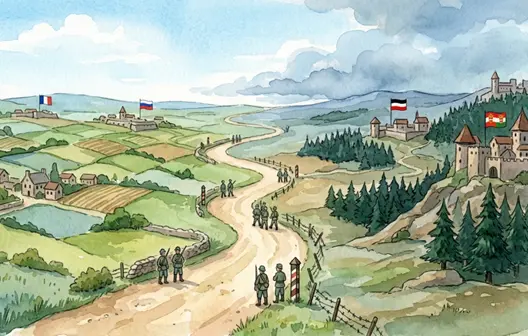
In the early 1900s, many European nations competed for power. Germany, led by Kaiser Wilhelm II, wanted to expand its influence. France still remembered losing Alsace and Lorraine to Germany, which caused deep distrust. To protect themselves, several nations formed alliances, promising to support one another if war began.
Two Sides Form
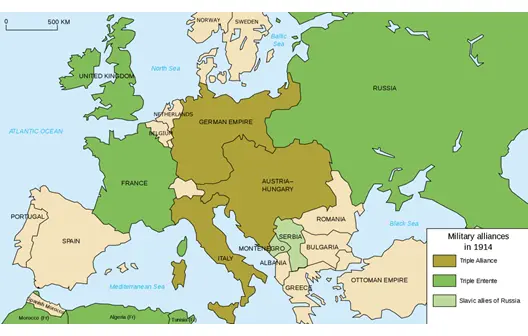
Europe became divided into two major groups. One side included France, England, and Russia. The other included Germany and Austria-Hungary. These alliances were meant to keep peace, but instead they created a situation where one event could pull many countries into conflict.
A Continent on Edge
By 1914, distrust between nations was high. Countries built up their armies, strengthened their alliances, and prepared for possible conflict. Leaders feared that Europe was so tense that even a small crisis could lead to something much larger.
A Powder Keg Ready to Explode
President Woodrow Wilson hoped the United States could stay out of European problems. His advisor, Colonel House, warned that Europe was like a “powder keg”—a dangerous situation that could explode at any moment. Rivalries, alliances, and military build‑ups made the continent unstable.
The World on the Brink
The alliances that were meant to protect nations instead increased tension. Europe was divided into two powerful sides, each ready to defend its partners. The world was standing on the edge of a conflict that would soon become World War I.
Word Match
Drag the vocabulary words to their correct definitions!
Vocabulary Words
Definitions
Lesson 1: The Road to World War I Quiz
Activities & Extensions
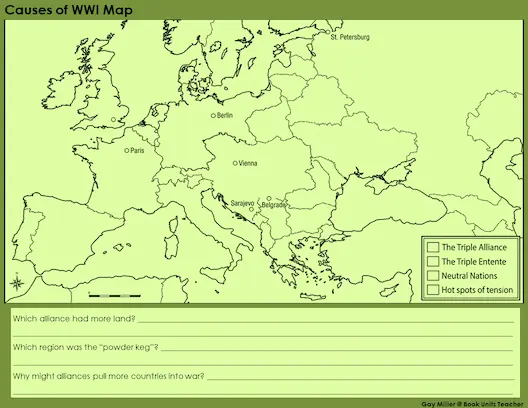
Students complete a simple color-by-number map of Europe to visualize the alliances and tensions that helped cause World War I. This activity reinforces the idea of Europe as a “powder keg” ready to explode.
How to Do It: On the handout, provide a basic outline map of Europe with key countries labeled (Germany, Austria-Hungary, Serbia, Russia, France, England). Include a color key such as:
- Triple Alliance – blue
- Triple Entente – red
- Neutral nations – yellow
- Hot spots of tension (Serbia, Bosnia) – orange
After coloring, students answer a few short questions on the handout, such as:
- Which alliance controlled more land?
- Which region was the “powder keg” of Europe?
- How could alliances pull more countries into a war?
Materials: handout, colored pencils, pencil
Optional Extension: Students add a tiny symbol to each country (for example, ⚔️ for conflict, ✉️ for alliances, 💣 for tension) to show its role in the lead-up to war.
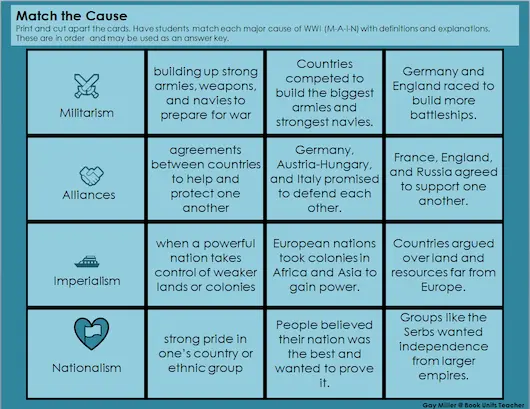
Students use cut-apart cards to match each major cause of World War I (Militarism, Alliances, Imperialism, Nationalism) with a simple definition and example. This is a quick, hands-on way to review the causes.
How to Do It: On the handout, create three sets of cards:
- Cause cards: Militarism, Alliances, Imperialism, Nationalism
- Definition cards: short, student-friendly explanations
- Example cards: one real-world example for each cause
Students cut out the cardss and match each cause with its correct definition and example. They can glue the completed sets into their notebooks or arrange them on their desks.
Materials: handout, scissors, glue (optional), pencil
Optional Extension: Students draw a small symbol for each cause (for example, a stack of weapons for militarism, two shaking hands for alliances, a ship or flag for imperialism, and a raised fist or flag for nationalism).
World War 1 Navigation
Explore the Full World War 1 and Roaring Twenties Unit
This complete history unit includes research passages, organizers, writing tasks, quizzes, activities, and website research — all in printable and digital formats. Everything you need to teach The Roaring Twenties with confidence.
View the Full Unit on TPT