MS-ESS2-5 • Grades 6–8

Atmosphere, Pressure & Wind

Earth's atmosphere is a layered system — each layer has distinct properties, and the pressure differences between regions within those layers are what set air in motion as wind. Understanding this sequence from layer to pressure to wind is the foundation for reading weather maps.

Layers of the Atmosphere

The atmosphere is divided into five distinct layers based on how temperature changes with altitude. Each layer has unique characteristics — from the weather-filled troposphere at the bottom to the near-vacuum of the exosphere at the top.

Layers of Earth's atmosphere A vertical diagram showing the five atmospheric layers stacked from the surface upward with key facts about each. Troposphere 0–12 km • Weather occurs here • Temperature decreases with altitude Stratosphere 12–50 km • Ozone layer absorbs UV radiation • Jets fly here Mesosphere 50–85 km • Coldest layer • Most meteors burn up here Thermosphere 85–600 km • Very hot but thin • Aurora borealis occurs here Space station orbits in this layer Exosphere 600+ km • Gradually fades into outer space Satellites orbit here 0 km 12 km 50 km 85 km 600 km Space

Atmosphere & Ozone Organizers

A staggered flip organizer and a hand mnemonic for atmospheric composition help students remember the five layers and their properties, while a Check for Understanding page assesses comprehension of both atmospheric structure and the ozone layer.
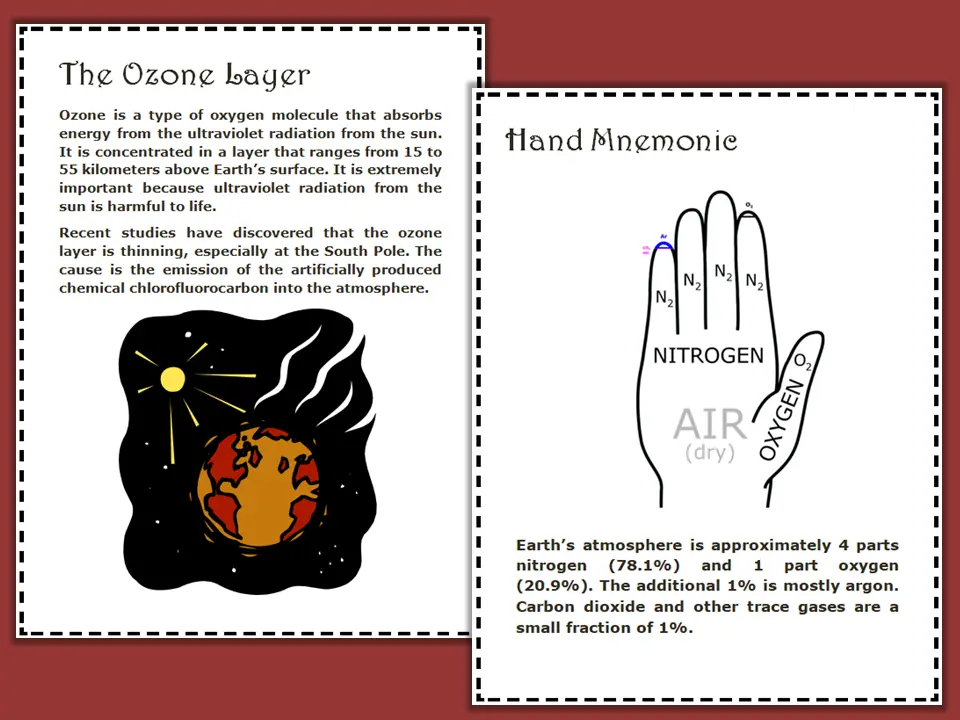
Atmospheric layers and ozone teaching posters

Atmospheric Layers Posters

Teaching posters cover the ozone layer in detail, including its role in absorbing UV radiation, its altitude in the stratosphere, and the causes and effects of ozone depletion.
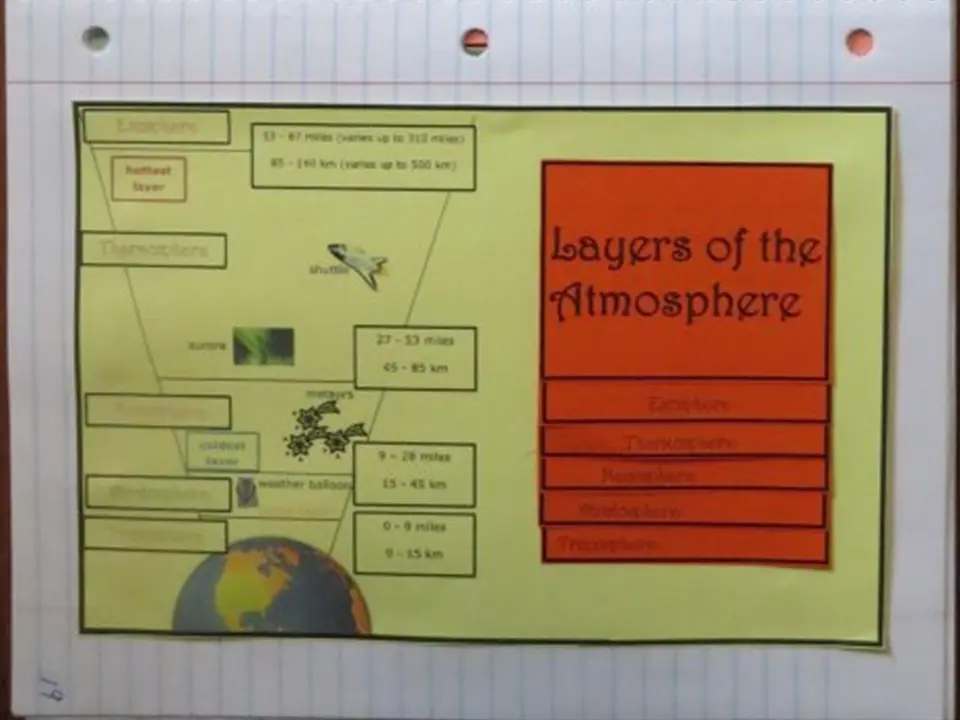
Staggered flip atmospheric layers organizer

Layers Staggered Flip Organizer

A staggered flip organizer gives each atmospheric layer its own labeled flap — students open each flap in order from the ground up, recording altitude, temperature pattern, and key facts.
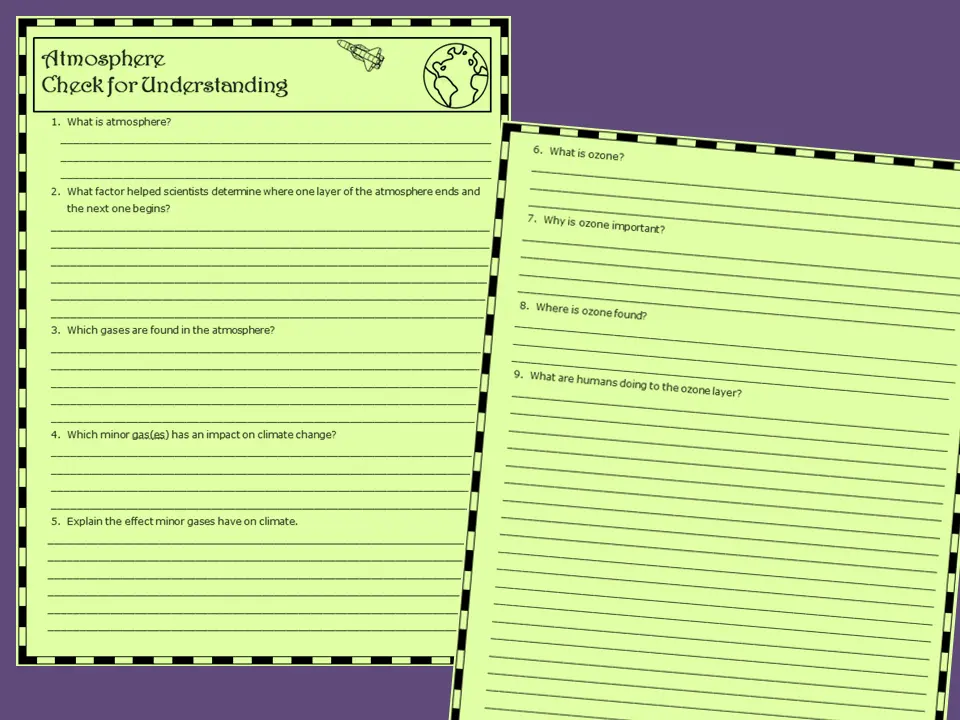
Atmosphere check for understanding page

Atmosphere Check for Understanding

Structured questions assess student understanding of all five atmospheric layers, the composition of each, and the role of the ozone layer in protecting Earth's surface.
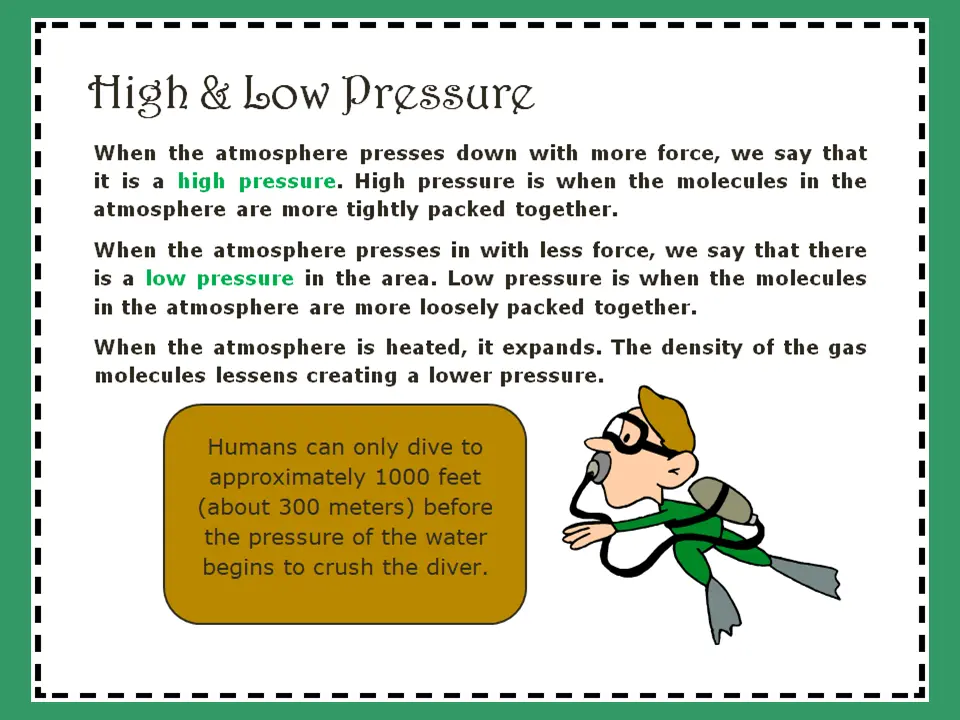
High & Low Pressure Systems

Air pressure is the weight of the air above pressing down on a surface. Where air is dense and heavy it creates high pressure; where it is thin and light it creates low pressure. Wind is simply air moving from high pressure toward low pressure.

High and low pressure systems and wind A diagram comparing high pressure where air sinks and spreads outward with clear skies, and low pressure where air rises and converges inward with clouds and precipitation. High Pressure (H) Air molecules packed tightly H Air sinks & spreads outward Clear skies, fair weather Wind flows high → low Low Pressure (L) Air molecules spread apart L Air rises & converges inward Clouds, precipitation likely The greater the pressure difference, the faster the wind. Isobars close together on a weather map mean stronger winds.

Air Pressure Organizers & Experiments

Three activities take students from understanding what air pressure is to measuring it themselves — covering isobars, a pamphlet fold organizer, and a hands-on barometer experiment.

Air pressure teaching poster

Air Pressure Poster

A reference poster explains high and low pressure systems, how air molecules create pressure, and why humans can only survive within a narrow pressure range.

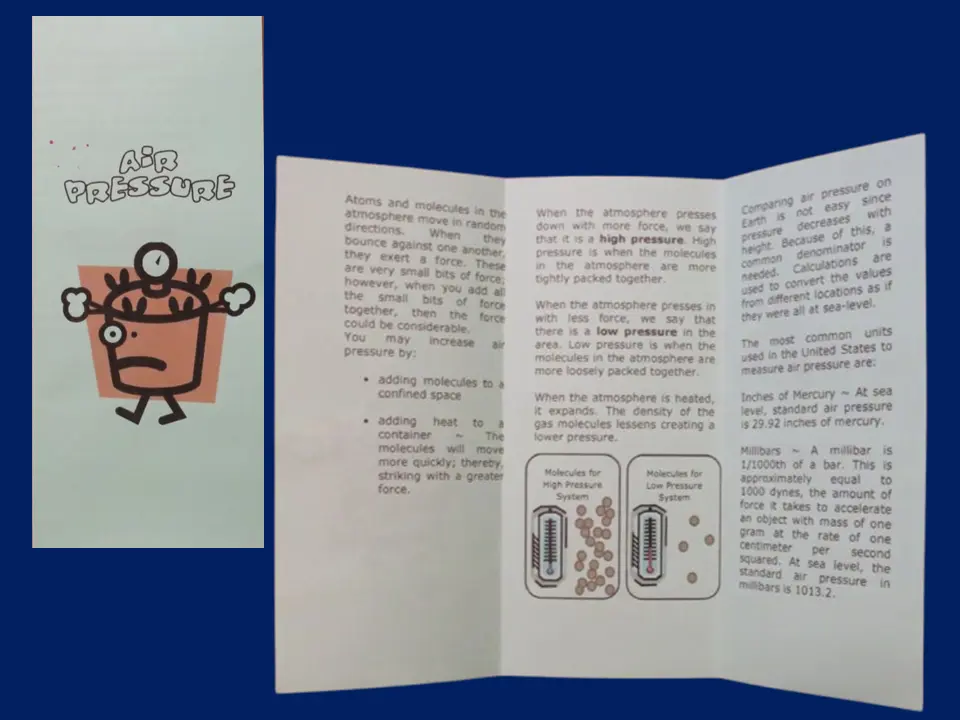
Air pressure pamphlet fold organizer

Air Pressure Pamphlet Fold

A three-panel pamphlet organizer covers air pressure concepts, isobars, and the relationship between pressure and wind — with space for student notes and diagrams.

Create a barometer experiment

Create a Barometer Experiment

Students build a simple barometer using household materials and track air pressure changes over several days, connecting their readings to observed weather conditions.

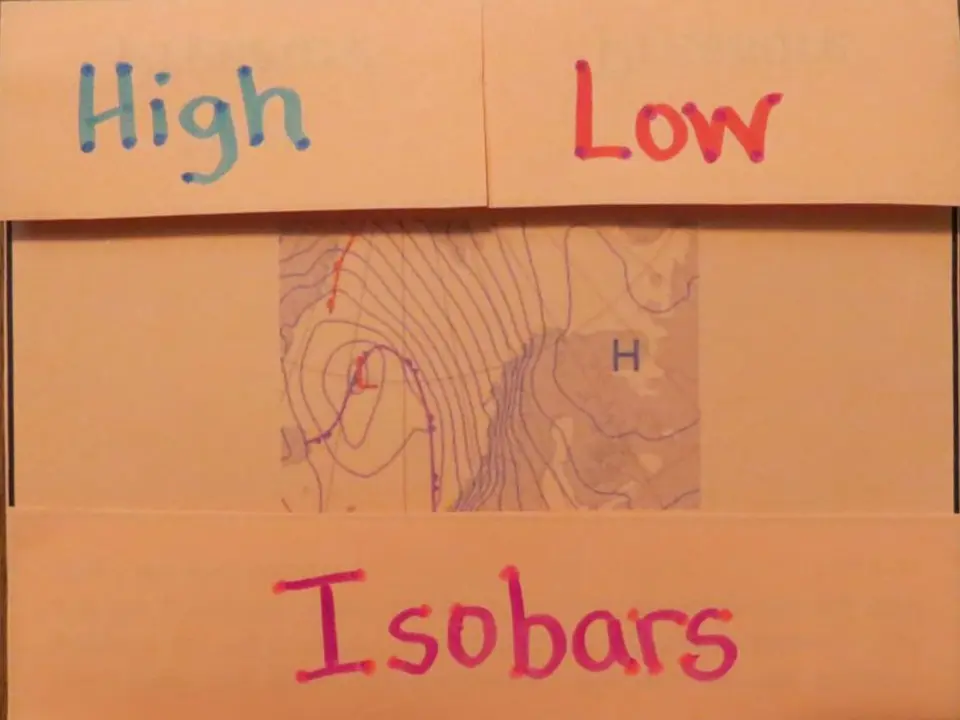
High & Low Pressure Organizer & Wind Booklet

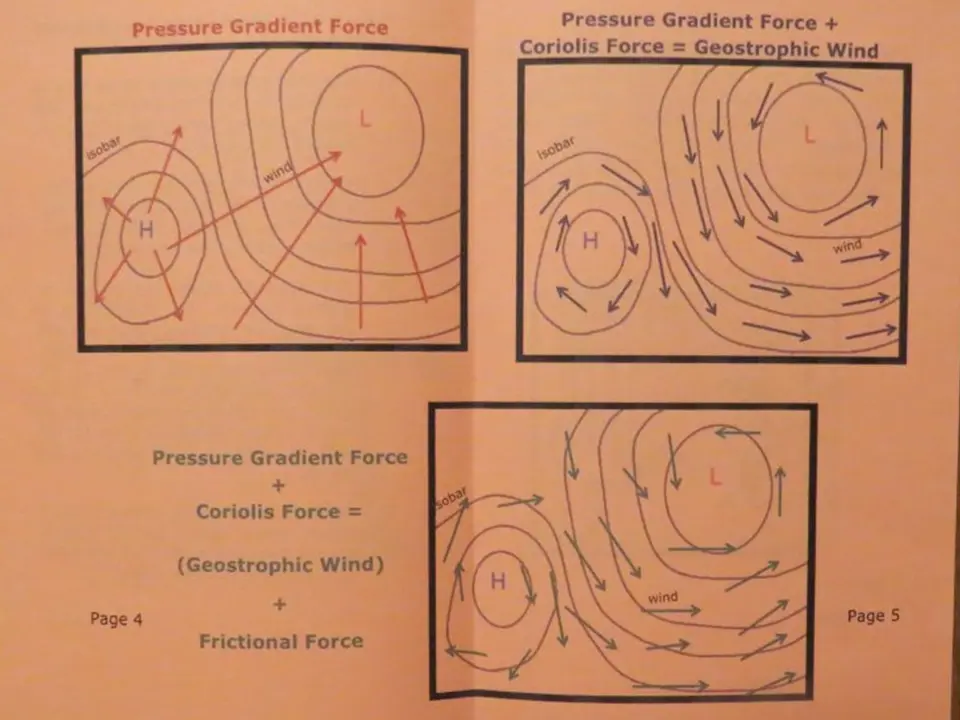
A three-flap flip organizer covers high pressure, low pressure, and isobars together, while a separate wind booklet goes deeper into pressure gradient force, the Coriolis effect, and how converging winds create the patterns seen on weather maps.

High and low pressure three-flap organizer
Wind booklet showing pressure gradient and Coriolis force

The Coriolis effect

Because Earth rotates, winds don't travel in straight lines — they curve. In the Northern Hemisphere winds curve to the right; in the Southern Hemisphere they curve to the left. This is why hurricanes rotate counterclockwise in the north and clockwise in the south. The wind booklet covers this concept with diagrams showing how pressure gradient force, Coriolis force, and friction combine to determine actual wind direction and speed.

MS-ESS2-4 • MS-ESS2-5 • MS-ESS2-6 • Grades 6–8

Want the Complete Weather & Climate Unit?

This page is one part of a full NGSS-aligned unit covering the hydrologic cycle, atmospheric layers, air pressure, fronts, storms, humidity, temperature, climate patterns, and more — with hands-on experiments, foldable organizers, vocabulary tools, and Check for Understanding pages throughout.

View the Full Unit on TPT