MS-ESS1-2 • MS-ESS1-3 • Grades 6–8

Solar System & Scale Models

Numbers alone can't communicate the true scale of the solar system. These activities make the unimaginable distances and size differences between planets physically tangible — using a football field, a classroom, and everyday objects as reference points.

Distances in the Solar System

Astronomers measure distances within the solar system in astronomical units (AU) — one AU is the average distance from Earth to the Sun, about 93 million miles. The diagram below shows the eight planets at their relative distances, making the enormous gap between Mars and Jupiter visible at a glance.

Solar system planets to scale by distance A horizontal diagram showing the eight planets at relative distances from the Sun, with AU values labeled below each planet. Sun Mercury 0.4 AU Venus 0.7 AU Earth 1.0 AU Mars 1.5 AU asteroid belt Jupiter 5.2 AU Saturn 9.5 AU Uranus 19 AU Neptune 30 AU 1 AU = 93 million miles. The four inner planets are clustered close together compared to the vast distances between the outer planets.

The Thousand Yard Model

In this classic scale model activity, the Sun is placed at one end of a thousand-yard course and students calculate where each planet would be placed if the entire solar system were compressed to fit within that distance. The results are always surprising.

Why Scale Models Matter

If the Sun were the size of a large beach ball (roughly 2 feet across), Earth would be a small pea located about 215 feet away. Neptune would be over a mile from the beach ball. No textbook diagram can show this relationship at true scale — which is exactly why students need to build and walk the model themselves.

  1. Students use the provided data table to calculate each planet's scaled distance from the Sun.
  2. The class walks the scale model outdoors, placing markers at each calculated position.
  3. Students record observations about the spacing — particularly the long gap between Mars and Jupiter.
  4. Back in the classroom, students compare the model distances to the actual AU values.
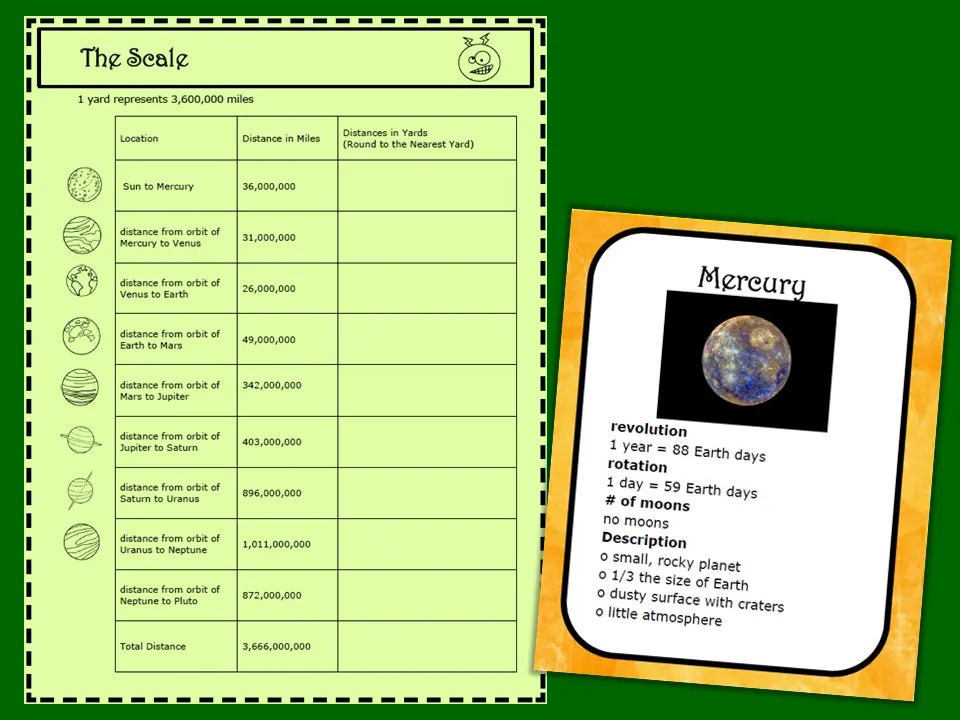
Planet scale chart and reference data

Planet Sizes Compared

Scale in the solar system applies to sizes as well as distances. Jupiter alone could fit more than 1,300 Earths inside it — and the Sun could fit more than a million Earths.

Planet sizes compared to the Sun Circles showing the Sun and eight planets at relative sizes, demonstrating how much larger the gas giants are compared to the rocky inner planets. Sun Mercury Venus Earth Mars Jupiter Saturn Uranus Neptune If the Sun were the size of a classroom door, Earth would be about the size of a marble.

If Our Classroom Were the Sun

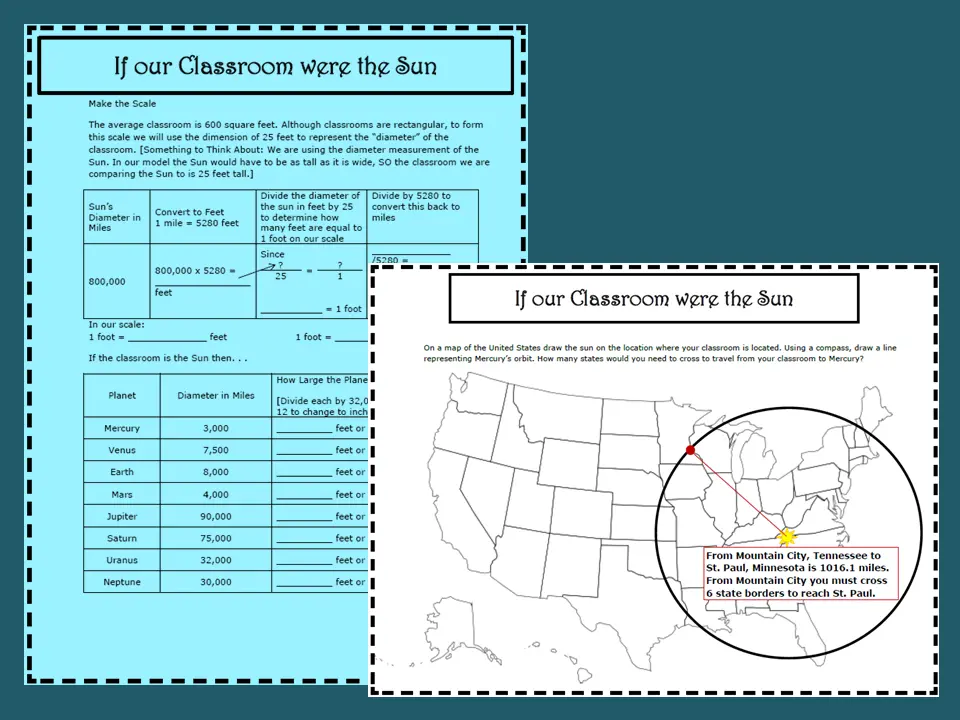
This project applies the same scale-modeling concept to size rather than distance. Students calculate how large each planet would be if the Sun were scaled to the size of their classroom, then map where each scaled planet would appear on a US map from their school's location.

If Our Classroom Were the Sun project pages

What Students Discover

When the Sun is scaled to classroom size, Earth becomes so small it might be a pinhead — and Neptune would be located hundreds of miles away. Students plot these positions on a real US map, which makes the concept of astronomical distance genuinely shocking rather than just a number to memorize.

MS-ESS1-1 • MS-ESS1-2 • MS-ESS1-3 • MS-ESS1-4 • Grades 6–8

Want the Complete Earth's Place in the Universe Unit?

This page is one part of a full NGSS-aligned unit covering lunar phases, tides, eclipses, seasons, the Big Bang, gravity, galaxies, the solar system, planets, the geologic time scale, and more — with hands-on models, projects, and Check for Understanding pages throughout.

View the Full Unit on TPT