The universe began as an incredibly hot, dense point about 13.8 billion years ago. Since then, gravity has shaped everything — pulling matter into stars, stars into galaxies, and galaxies into the vast structures we observe today.
The Big Bang theory is the leading scientific explanation for the origin of the universe. It describes how the universe expanded from an extremely hot, dense state and continues expanding today — supported by evidence including cosmic background radiation and the observed movement of galaxies away from each other.
The universe begins as a singularity — an incredibly hot, dense point. Space itself begins to expand rapidly.
The first protons, neutrons, and simple atomic nuclei (hydrogen and helium) form as the universe cools.
The universe cools enough for atoms to form. Light can finally travel freely — this is what we detect today as cosmic microwave background radiation.
Gravity pulls hydrogen clouds together, forming the first stars and eventually the first galaxies.
Our solar system forms from a cloud of gas and dust orbiting a new star — the Sun.
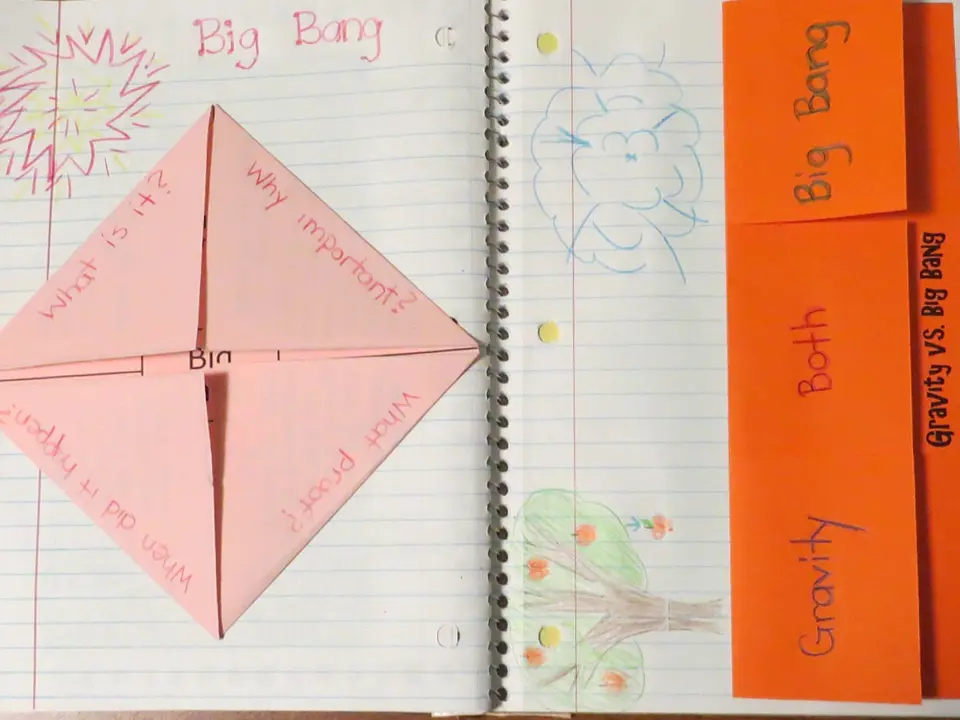
Gravity is the same force whether it's pulling you toward Earth or holding a galaxy together. The difference is scale — and scale in space is almost impossible to imagine without a model.
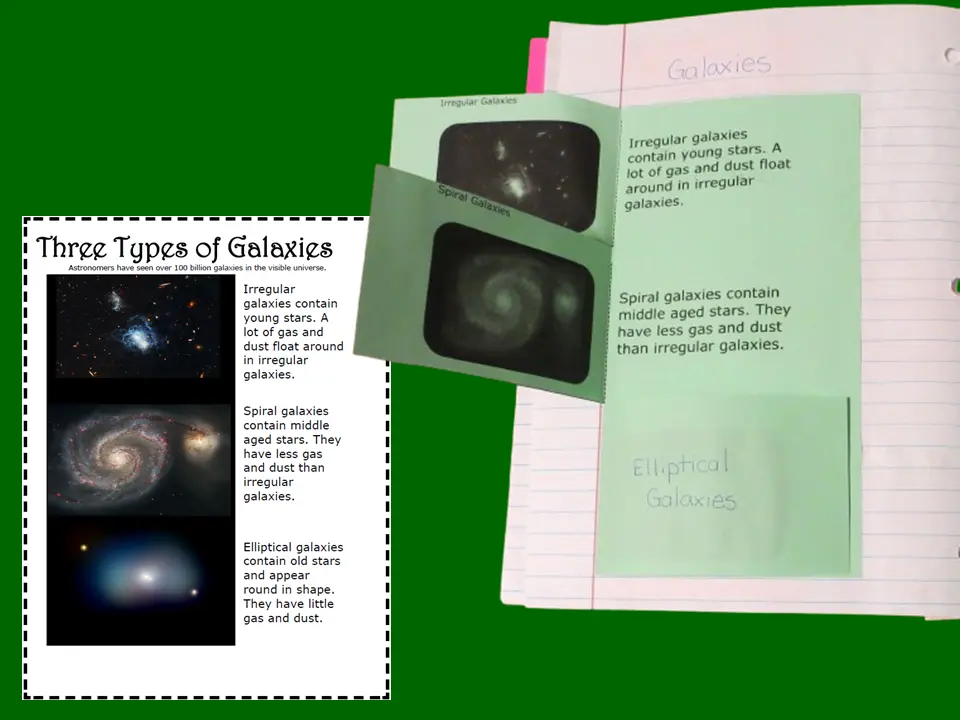
Astronomers classify galaxies by shape into three main types. Each type reflects different histories of star formation, collisions, and gravitational interactions over billions of years.
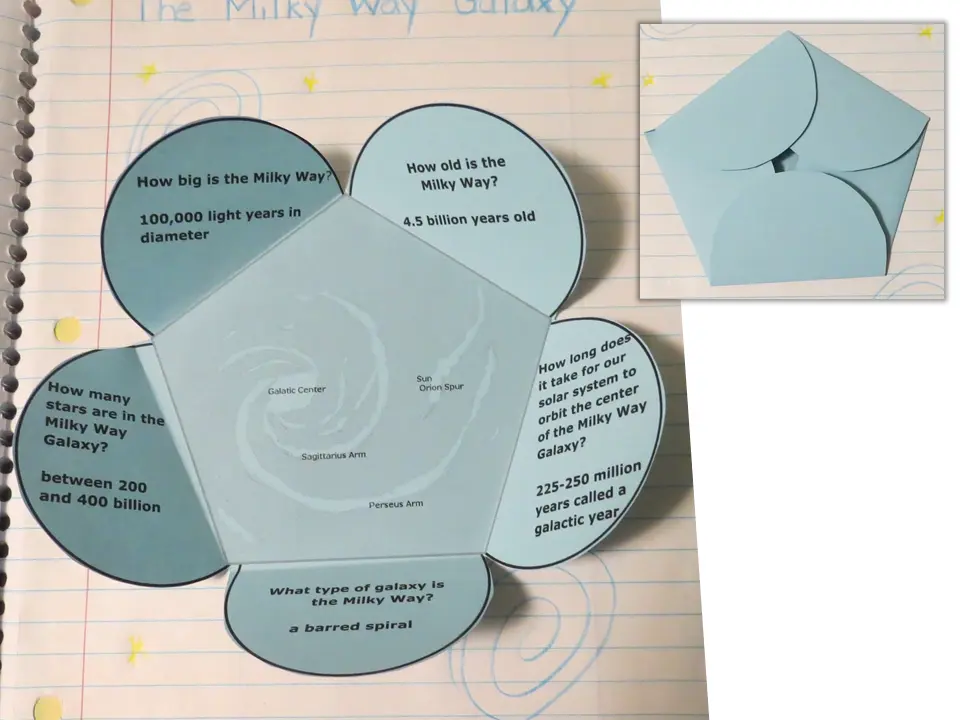
Two organizers take students from classifying all galaxy types to focusing in on our own home galaxy — the Milky Way — with key facts, structure, and our location within it.
Real photographs of spiral, elliptical, and irregular galaxies are paired with student organizer pages where they record key characteristics of each type.
A five-section fold-out organizer structures the key facts about the Milky Way — its size, shape, age, number of stars, and our location within the Orion Arm.
This page is one part of a full NGSS-aligned unit covering lunar phases, tides, eclipses, seasons, the Big Bang, gravity, galaxies, the solar system, planets, the geologic time scale, and more — with hands-on models, projects, and Check for Understanding pages throughout.
View the Full Unit on TPT