The New Deal
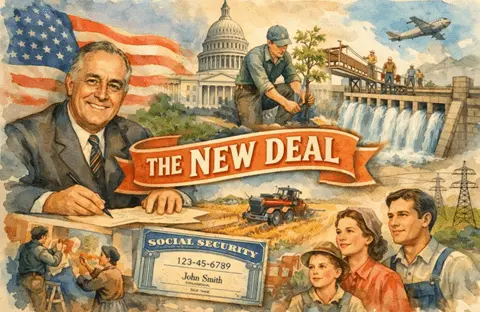
Fast Facts: The New Deal
The New Deal
- President: Franklin D. Roosevelt
- Key Goal: Relief, Recovery, Reform
- First Action: Bank Holiday
- Major Programs: CCC, WPA, TVA
- Long-Term Impact: FDIC protects bank deposits
The New Deal at a Glance
- Roosevelt was elected in 1932 during the Great Depression.
- He declared a Bank Holiday to stop bank failures.
- Fireside Chats helped Americans trust the banks again.
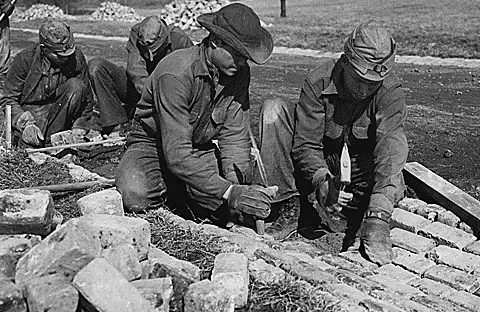
- Programs like the CCC, WPA, and TVA created jobs.
- The FDIC insured bank deposits and restored confidence.
Roosevelt Takes Office
By 1932, the Great Depression had caused widespread unemployment and hardship. Americans elected Franklin D. Roosevelt because he promised a “New Deal” to help the country recover. When he took office, Roosevelt declared a Bank Holiday to stop bank failures. He explained his plans in friendly radio talks called Fireside Chats, which helped people trust the banks again.
The First Hundred Days
During his first hundred days in office, Roosevelt and Congress created programs to provide relief, recovery, and reform. The government lent money to banks, insured deposits, and helped farmers keep their land. Not all programs worked, but many made a big difference.
CCC, WPA, and TVA
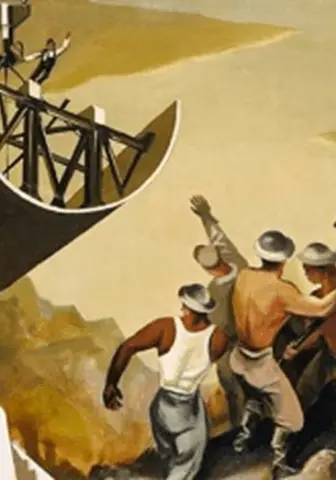
The Civilian Conservation Corps (CCC) gave jobs to young men who worked on outdoor projects like planting trees and building trails. The Works Progress Administration (WPA) hired millions of people to build roads, schools, parks, and bridges. The Tennessee Valley Authority (TVA) built dams to control floods and bring electricity to rural areas.
Restoring Confidence
The Federal Deposit Insurance Corporation (FDIC) was created to protect people’s bank deposits. This helped restore confidence in the banking system. The New Deal did not end the Great Depression, but it provided jobs, improved communities, and gave Americans hope.
A Lasting Legacy
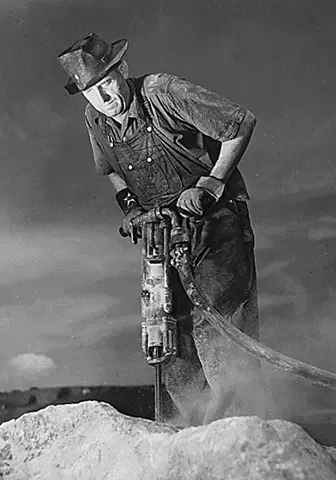
Many New Deal programs still exist today, showing how Roosevelt’s ideas changed the country. His leadership helped guide the nation through one of its most difficult times.
Word Match
Drag the vocabulary words to their correct definitions!
Vocabulary Words
Definitions
Lesson 3 — The New Deal Quiz
Activities & Extensions
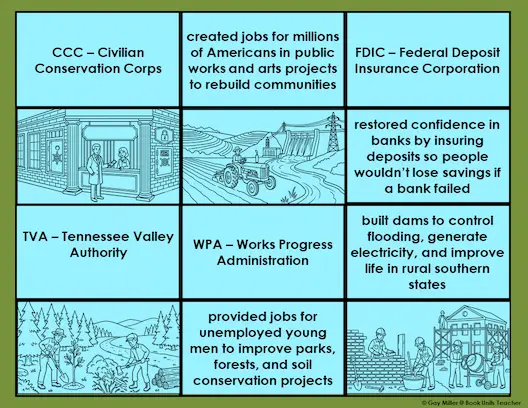
Students complete a three‑way matching activity to learn about major New Deal organizations. Each set of cards includes the organization’s name, an illustration showing what workers did, and a short description of its purpose.
How to Do It: Print or display the cards. Students match each organization’s name with the correct illustration and description. This reinforces understanding of how different programs helped people during the Great Depression.
- CCC — Civilian Conservation Corps
- WPA — Works Progress Administration
- TVA — Tennessee Valley Authority
- FDIC — Federal Deposit Insurance Corporation
Materials: Printed or digital cards, scissors (if printed), notebook for notes
Optional Extension: Students design their own card for another New Deal program, such as the Social Security Act or the Agricultural Adjustment Administration.
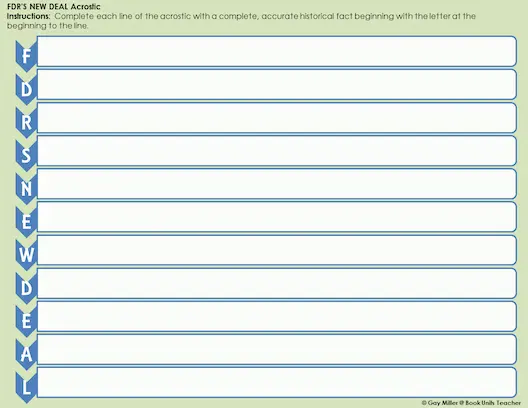
Students choose between two creative, letter‑by‑letter research frameworks to review key concepts, figures, and programs from the Great Depression and FDR’s First 100 Days.
How to Do It: Provide students with the project handout. Students can either complete an expanded acrostic poem using the letters F-D-R-S-N-E-W-D-E-A-L where each letter starts a full historical fact phrase, or they can complete an "Alphabet Soup" challenge by finding a New Deal program, event, or key figure for 10–15 different letters of the alphabet.
- FDR'S NEW DEAL Acrostic: Best for a deep‑dive narrative focus (e.g., "Fireside chats were used to reassure the public...").
- Alphabet Soup Challenge: Best for tracking the whirlwind of "Alphabet Agencies" (e.g., "A is for AAA, B is for Bank Holiday...").
Materials: Project handout, colored pencils or markers, classroom research materials or websites
Optional Extension: Students present their completed web‑pages or posters to the class, challenge peers to guess the New Deal program based only on their descriptive fact phrase, or turn their alphabet letters into a clickable navigation menu.
Great Depression Navigation
Explore the Full Great Depression Unit
This complete history unit includes research passages, organizers, writing tasks, quizzes, activities, and website research — all in printable and digital formats. Everything you need to teach the Great Depression with confidence.
View the Full Unit on TPT