Lesson Plans - Civil War and Reconstruction (1850-1877)
These plans are aligned to the Tennessee Teaching Standards.
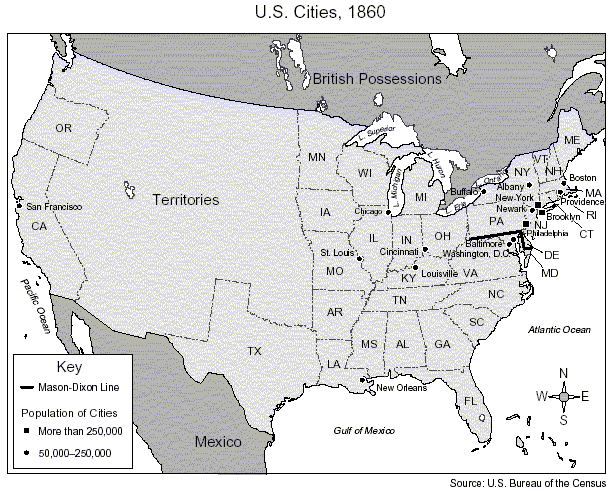
Interpret sectional differences in the North and South in pre-Civil War (i.e., a map of Union, Confederate, and border-states; pictorial representations of crop production; reading timelines; and interpreting bar graphs showing human, natural, and man-made resources).
Teach timelines using Seeing Time as a guide. http://www.beaconlearningcenter.com/WebLessons/SeeingTime/default.htm
Have students make a timeline with pre-Civil War events. Discuss each event as students add to timeline.
Missouri Compromise of 1820
Compromise of 1850
Uncle Tom's Cabin was published in 1852
Kansas-Nebraska Act in 1854
Bleeding Kansas in 1855
Dred Scott 1857
Harper's Ferry 1859
South Carolina was the first state to secede from the Union on December 20, 1860
Lincoln Elected March 1861
Fort Sumter April 12, 1861
Lincoln calls up 75,000 state militia troops to crush the rebellion. April 14, 1861
Jefferson Davis is elected President of the Confederate States of America. November 6, 1861
The first battle of Bull Run is fought. July 21, 1861
Interpret sectional differences in the North and South in pre-Civil War (i.e., a map of Union, Confederate, and border-states; pictorial representations of crop production; reading timelines; and interpreting bar graphs showing human, natural, and man-made resources).

Take a blank map of the United States. Make a color key. Color the map according to the following regions in the Kansas-Nebraska Act of 1854.
Free States
Free Territory
Decision on Slavery left to the People of the Territory
Slave State
Slave Territory
North vs. South Lesson north_south.htm
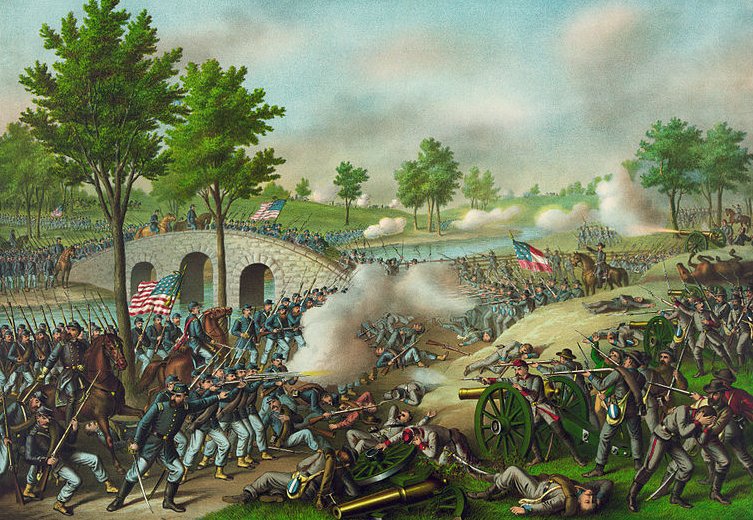
Everyone thought the war wouldn't last long. Lincoln asked volunteers to sign up for only three months.
The Southerners were fighting for a way of life they believed in. They thought England would help them because they used a lot of the cotton the South grew. Many Southerners deserted the army because they didn't have the things they needed for fighting.
The Northerners had more men, more factories, and more weapons. The Northern military leaders were weaker than the Southern leaders. They later became as good with training.
Confederate 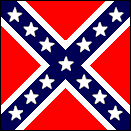 |
Union 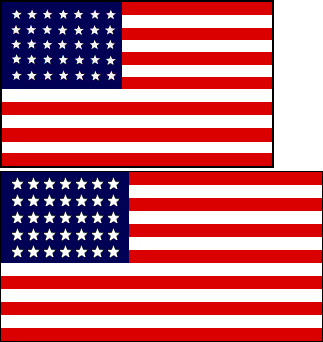 |
| favored slavery | opposed slavery |
| felt they were fighting a second war of independence | felt they were fighting a war to free the slaves |
| made living from small farms and plantations | made living from factories and trade |
| wanted to lower taxes on goods | wanted to higher taxes on Europeans goods so Southerners would buy Northern products |
| believed in states' rights | believed that the Union must be saved above all else |
Interpret sectional differences in the North and South in pre-Civil War (i.e., a map of Union, Confederate, and border-states; pictorial representations of crop production; reading timelines; and interpreting bar graphs showing human, natural, and man-made resources).
Make pictorial graph and bar graph.
Census Bar Graph (1790, 1890, 1990)


Recognize military and nonmilitary leaders from the North and South during Civil War (i.e., Frederick Douglass, Clara Barton, Chief Justice Roger Taney, Abraham Lincoln, Ulysses S. Grant, Robert E. Lee, and Jefferson Davis).
 |
Frederick Douglass was born a slave. He taught himself to read and write. He ran away from his master. Douglass wrote and told of his life as a slave and gave lectures to groups of abolitionists. |
Dred Scott was a slave. His master took him from the slave state of Missouri to the free state of Illinois. Scott lived as a slave for four years in a free state. Then his master took him back to Missouri. Abolitionist thought it was a good case to test slavery. Abolitionists paid for a lawyer so Scott could sue his master for freedom. The case went to the Supreme Court. On March 6, 1857 the Chief Justice Roger Taney decided Scott had no right to freedom because he was property and could be moved anywhere, not a person. The court also said that any state which did anything against slavery was unconstitutional.
Recognize military and nonmilitary leaders from the North and South during Civil War (i.e., Frederick Douglass, Clara Barton, Chief Justice Roger Taney, Abraham Lincoln, Ulysses S. Grant, Robert E. Lee, and Jefferson Davis).
Lecture - Go over notes for Lessons 6 and 8. lincoln_douglas.htm and abe_lincoln.htm
Recognize military and nonmilitary leaders from the North and South during Civil War (i.e., Frederick Douglass, Clara Barton, Chief Justice Roger Taney, Abraham Lincoln, Ulysses S. Grant, Robert E. Lee, and Jefferson Davis).
Interpret timelines that depict major historical post-Civil War events.
Have students make a timeline with post-Civil War events. Discuss each event as students add to timeline.
Emancipation Proclamation January 1, 1863
Lincoln is reelected. November 8, 1864
January 31, 1865 The Thirteenth Amendment, abolishing slavery throughout the Union, wins Congressional approval and is sent to the states for ratification. By the end of February, 18 states will ratify the amendment; after significant delay in the South, ratification will be completed by December.