Brown v. Board & The Little Rock Nine
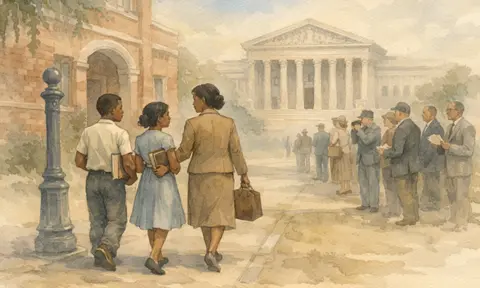
Fast Facts: School Desegregation
School Desegregation
- Key Case: Brown v. Board of Education (1954)
- Main Lawyer: Thurgood Marshall
- Supreme Court Ruling: Segregated schools unconstitutional
- Little Rock Nine: First to integrate Central High
- Federal Action: Eisenhower sent troops to protect students.
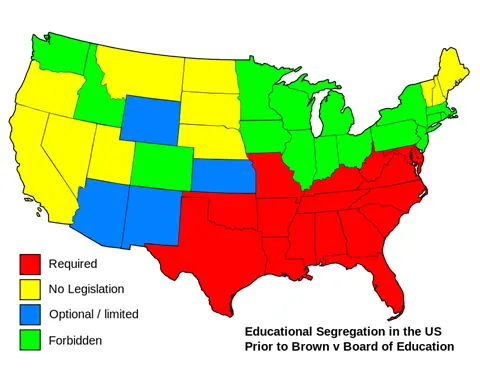
School Desegregation at a Glance
- Brown v. Board ended “separate but equal” in public schools.
- Thurgood Marshall argued the case for the NAACP.
- Some states resisted the ruling and refused to integrate.
- The Little Rock Nine faced threats and violence when entering school.
- President Eisenhower sent federal troops to enforce integration.
The Brown v. Board Decision
In 1954, the Supreme Court ruled in Brown v. Board of Education that segregated schools were unconstitutional. The case was argued by Thurgood Marshall, a lawyer for the NAACP. The Court said that separating students by race was unfair and violated the Constitution.
Resistance to Integration
Even after the ruling, many states in the South refused to integrate their schools. Some leaders claimed that mixing Black and white students would cause problems. This resistance made it difficult for African American students to attend better-funded schools.
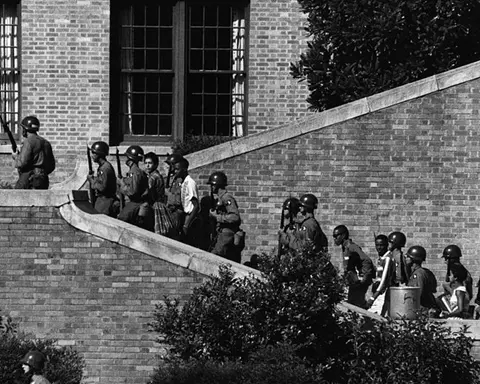
The Little Rock Nine
In 1957, nine African American students, known as the Little Rock Nine, were chosen to integrate Central High School in Little Rock, Arkansas. When they tried to enter the school, the governor sent the National Guard to block them. Large crowds gathered and threatened the students.
Federal Troops Step In
President Dwight D. Eisenhower sent federal troops to protect the Little Rock Nine and escort them into the school. With the soldiers’ help, the students were finally able to attend classes, although they still faced bullying and harassment.
A Step Toward Equality
The bravery of the Little Rock Nine showed the nation that integration would not be easy, but it was necessary. Their actions helped push the Civil Rights Movement forward and encouraged more schools to follow the law.
Word Match
Drag the vocabulary words to their correct definitions!
Vocabulary Words
Definitions
Lesson 2 — Brown v. Board & The Little Rock Nine Quiz Quiz
Activities & Extensions
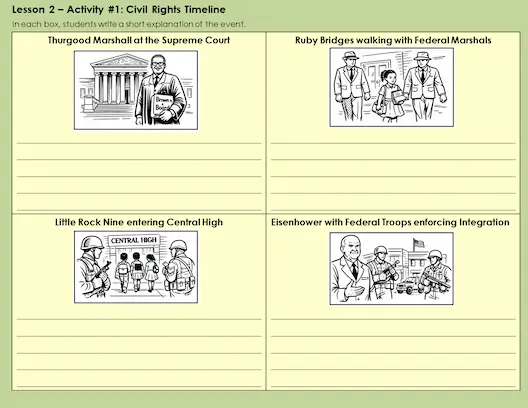
Students explore a comic-style timeline showing major milestones in school desegregation. This visual activity helps them understand the sequence of events and the courage of the people involved.
How to Do It: Display the comic timeline on the board or print a single copy for groups. Students rotate through each panel (Thurgood Marshall, Ruby Bridges, Little Rock Nine, and Milestones) and write or discuss:
- What is happening in this panel?
- Why was this moment important?
- How did this help end segregation?
Optional Extension: Students create a quick-sketch “mini panel” in their notebooks showing one additional moment from the article.
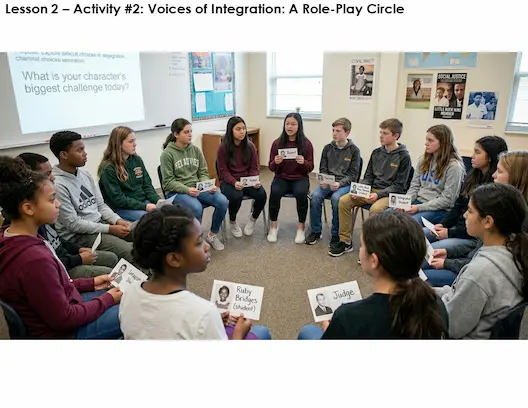
Students step into the shoes of people involved in school desegregation. This activity requires no handouts and encourages empathy, perspective‑taking, and discussion.
How to Do It: Assign students simple roles such as: Ruby Bridges, a parent, a teacher, a judge, a student at an integrated school, or a member of the Little Rock Nine. Students sit in a circle and respond to prompts such as:
- What are you feeling today?
- What challenges are you facing?
- What gives you courage?
Optional Extension: Students create a “courage quote” in their notebooks — one sentence their character might say to inspire others.
Civil Rights Navigation
Explore the Full Civil Rights Unit
This complete history unit includes research passages, organizers, writing tasks, quizzes, activities, and website research — all in printable and digital formats. Everything you need to teach the Civil Rights with confidence.
View the Full Unit on TPT