Earthquakes & Landslides

MS-ESS2-2 • How geoscience processes have changed Earth's surface

Earthquakes and landslides are two of the fastest geologic processes students will study, often happening in seconds rather than millions of years. This page covers the types of seismic waves, how the Richter scale measures magnitude, and the eight distinct types of landslides and what causes them.

Types of Seismic Waves

An earthquake releases energy in three distinct wave types, each traveling at a different speed and moving the ground in a different way. Seismologists use the time gap between wave arrivals to pinpoint where an earthquake started.

Types of seismic waves Three diagrams showing P-waves, S-waves, and surface waves, each illustrating the direction of ground motion relative to the direction the wave travels. P-wave Compresses & stretches, fastest wave S-wave Moves ground up & down, slower Surface wave Rolls along the surface, most damage P-waves arrive first, then S-waves, then surface waves — seismologists use this order to locate an earthquake's epicenter.

Earthquakes Trifold Organizer

A trifold organizer brings seismic waves, types of earthquakes, and the Richter scale together on three connected panels — students can compare all three concepts side by side without flipping pages.
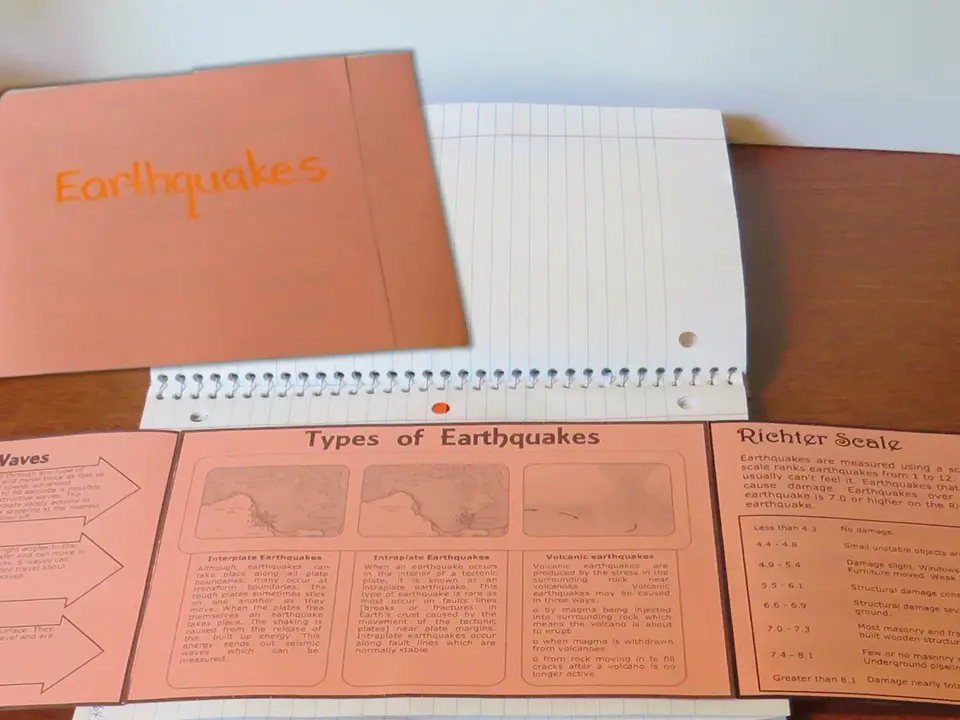
Photo: Earthquakes trifold organizer, open flat

The Richter Scale

2.5 & under
Often not felt
2.5–5.4
Felt, minor damage
5.5–6.0
Slight damage to buildings
6.1–6.9
May cause major damage
7.0+
Serious damage over large areas
Eight Types of Landslides

"Landslide" is a catch-all term — geologists actually classify mass movement into eight distinct types based on how fast the material moves and how much water is involved.

Categories of landslides Eight landslide types grouped into three categories: fast and dry, fast and wet, and slow movement. Fast & dry Quick with little water Rotational Curved, spoon-shaped slide Translational Slides on a flat surface Debris avalanche Unstable slope collapses Lateral spread Spreads on flat ground Fast & wet Mass combines with water Debris flow Rapid mudslide downslope Earthflow Viscous flow, gentle slopes Slow movement Over weeks or years Creep Slow steady downward drift Permafrost flow Thaw of frozen ground Fall / rockfall Quick drop from steep slope Topple Forward rotation off a slope

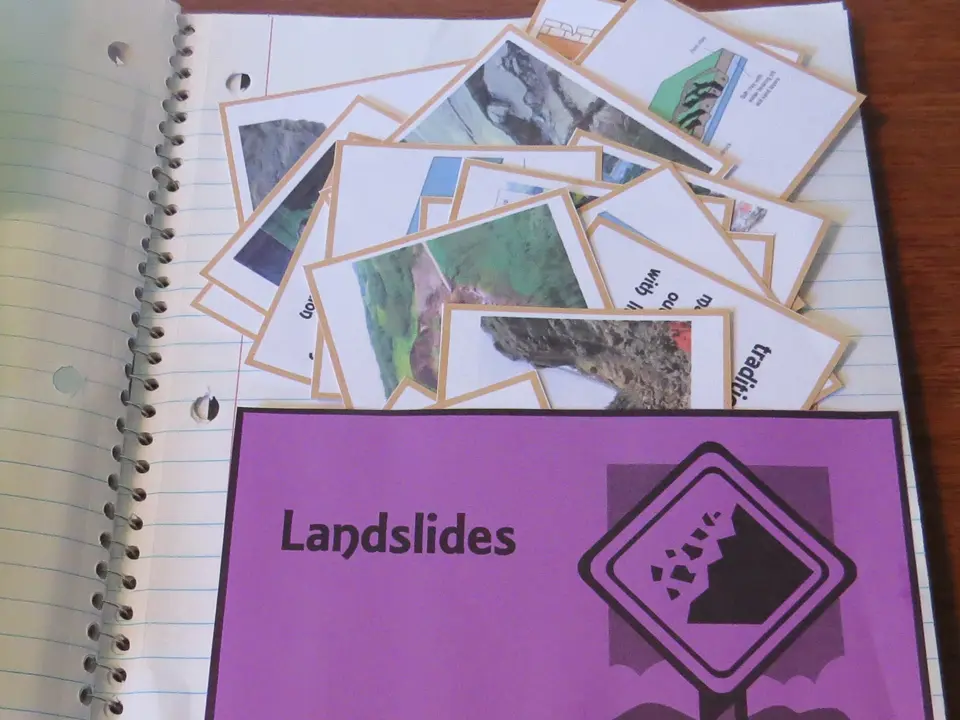
Landslide Matching Cards

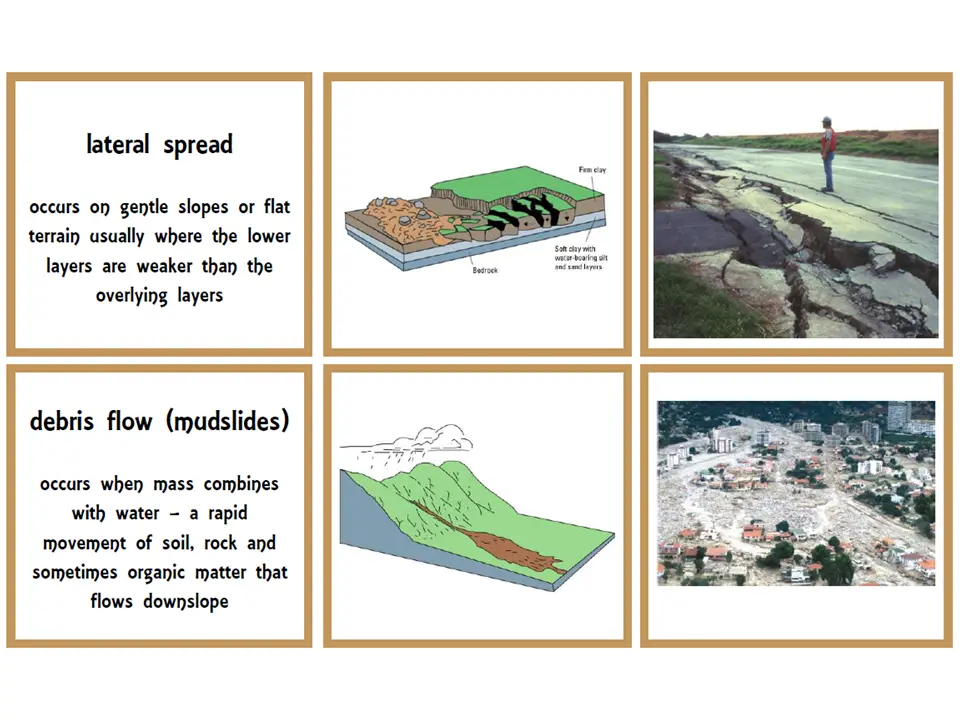
A set of matching cards pairs each landslide type's name with its definition, a labeled diagram, and a real photo — giving students three ways to recognize the same concept.

landslide matching cards set 1
landslide matching cards set 2

What Causes Landslides?

Landslides rarely happen without a trigger. Most can be traced back to one of six common causes — students sort and explain each one in a connected organizer.

Groundwater
Loss of Vegetation
River & Ocean Erosion
Snowmelt & Heavy Rain
Earthquakes
Volcanic Eruptions
MS-ESS2-1 • MS-ESS2-2 • MS-ESS2-3

Want the Complete Geology Unit?

This page covers just one piece of a full NGSS-aligned Earth's Systems: Geology unit — over 370 pages of interactive notebook activities, mini posters, organizers, mini research projects, and Check for Understanding pages covering the rock cycle, plate tectonics, volcanoes, earthquakes, weathering, erosion, and the evidence for plate tectonics.

View the Full Unit on TPT