Multiples & Factors

GCF, LCM, Factor Trees & the Venn Diagram Method
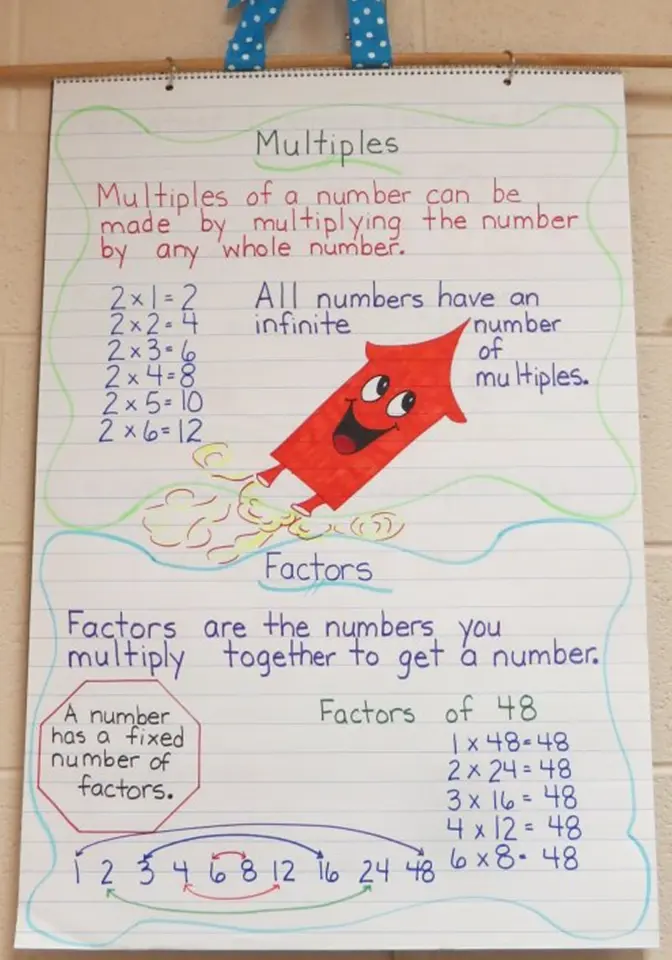
Multiples and Factors Anchor Chart

Multiples & Factors Anchor Chart

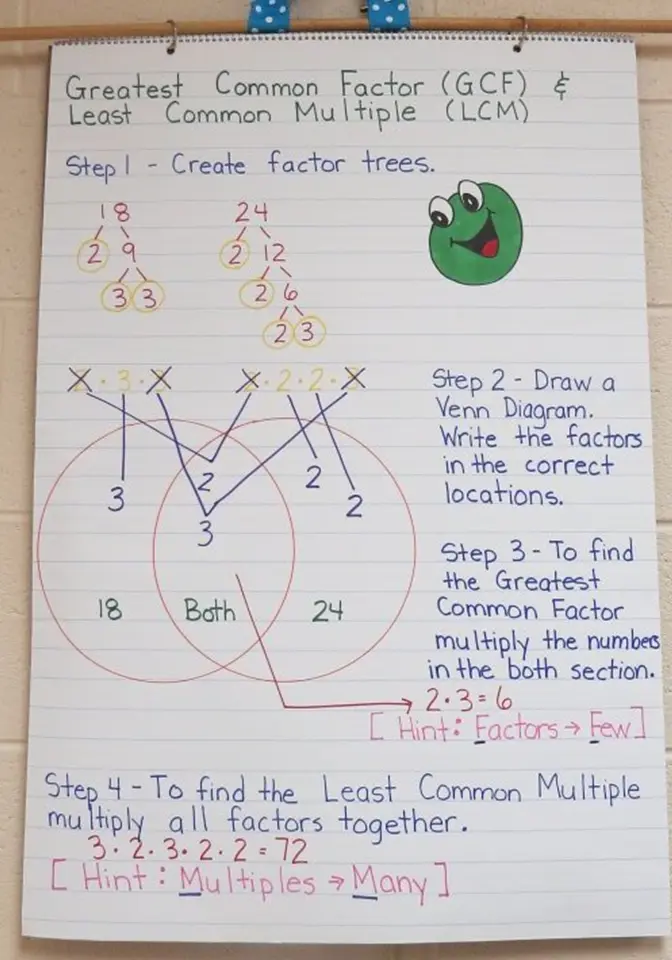
GCF and LCM Using Factor Trees and Venn Diagram Anchor Chart

GCF & LCM — Factor Trees & Venn Diagram
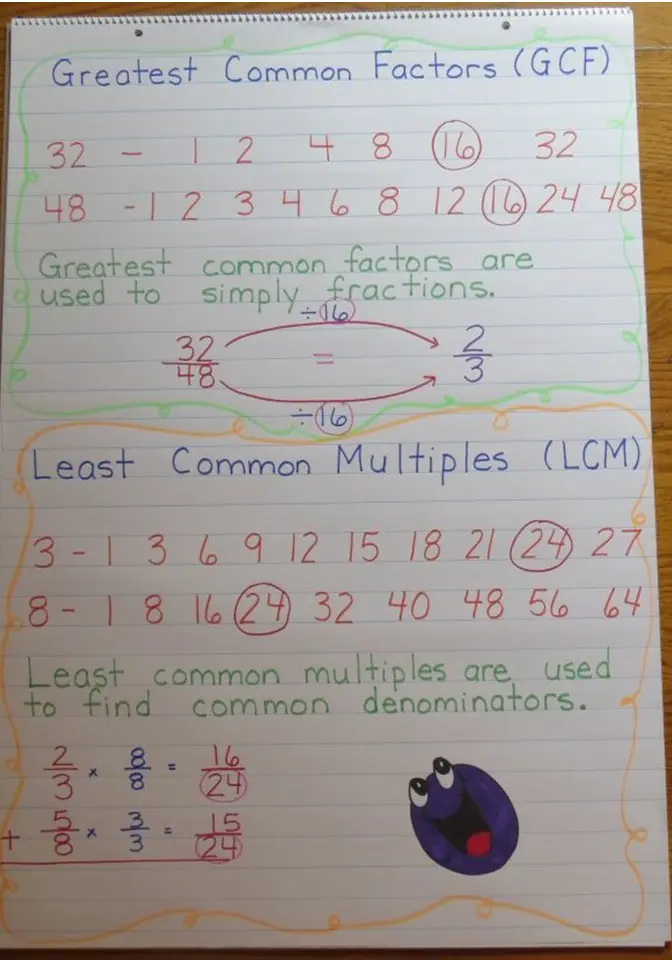
GCF and LCM Using Lists Anchor Chart

GCF & LCM — The List Method

Understanding multiples and factors unlocks two of the most useful skills in upper elementary math — simplifying fractions and finding common denominators. This page covers both concepts from the ground up, then shows two powerful methods for finding the Greatest Common Factor (GCF) and Least Common Multiple (LCM): the factor tree with Venn diagram, and the list method.

Multiples vs. Factors — What's the Difference?

∞ Multiples

Multiples of a number are made by multiplying that number by any whole number. Every number has an infinite number of multiples — they go on forever!

Multiples of 2:
2×1 = 2
2×2 = 4
2×3 = 6
2×4 = 8
2×5 = 10  ... and on forever!
∞ All numbers have an INFINITE number of multiples

√ Factors

Factors are the numbers you multiply together to get a number. Every number has a fixed number of factors — you can list them all!

Factors of 48:
1 × 48 = 48
2 × 24 = 48
3 × 16 = 48
4 × 12 = 48
6 × 8  = 48
✓ All numbers have a FIXED number of factors
Memory Hint:  Think of Multiples as going Many places (infinite!) and Factors as being Few (a fixed set). This same hint helps with GCF and LCM later!

Explore Multiples

Choose a number and watch its multiples light up in the grid below!

Show multiples of:

Factor Finder

Type any number and find all of its factors instantly!

Find factors of:
Try these:   Factors of 36  |  Factors of 48  |  Factors of 100  |  Factors of 60

Factor Trees — Step by Step

A factor tree breaks a number down into its prime factors. Click through each step to watch the tree grow!

Step 1 Start with the number 18. Find any two factors that multiply to give 18. We'll use 2 × 9.

Factor Tree of 18

18 2 9 3 3
18 = 2 × 3 × 3

Factor Tree of 24

24 2 12 4 3 2 2
24 = 2 × 2 × 2 × 3

GCF & LCM with a Venn Diagram

Using the prime factorizations from the factor trees above: 18 = 2 × 3 × 3  and  24 = 2 × 2 × 2 × 3

Click each prime factor in the bank below, then click where it belongs in the Venn diagram!

Only in 18 (left)
Both (middle)
Only in 24 (right)
Prime Factor Bank — click a factor, then click where it goes:
3 (from 18)
3 (from 18)
2 (from 24)
2 (from 24)
2 (shared)
3 (shared)
Only in 18 Only in 24 Both

The List Method for GCF & LCM

The list method works great for smaller numbers. Write out the factors or multiples, then circle the answer!

Greatest Common Factor (GCF)

List ALL factors of each number. Circle the greatest one they share.

32: 1 2 4 8 16 32
48: 1 2 3 4 6 8 12 16 24 48
GCF of 32 & 48 = 16
Real use: GCF is used to simplify fractions.
32/48 ÷ 16/16 = 2/3
Hint: Factors → Few

Least Common Multiple (LCM)

List MULTIPLES of each number. Circle the smallest one they share.

3: 3 6 9 12 15 18 21 24 27
8: 8 16 24 32 40 48
LCM of 3 & 8 = 24
Real use: LCM is used to find common denominators.
2/3 + 5/8 → use denominator 24
Hint: Multiples → Many

🍔 Real World Problem — Hot Dogs & Buns!

Hot dogs come in packages of 10. Hot dog buns come in packages of 8. How many packages of each would you need to have the same number of hot dogs and buns?

8: 8 16 24 32 40 48 56 64 72
10: 10 20 30 40 50 60

LCM = 40  →  Buy 5 packages of buns (5×8=40) and 4 packages of hot dogs (4×10=40)

Practice Problems

Choose a set and check your answers!

Find the 5th multiple of each number.

How many factors does each number have?

Find the Greatest Common Factor of each pair.

Find the Least Common Multiple of each pair.

Free Printable Organizers

Multiples, Factors, GCF & LCM Organizer Pack
Download all three free printable organizers: the Multiples & Factors two-pocket foldable, the GCF & LCM factor tree with Venn diagram worksheet, and the GCF & LCM list method foldable. Perfect for interactive notebooks!
  Download Free PDF

Teaching Ideas

🎮 Factor Game

Students take turns choosing numbers from a grid. Their score is the sum of all factors of that number not yet claimed. The player with the highest score wins. This builds factor fluency in a competitive, engaging way.

🍔 Real World LCM

Use the hot dog and bun problem as an introduction. Then have students find their own real-world LCM problems — items that come in different-sized packages that they'd want equal amounts of.

🔗 Fraction Connection

Immediately connect GCF to simplifying fractions and LCM to finding common denominators. Students understand the purpose better when they see how these skills are used in the very next lesson.

📊 Color-Coded Venn Diagrams

Have students use three colors — one for each section of the Venn diagram. The overlap color reminds them that shared factors go in the GCF calculation, while all colors together form the LCM.

✏ Interactive Notebook Foldables

The downloadable foldables work beautifully in interactive notebooks. The two-pocket design for Multiples and Factors lets students store their own examples, making it a personalized reference tool.

🔍 Divisibility Rules Connection

Teach divisibility rules for 2, 3, and 5 alongside factor trees. Students who know that a number is divisible by 3 if its digits sum to a multiple of 3 will build factor trees much more efficiently.

Explore More Math Topics

Visit other math pages at Book Units Teacher: