Coordinate Grid Activities

Coordinate grids become much more meaningful when students can move, build, and explore points in real space. These activities help students understand ordered pairs, graphing, distance on a grid, and real‑world applications through hands‑on practice.

How to Read & Plot Ordered Pairs

An ordered pair tells you exactly where a point is on the grid. Click through each step to see how it works!

The two axes: The horizontal line is the x-axis and the vertical line is the y-axis. They cross at the origin (0, 0). The grid is divided into four sections called quadrants.
x y -5 -4 -3 -2 -1 0 1 2 3 4 5 5 4 3 2 1 -1 -2 -3 -4 -5 Q I Q II Q III Q IV origin
x-axis = horizontal
y-axis = vertical
Origin = (0, 0)
An ordered pair is written as (x, y). The first number tells you how far to move left or right along the x-axis. The second number tells you how far to move up or down along the y-axis. We will plot the point (3, 2).
( 3 , 2 )
x = 3 → move 3 right
y = 2 → move 2 up
Memory tip: Walk along the hall (x-axis) first, then take the elevator (y-axis)!
Step 1 — Move along the x-axis. Starting at the origin (0,0), move 3 units to the right because x = 3.
0 1 2 3 4 5 2 3 3 right (3,0)
Step 2 — Move along the y-axis. From (3, 0), move 2 units up because y = 2. Now you are at the point (3, 2)!
0 1 2 3 4 2 3 2 up (3,2)
The point (3, 2) is plotted! It sits in Quadrant I because both x and y are positive. Remember: always go across first, then up or down.
Quadrant I
(+x, +y) — right & up
Quadrant II
(-x, +y) — left & up
Quadrant III
(-x, -y) — left & down
Quadrant IV
(+x, -y) — right & down

Plot Your Own Points

Click anywhere on the grid to plot a point and see its ordered pair! Try to plot points in all four quadrants.

Click any intersection on the grid to plot a point!
x y -6 -5 -4 -3 -2 -1 0 1 2 3 4 5 6 5 4 3 2 1 -1 -2 -3 -4 -5 Q I Q II Q III Q IV

Mystery Location

Follow the coordinate clues one at a time to figure out the mystery point! Reveal each clue, then make your guess.

Which Quadrant?

Look at the ordered pair and click which quadrant it belongs in!

Question 1 of 12

Practice Problems

Fill in the missing coordinate or quadrant number, then check your answers!

A point is described. Give the missing x or y coordinate.

Type the quadrant number (1, 2, 3, or 4) for each ordered pair.

Fill in the missing coordinate to make the statement true.

Teaching Ideas

🏙️ Plan a Town

Students use the foldable organizer to design a small town on the coordinate grid. They place buildings, label each location with ordered pairs, and explain why they chose each placement. This builds fluency with reading and writing coordinates.

🧭 Directions on the Grid

After building their towns, students write directions from one location to another using coordinate pairs to indicate turns and movement. This reinforces the meaning of the x‑ and y‑axes in a practical way.

🚶 How Many Blocks?

Students determine the number of “blocks” between two locations by comparing their x‑ and y‑coordinates. This activity helps students visualize distance on a grid without introducing the coordinate plane formula.

👥 Partner Build Challenge

One student creates a town layout and calls out the coordinates. The partner builds the same town on a blank grid. When finished, students compare their maps to see how accurately they followed the ordered pairs.

❓ Mystery Location

Students follow a series of coordinate clues to discover a hidden location on the grid. This works well as a warm‑up, early finisher activity, or small‑group challenge.

🎯 Target the Point

Place several “target points” on the coordinate grid and assign each one a different point value. Students plot ordered pairs you call out and earn points when they land on or near a target. This turns coordinate practice into a fun, fast‑paced game that builds accuracy and fluency.

🟦 Life‑Sized Four‑Quadrant Grid

Use colorful tape to create a giant four‑quadrant coordinate grid on the classroom floor. The floor tiles naturally form the grid lines, making it easy for students to see the axes and count units. Call out ordered pairs and have students walk to the correct location. You can also give each student a card with a coordinate and have them find their "spot" on the grid. This full‑body activity helps students internalize how the x‑ and y‑axes work and makes graphing incredibly fun.
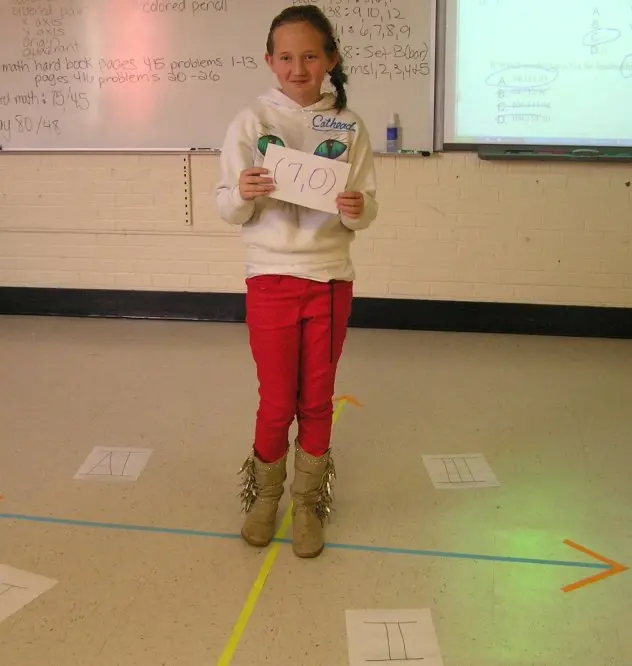
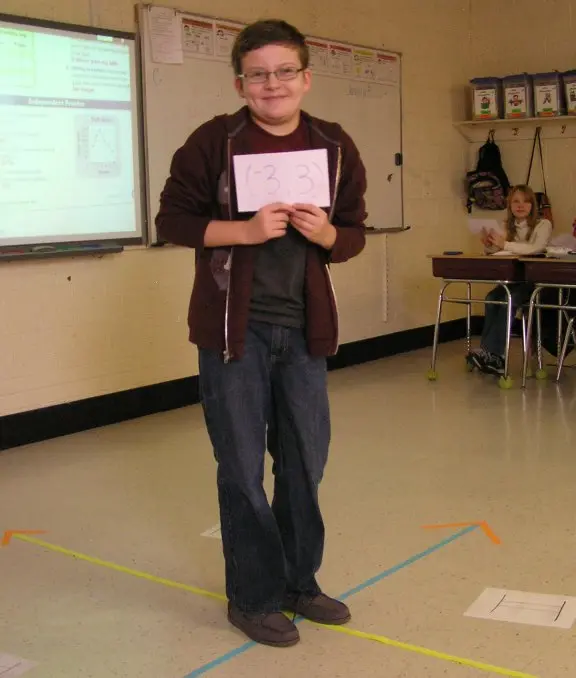
Life-sized coordinate grid made with colorful tape on classroom floor Students standing on ordered pairs on a floor-tile coordinate grid

Explore More Math Topics

Visit other math pages at Book Units Teacher: