Last updated: August 3, 2026
Theme is that elusive message hiding behind every story; the one students know exists but often treat like a secret code they forgot the cipher for. Some kids catch on quickly, while others proudly announce themes like “The theme of Charlotte’s Web is… pigs can talk.” Close, but not quite. These teaching theme activities are easy to add to your lessons. Once students learn how to spot patterns in characters, conflicts, and resolutions, theme becomes much easier to uncover.
Jump to
This lesson walks students through practical, teacher‑tested strategies for identifying theme without frustration. You’ll find organizers, examples, and activities that make theme finally click.
What Is Theme?
Theme is the message, lesson, or insight the author wants readers to understand. Unlike characters or setting, theme isn’t something students can point to on a page. It must be inferred by examining the character’s actions, conflicts, choices, and growth. Strong readers learn to look beyond what happened to understand why it matters.
Common Misconceptions
Students often:
- confuse theme with topic (friendship, courage, family)
- confuse theme with plot (what happened)
- confuse theme with moral (a lesson stated directly)
- choose themes that are too specific or too vague
- believe a story can only have one theme
- think theme must be stated word‑for‑word in the text
Clarifying these misconceptions helps students identify theme more accurately.
Theme vs. Main Idea
Students often confuse theme and main idea because both involve finding meaning in a text.
Main idea tells what a text is mostly about.
Theme explains the message or lesson the author wants readers to understand.
For example:
Main idea: A spider saves a pig’s life.
Theme: True friendship is shown through sacrifice and kindness.
Teaching this distinction helps students answer higher-level comprehension questions with greater confidence.
Now that students understand what theme is and how to identify it, the activities below help students infer theme, support their ideas with evidence, and compare themes across texts.
Be sure to get the handout for all activities in this post.
5 Classroom-Tested Activities for Teaching Theme
💡 Activity #1 – Anchor Charts: AKA Your Secret Weapon for Teaching Theme
“THE MEssage” really is the message.
Theme is abstract, but anchor charts make it visual. One of my favorite posters is the “THE MEssage” chart, which reminds students that theme is the takeaway, the golden idea, the mental souvenir from the story.
It drives home the idea that the theme is the message behind the story, movie, or even song.
Here’s how it works:
- Students pick two potential themes from a story.
- They draw arrows to illustrate how those themes are connected.
- Then, they back it up with quotes or events from the text like little literary lawyers.
🖨️ Pro Tip: Print this chart as a classroom poster, handout, or notebook insert. That way, it’s always in front of them when the “what’s the theme again?” panic strikes.
🦁 Activity #2 – Fables: Short, Sweet, and Theme-Tastic
Short, sweet, and totally message-packed.
Fables don’t waste words and that makes them perfect for theme instruction. Strip the moral off the end (gasp!) and let your students figure out the message on their own.
Great picks:
- The Lion and the Mouse
- The Boy Who Cried Wolf
This works for group chats, solo sleuthing, or a quick formative assessment when you need to check who’s picking up what you’re laying down.
Activity #3 – Songs: Because Music Makes Everything Better
Music that teaches while it grooves.
Storytelling isn’t just for books. It’s in the lyrics of the songs your students already know and love (or at least pretend to). Many songs pack serious thematic punch.
🎤 Try these classroom favorites:
- “Hero” – Mariah Carey
- “Good Riddance (Time of Your Life)” – Green Day
- “The Climb” – Miley Cyrus
- “I Hope You Dance” – Lee Ann Womack
- “Cat’s in the Cradle” – Harry Chapin
Break down the lyrics, ask students what message the songwriter’s trying to deliver, and watch as literary analysis sneaks into their Spotify playlists.
🍿Activity #4 – Movies: Because Sometimes the Book Isn’t Better
Movies are goldmines for teaching theme, especially since your students probably already know half the plotlines. Use that to your advantage!
Here’s a fun twist:
- Share a list of popular movies (included in the handout!).
- Have students check off the ones they’ve seen (Google Form version makes this easy).
- Group them by movie choice and ask each group to identify a theme, backed up with specific scenes or dialogue.
Movies that work well for Teaching Theme
- The Emperor’s New Groove (redemption, friendship)
- Antz (individuality, rebellion)
- Charlotte’s Web (friendship, sacrifice)
- The Wizard of Oz (courage, self-discovery)
- Willy Wonka and the Chocolate Factory (greed, humility)
🎬 Bonus: Students think they’re just talking about movies… but you know they’re actually analyzing literature. Sneaky, right?
📚 Activity #5 – Short Stories That Deliver Big
Brevity = clarity + engagement.
Short stories get to the point quickly making them ideal for teaching theme without overwhelming your students.
Lesson Flow
- Pick a level-appropriate story
- Read together or in small groups
- Discuss character choices + consequences
- Reveal the theme like literary sleuth
Some great examples include:
“Thank You, Ma’am” by Langston Hughes
- Lexile Level: 780L
- Grade Level Equivalent: 5th-6th grade
- Themes: kindness, trust, and second chances
“All Summer in a Day” by Ray Bradbury
- Lexile Level: 740L
- Grade Level Equivalent: 5th-6th grade
- Themes: Jealousy, isolation, and the impact of bullying
“The Marble Champ” by Gary Soto
- Lexile Level: 750L
- Grade Level Equivalent: 4th-6th grade
- Themes: determination and achievement
“The Necklace” by Guy de Maupassant
- Lexile Level: 900L
- Grade Level Equivalent: 7th-9th grade
- Themes: vanity, pride, and sacrifice
Why Theme Matters
Theme helps students think deeply about the meaning of a story. When students understand theme, they begin to:
- connect events to the author’s message
- analyze how characters change
- explain what readers can learn from the story
- compare themes across texts
- understand how conflict shapes meaning
Theme moves students from literal comprehension to thoughtful interpretation.
Questions Students Should Ask
To deepen their understanding, students can ask:
- What lesson does the character learn?
- How does the character change from beginning to end?
- What message does the author want readers to think about?
- How does the conflict reveal the theme?
- What evidence supports this theme?
- Could another reader interpret the theme differently?
These questions help students move from surface‑level ideas to meaningful interpretation.
Common Mistakes Students Make When Identifying Theme
Students frequently make the same mistakes when learning about theme.
Mistake #1: Confusing the Topic with the Theme
A student might say:
“The theme is friendship.”
Friendship is actually the topic.
A complete theme explains something about friendship.
For example:
True friendship requires loyalty and sacrifice.
Mistake #2: Retelling the Plot
Students often summarize what happened instead of explaining the author’s message.
Instead of:
Charlotte saves Wilbur.
Encourage:
Acts of kindness can change another person’s life.
Mistake #3: Looking for Only One Theme
Many stories contain multiple themes.
For example, Charlotte’s Web explores:
- friendship
- sacrifice
- growing up
- the cycle of life
Discussing more than one possible theme encourages deeper thinking and richer classroom conversations.
Teaching theme doesn’t have to be like deciphering a secret code. With anchor charts, fables, favorite tunes, movies, and short stories, you can guide your students toward meaningful understanding without losing your own theme (which is probably “patience and coffee”).
Grab the Free Lesson Handout
Download your free materials and let’s make theme a classroom hit!
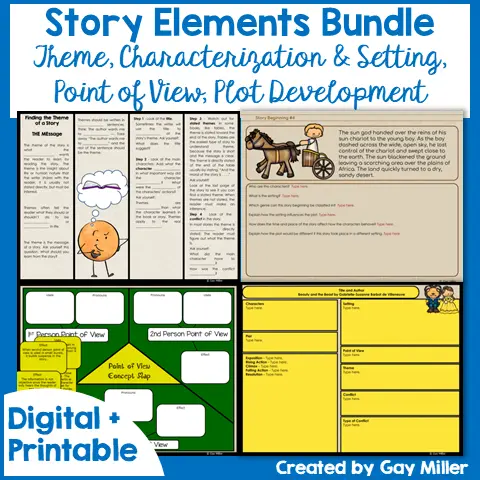
See the product that inspired this post.
Our Story Elements Series offers engaging activities in both digital (Google Slides) and printable formats, easily convertible to PowerPoint for offline use. It includes a vocabulary list with definitions, a multiple-choice quiz, question stems by grade level, video lessons with organizers, and various activities. Check out the previews of each book in the bundle, covering Point of View, Characters and Settings, Plot Development, and Theme.

6 comments
Skip to comment form
My brother recommended I may like this blog. He was entirely right.
This put up truly made my day. You cann’t believe
simply how so much time I had spent for this info!
Thank you!
You are so awesome!
This web site is something that is needed on the internet, someone with some originality!
Great article.
Great article.
Hello, after reading this amazing post i am also cheerful to share my know-how here with
mates.
Magnificent content. Thanks for writing!