The Great Depression
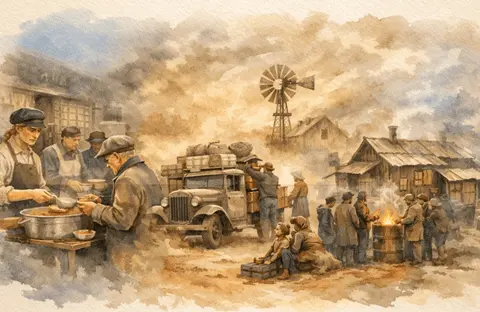
Fast Facts: The Great Depression
Life During the Great Depression
- Time Period: 1930s
- Main Problem: Millions lost their jobs
- City Impact: Soup kitchens and breadlines
- Farm Impact: Dust Bowl and low crop prices
- Key Issue: Many families lost homes and farms
The Great Depression at a Glance
- Millions of Americans became unemployed after 1929.
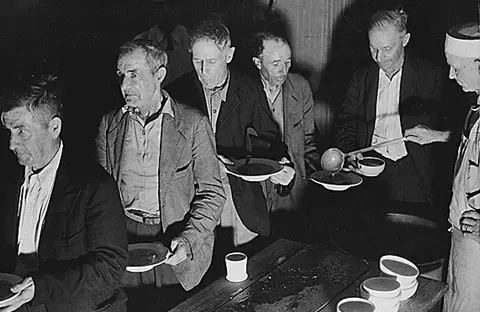
- Cities opened soup kitchens and breadlines to feed people.
- Young men often left home to search for work.
- Farmers suffered from low prices and the Dust Bowl.
- Many families lost their homes and lived in makeshift shelters.
Struggles in the Cities
After the Stock Market Crash, the United States entered the Great Depression. Millions of people lost their jobs. Without money, many families could not afford food or rent. Cities opened soup kitchens and breadlines to help people get a simple meal.
Searching for Work
Young men and teenage boys often left home to look for work in other towns. They traveled by hopping onto trains and hoped to find temporary jobs. Most earned very little, but they tried to help their families however they could.
Farmers and the Dust Bowl
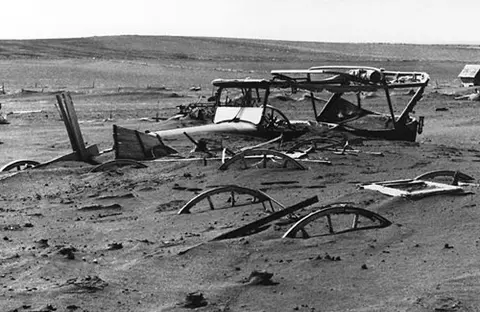
Farmers also suffered. Crop prices dropped after World War I, and many farmers could not pay their loans. A severe drought hit the central United States, creating the Dust Bowl. Dust storms destroyed crops and made it impossible to farm. Many families had to leave their homes and move west.
Growing Anger and Hoovervilles
Some people grew angry and demanded more help from the government. President Herbert Hoover believed that states, not the federal government, should help people in need. His programs were not enough. Families who lost their homes built small shelters called Hoovervilles, named after the president.
A Nation Ready for Change
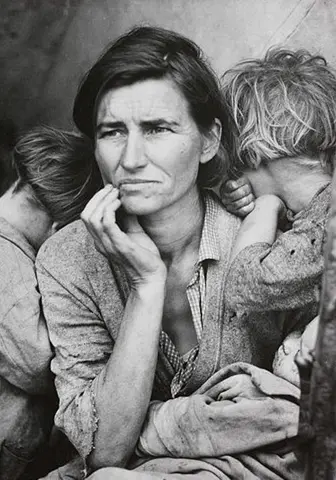
By the early 1930s, the country was struggling. People wanted new ideas and stronger leadership. They hoped the next president could help the nation recover from the Great Depression.
Word Match
Drag the vocabulary words to their correct definitions!
Vocabulary Words
Definitions
Lesson 2 — Life During the Great Depression Quiz
Activities & Extensions
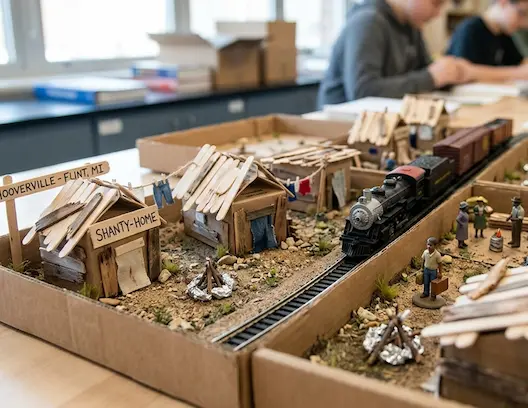
Students explore the reality of the makeshift “cardboard jungles” that arose during the 1930s. By linking historical fiction to a tactile, collaborative building project, students gain a deeper understanding of community and daily survival during the Great Depression.
How to Do It: Read Chapter 8 of Bud, Not Buddy by Christopher Paul Curtis, focusing on the descriptions of the shelters and the train tracks at the edge of town. Using empty milk cartons or small boxes as a frame, students cover their structures with broken popsicle sticks with ragged, splintered ends to mimic scavenged wood. Students arrange their finished shanties inside corrugated cardboard case trays (soda flats) to build individual neighborhoods that can be lined up along a shared toy train track.
Materials:
- Cardboard case trays (soda or canned food flats)
- Empty milk cartons or small cardboard boxes
- Popsicle sticks (broken and splintered)
- Glue, scissors, and scraps of fabric or twine
Optional Extension: Students add miniature details to their tray, such as a tin foil campfire or twine clotheslines, and write a brief reflection on how the residents of the shantytown supported one another.
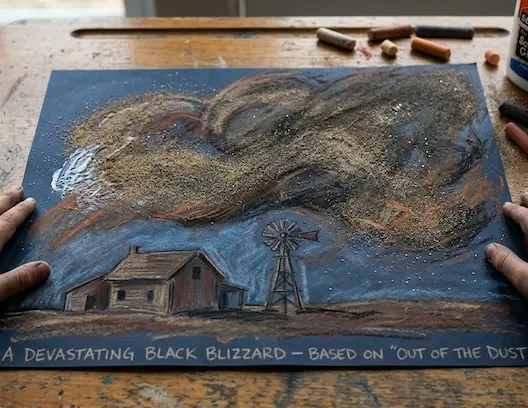
Students recreate the eerie, overwhelming power of a Great Plains “Black Blizzard” using multi‑textured art mediums. This activity connects historical poetry to physical art, allowing students to mimic the gritty reality of the ecological disaster.
How to Do It: Read a selection from Karen Hesse's verse novel Out of the Dust (such as the poems “Fields of Flashing Light” or “Dust Storm”). On a piece of dark construction paper, students use colored chalk to sketch a simple, static farm scene with a farmhouse or windmill. Next, they apply white school glue to the sky area in a swirling, turbulent storm pattern. While the glue is wet, they generously sprinkle sand or fine dirt over the paper and shake off the excess to create a textured, realistic dust storm cloud.
Materials:
- Dark or blue construction paper
- Colored chalk
- White liquid school glue and paintbrushes
- Real sand or fine dirt
Optional Extension: Students choose a powerful line or phrase from the Out of the Dust poems and neatly write it across the bottom of their artwork as a caption.
Great Depression Navigation
Explore the Full Great Depression Unit
This complete history unit includes research passages, organizers, writing tasks, quizzes, activities, and website research — all in printable and digital formats. Everything you need to teach the Great Depression with confidence.
View the Full Unit on TPT