The Stock Market Crash
Fast Facts: The Stock Market Crash
The Stock Market Crash
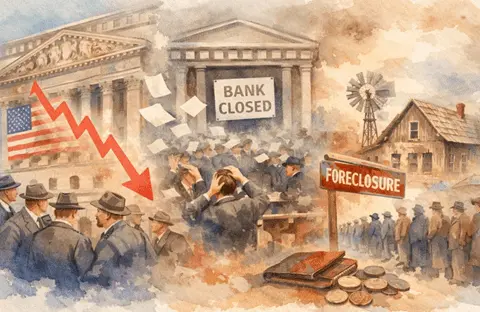
- Era: End of the Roaring Twenties
- Key Date: Black Tuesday — October 29, 1929
- Main Issue: Stock prices fell suddenly
- Cause: Overproduction, debt, and risky investments
- Outcome: Beginning of the Great Depression
The Crash at a Glance
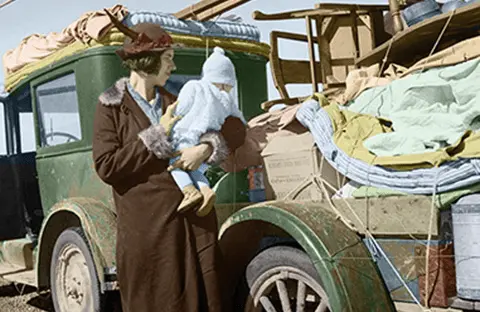
- Stock prices rose quickly during the 1920s.
- Many people borrowed money to buy stocks.
- Factories produced more goods than people could buy.
- Panic selling caused prices to fall sharply.
- Black Tuesday marked the start of the Great Depression.
The Roaring Twenties Slow Down
After World War I, Americans bought cars, radios, and appliances, often using installment plans. Many people invested in the Stock Market, hoping to make money as companies grew. But by the late 1920s, factories were making more goods than people could buy. Workers lost jobs, and families struggled to pay their bills.
Warning Signs Appear
As businesses slowed, investors became nervous. Some began selling their stocks, causing prices to drop. More people rushed to sell, hoping to avoid losing money. This created panic in the Stock Market.
Black Tuesday
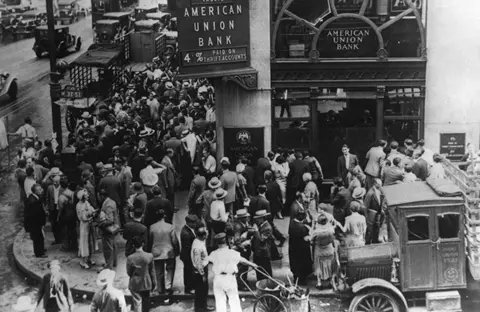
On October 29, 1929, the Stock Market crashed. Prices fell faster than anyone could sell. Banks had invested money in the market, and when it collapsed, many banks lost everything. People rushed to withdraw their savings, but some banks had no money left and closed.
Farmers Face Hard Times
Farmers were already struggling. After World War I, they could no longer sell as many crops overseas. Prices dropped, and many farmers could not pay their loans. Some lost their farms to the bank.

A Nation in Trouble
The Stock Market Crash did not cause the Great Depression by itself, but it made the country’s problems much worse. Businesses closed, banks failed, and millions of Americans faced unemployment. The crash marked the end of the Roaring Twenties and the beginning of a difficult time in American history.
Word Match
Drag the vocabulary words to their correct definitions!
Vocabulary Words
Definitions
Lesson 1 — The Stock Market Crash Quiz
Activities & Extensions
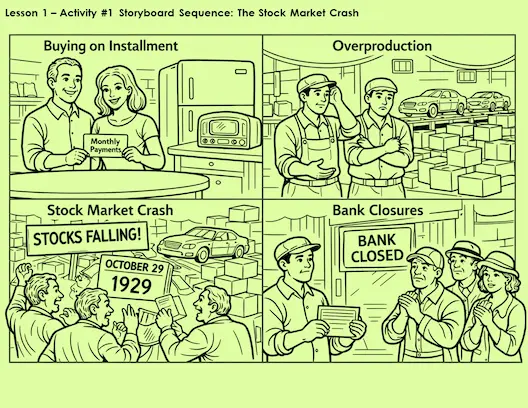
Students create a simple four‑panel storyboard showing key events that led to the Stock Market Crash. This can be done with AI‑generated images, teacher‑selected images, or quick student sketches.
How to Do It: Display or provide four images showing moments such as:
- Americans buying goods on installment plans
- Factories producing more goods than people could buy
- Panic selling on Black Tuesday
- Banks failing after the crash
Students place the images in order and write a short caption for each panel answering: What happened? and Why did it matter?
Materials: Four images (AI‑generated or displayed on screen), notebook, pencil
Optional Extension: Students add a fifth panel titled The Beginning of the Great Depression explaining how the crash affected families.
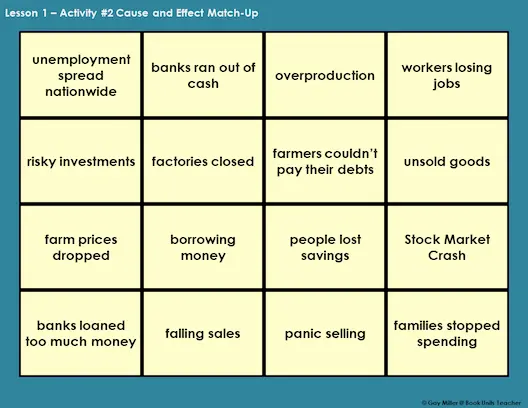
Students build a simple cause‑and‑effect chain to understand how economic problems led to the Stock Market Crash. This reinforces sequencing and historical reasoning without requiring a worksheet.
How to Do It: Students draw a chain of four boxes in their notebooks. In each box, they record one cause from the article and the effect that followed.
- Overproduction → unsold goods
- Falling sales → workers losing jobs
- Borrowing money to buy stocks → risky investments
- Panic selling → Stock Market Crash
Students add arrows or symbols to show how each event led to the next.
Materials: Notebook, pencil
Optional Extension: Students add a final box explaining how the crash led to bank failures and unemployment.
Great Depression Navigation
Explore the Full Great Depression Unit

This complete history unit includes research passages, organizers, writing tasks, quizzes, activities, and website research — all in printable and digital formats. Everything you need to teach the Great Depression with confidence.
View the Full Unit on TPT