
Ancient Egypt Government
Below you will find a complete list of the pharaohs that ruled Egypt. Some of the more famous ones are linked to an explanation clarifying their accomplishments.
~~~~~~~EARLY DYNASTIC PERIOD~~~~~
Historians know little about the pharaohs that lived during this time. Only through the monuments do we know that they existed.
| 1st Dynasty (2920 - 2770)
During this time the capital at Memphis was founded. Papyrus was invented. Writing was used by the government. Many impressive artifacts have been found from this period. |
|
| Menes (Aha) | |
| Iti (Neithhotep) | |
| Djer | |
| Wadj | |
| Den (Udimu) | |
| Anendjib | |
| Semerkhet | |
| Kaa | |
| 2nd Dynasty (2770 - 2650)
After much rivalry for the throne Hetepsekhemsy won. At this time the kings disagreed over which god, Horus and Seth, was in power. This was finally settled when Khasekhemwy became ruler. He took both titles. Disorder erupted during the end of this dynasty. There could have been a civil war. |
|
| Hetepsekhemwy | |
| Reneb | |
| Ninetjer | |
| Peribsen | |
| Khasekhemwy | |
~~~~~~~OLD KINGDOM~~~~~~~
The age of the Pyramid
3rd Dynasty Djoser built the step pyramid. |
|
| Sanakhte (Nebka) | 2650 - 2630 |
| Netjerykhet (Djoser) | 2630 - 2611 |
| Sekhemkhet (Djoser Teti) | 2611 - 2603 |
| Khaba | 2603 - 2599 |
| Huni | 2599 - 2575 |
4th Dynasty During this dynasty there was a great peace. The kings were able to put their energies in art. King Khufu's Great Pyramid of Giza was built. People prayed to the sun god Re. The first religious words were written on the walls of the royal tombs.
|
|
| Senefru Built Bent Pyramid | 2575 - 2551 |
| Khufu (Cheops) Built Great Pyramid | 2551 - 2528 |
| Radjedef | 2528 - 2520 |
| Khafre (Chephren) Built Great Sphinx | 2520 - 2494 |
| Menkaure (Mycerinus) | 2490 - 2472 |
| Shepseskaf | 2472 - 2467 |

5th Dynasty For the first time high officials came from people outside of the royal family. The pyramids begin to be smaller and less solid. However, the carvings in the temples were of great quality. Papyrus scrolls from this time have been discovered. They showed record keeping of goods. |
|
| Userkaf | 2465 - 2458 |
| Sahure | 2458 - 2446 |
| Neferirkare Kakai | 2446 - 2426 |
| Shepseskare Ini | 2426 - 2419 |
| Raneferef | 2419 - 2416 |
| Niuserre Izi | 2416 - 2392 |
| Menkauhor | 2396 - 2388 |
| Djedkare Izezi | 2388 - 2356 |
| Wenis | 2356 - 2323 |
6th Dynasty Many records of trading expeditions have been discovered from this period. |
|
| Teti | 2323 - 2291 |
| Pepy I (Meryre) | 2289 - 2255 |
| Merenre Nemtyemzaf | 2255 - 2246 |
| Pepy II (Neferkare) | 2246 - 2152 |
~~~~~FIRST INTERMEDIATE PERIOD~~~~~
During this time the government had a breakdown. The regional governors divided the land among themselves.
Order was gained in 1986 when Montuhotep reunited the country.
King Mentuhotep moved the capital from Memphis to Thebes.
7th and 8th Dynasties (2150 - 2135) The political structure of the Old Kingdom collapsed. There was famine, civil disorder, and a high death rate. |
|
| Netrikare | |
| Menkare | |
| Neferkare II | |
| Neferkare III | |
| Djedkare II | |
| Neferkare IV | |
| Merenhor | |
| Menkamin I | |
| Nikare | |
| Neferkare V | |
| Neferkahor | |
| Neferkare VI | |
| Neferkamin II | |
| Ibi I | |
| Neferkaure | |
| Neferkauhor | |
| Neferirkare II | |
Authorized Kings about whom nothing more is known. |
|
| Wadjkare | |
| Sekhemkare | |
| Iti | |
| Imhotep | |
| Isu | |
| Iytenu | |
9th and 10th Dynasties (2135 - 1986) Egypt split into the north, ruled from Herakleopolis, and the south, ruled from Thebes. |
|
| Neferkare | |
| several kings named Kheti | |
| Meri-Hathor (?) | |
| Merikare | |
11th Dynasty |
|
| Inyotef I (Sehertawy) | 2074 - 2064 |
| Inyotef II (Wahankh) | 2064 - 2015 |
| Inyotef III (Nakhtnebtepnefer) | 2015 - 2007 |
| Montuhotep II | 2007 - 1986 |
~~~~~~~MIDDLE KINGDOM~~~~~~~
Properous period with much foreign trade. Many large building projects. Skilled jewelry making.
The government became strong with King Amenemhet I's rule.
11th Dynasty Egypt was unified once again under the rule of Metuhotep. He built an exceptional mortuary complex at Dyr al-Bahri. |
|
| Montuhotep II (Nebhepetre) | 1986 - 1956 |
| Montuhotep III (Sankhkare) | 1956 - 1944 |
| Montuhotep IV (Nebtawyre) | 1944 - 1937 |
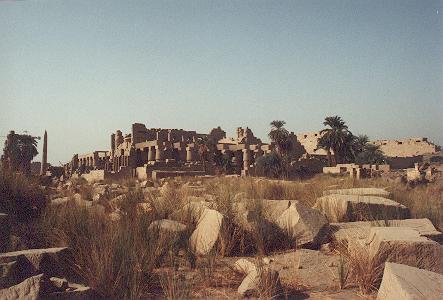
Temple of Amon - Ra built during the |
|
12th Dynasty Amenemhet moved the capital back to Memphis. Sesostris II reorganized Egypt into 4 regions (northern and southern halves of the Nile Valley and eastern and western Delta). Written language was regularized. |
|
| Amenemhet I (Sehetepibre) | 1937 - 1908 |
| Senwosret I (Kheperkare) | 1917 - 1872 |
| Amenemhet II (Nubkaure) | 1875 - 1840 |
| Senwosret II (Khakheperre) | 1842 - 1836 |
| Senwosret III (Khakaure) | 1836 - 1817 |
| Amenemhet III (Nimaatre) | 1817 - 1772 |
| Amenemhet IV (Maakherure) | 1772 - 1763 |
| Neferusobek (Sobekkare) | 1763 - 1759 |
~~~~~SECOND INTERMEDIATE PERIOD~~~~~
The Hyksos invaded and conquered. Eventually the Theban princes regained power. Kamose defeated the Hyksos.
Weapons, horses, and chariots appeared.
13th Dynasty Few monuments from this period survived. Each king reigned for only a short time. Some of these kings were born commoners. The eastern Delta region broke away during this time. |
|
| Wegaf | 1783-1779 |
| Amenemhat-senebef | |
| Sekhemre-khutawi | |
| Amenemhat V | |
| Sehetepibre I | |
| Iufni | |
| Amenemhat VI | |
| Semenkare | |
| Sehetepibre II | |
| Sewadjkare | |
| Nedjemibre | |
| Sobekhotep I | |
| Reniseneb | |
| Hor I | |
| Amenemhat VII | |
| Sobekhotep II | |
| Khendjer | |
| Imira-mesha | |
| Antef IV | |
| Seth | |
| Sobekhotep III | |
| Neferhotep I | 1696 - 1686 |
| Sihathor | 1685 - 1685 |
| Sobekhotep IV | 1685 - 1678 |
| Sobekhotep V | 1678 - 1674 |
| Iaib | 1674 - 1664 |
| Ay | 1664 - 1641 |
| Ini I | |
| Sewadjtu | |
| Ined | |
| Hori | |
| Sobekhotep VI | |
| Dedumes I | |
| Ibi II | |
| Hor II | |
| Senebmiu | |
| Sekhanre I | |
| Merkheperre | |
| Merikare | |
14th Dynasty
Egypt was invaded by Asiatic desert people called Hyksos. These Hyksos made themselves kings and held the country for over 200 years.
Nehesi Khatire Nebfaure Sehabre Meridjefare Sewadjkare Heribre Sankhibre Kanefertemre Neferibre Ankhkare
15th Dynasty
The Hyksos sacked the old capital of Memphis and built their capital at Avaris in the Delta.
Salitis Bnon Apachnan (Khian) Apophis (Auserre Apepi) Khamudi
16th Dynasty The Hyksos rule brought about many new methods. Some were bronze working, pottery, looms and even new musical styles. New breeds of animals and crops were introduced. New weapons appeared. Among these were the composite bow, new daggers and scimitars, and the horse and chariot. |
|
| Anat-Her | |
| User-anat | |
| Semqen | |
| Zaket | |
| Wasa | |
| Qar | |
| Pepi III | |
| Bebankh | |
| Nebmaatre | |
| Nikare II | |
| Aahotepre | |
| Nubankhre | |
| Nubuserre | |
| Khauserre | |
| Khamure | |
| Jacob-Baal | |
| Yakbam | |
| Yoam | |
| Amu | |
17th Dynasty This line of rulers developed in Thebes, and controlled the area from Elephantine to Abydos. The first rulers made no attempt to fight the Hyksos. However, the later rulers fought a number of battles. |
|
| Antef V | |
| Rahotep | |
| Sobekemzaf I | |
| Djehuti | |
| Mentuhotep VII | |
| Nebirau I | |
| Nebirau II | |
| Semenenre | |
| Suserenre | |
| Sobekemzaf II | |
| Antef VI | |
| Antef VII | |
| Tao I (Senakhtenre) | |
| Tao II (Sekenenre) | |
| Kamose (Wadjkheperre) | |
~~~~~~~NEW KINGDOM~~~~~~~
Period of prosperity. Building projects and art flourished during the 18th and 19th dynasties especially at Thebes (at Luxor and Karnak)
Royalty was buried in the Valley of the Kings.
During the 20th dynasty officials began tomb robbing.
Priests became very powerful and the government broke down.
The capital was again moved to Memphis.
18th Dynasty Ahmose finally beat the Hyksos and sent them out of Egypt. This dynasty had a number of strong rulers.
|
|
| Ahmose (Nebpehtyre) | 1539 - 1514 |
| Amenhotep I (Djeserkare) | 1514 - 1493 |
| Thutmose I (Akheperkare) | 1493 - 1481 |
| Thutmose II (Akheperenre) | 1481 - 1479 |
| Hatshepsut (Maatkare) | 1473 - 1458 |
| Thutmose III (Menkheperre) | 1479 - 1425 |
| Amenhotep II (Akheperure) | 1427 - 1392 |
| Thutmose IV (Menkheperure) | 1392 - 1382 |
| Amenhotep III (Nebmaatre) | 1382 - 1344 |
| Amenhotep IV / Akhenaten | 1352 - 1336 |
| Neferneferuaten | 1341 - 1337 |
| Smenkhkare (Ankhkheperure) | 1337 - 1336 |
| Tutankhamun (Nebkheperure) | 1336 - 1327 |
| Ay (Kheperkheperure) | 1327 - 1323 |
| Horemheb (Djeserkheperure) | 1323 - 1295 |
19th Dynasty Seti I restored many monuments. His temple at Abydos has some of the most superior carved wall reliefs. Many battles and treaties were written between Egypt and Asiatic powers.
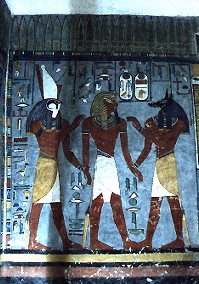
Horus and Anubis with Ramesses I
|
|
| Ramesses I (Menpehtyre) | 1295 - 1294 |
| Seti I (Menmaatre) | 1394 - 1279 |
| Ramesses II (Usermaatresetepenre) | 1279 - 1213 |
| Merenptah (Baenrehotephirmaat) | 1213 - 1203 |
| Amenmesse (Menmire) | 1203 - 1200 |
| Seti II (Userkheperuresetepenre) | 1200 - 1194 |
| Siptah (Akhenresetepenre) | 1194 - 1188 |
| Tausert (Sitremeritamun) | 1188 - 1186 |
20th Dynasty Setakht restored order to the country. Ramesses III was one of the greatest kings. |
|
| Setakht (Userkhauremeryamun) | 1186 - 1184 |
| Ramesses III (Usermaatremeryamun) | 1184 - 1153 |
| Ramesses IV (Hekamaatresetepenamun) | 1153 - 1147 |
| Ramesses V (Usermaatresekheperenre) | 1147 - 1143 |
| Ramesses VI (Nebmaatremeryamun) | 1143 - 1136 |
| Ramesses VII (Usermaatresetepenre) | 1136 - 1129 |
| Ramesses VIII (Usermaatreakhenamun) | 1129 - 1126 |
| Ramesses IX (Neferkaresetepenre) | 1126 - 1108 |
| Ramesses X (Khepermaatresetepenre) | 1108 - 1099 |
| Ramesses XI (Menmaatresetepenptah | 1099 - 1069 |
~~~~~~THIRD INTERMEDIATE PERIOD~~~~~~
The kings weakened, and Egypt was no longer a world power.
Civil war and foreign invaders tore Egypt apart.
The capital moved from Tanis to Libyan, to Nubia, to Thebes, to Sais, and then back to Nubia and Thebes.
21st Dynasty |
|
| Smedes | 1070-1044 |
| Amenemnisu | 1044-1040 |
| Psusennes | 1040-992 |
| Amenope | 993-984 |
| Osochor | 984-978 |
| Siamun | 978-959 |
| Psusennes II | 959-945 |
22nd Dynasty |
|
| Shoshenq I | 945-924 |
| Osorkon I | 924-909 |
| Takelot | 909--? |
| Shoshenq | II ?--883 |
| Osorkon II | 883-855 |
| Takelot II | 860-835 |
| Shoshenq III | 835-783 |
| Pami | 783-773 |
| Shoshenq IV | 773-735 |
| Osorkon IV | 735-712 |
23rd Dynasty |
|
| Pedubaste I | 828-803 |
| Osorkon IV | 777-749 |
| Peftjauwybast | 740-725 |
24th Dynasty |
|
| Shepsesre Tefnakht I | 725-720 |
| Wahkare Bakenranef | 720-715 |
~~~~~~~LATE KINGDOM~~~~~~~
The Nubians fell under the Assyrians invasion.
The Greeks helped re-establish order.
A renaissance in the arts of the 25th Dynasty showed a return to the Old Kingdom style.
25th Dynasty |
|
| Shebaka | 712-698 |
| Shebitku | 698-690 |
| Taharqa | 690-664 |
| Tantamani | 664-657 |
26th Dynasty |
|
| Psammetichus I (Psam-tik) | 664-610 |
| Psammetichus II | 610-595 |
| Apries | 589-570 |
| Amasis | 570-526 |
| Psammetichus III | 526-52 |
27th Dynasty |
|
| Cambyses | 525-522 |
| Darius I | 521-486 |
| Xerxes I | 486-466 |
| Artaxerxes I | 465-424 |
| Darius II | 424-404 |
28th Dynasty
Amyrtaios 404-399
29th Dynasty |
|
| Nepherites I | 399-393 |
| Psammuthis | 393 |
| Hakoris | 393-380 |
| Nepherites II | 380 |
30th Dynasty |
|
| Nectanebo I | 380-362 |
| Teos | 365-360 |
| Nectanebo II | 360-343 |
~~~~~~~SECOND PERSIAN PERIOD (343-332 B.C.)~~~~~~~
This period was added after Manetho created a list of kings.
31st Dynasty |
|
| Ochus (Artaxerxes III) | 343-338 |
| Arses | 338-336 |
| Darius III Codomannus | 335-332 |
~~~~~~~GRECO-ROMAN PERIOD (332 B.C. - 395 A.D.)~~~~~~~
Macedonian Kings - Alexandria |
|
| Alexander the Great | 332-323 |
| Philip Arrhidaeus | 323-316 |
| Alexander IV | 316-304 |
Ptolemaic Dynasty |
|
| Ptolemy I Soter I | 323-285 |
| Ptolemy II Philadelphus | 282-246 |
| Ptolemy III Euergeter I | 246-222 |
| Ptolemy IV Philopator | 222-205 |
| Ptolemy V Epiphanes | 205-180 |
| Ptolemy VI Philometor | 180-164 & 163-145 |
| Ptolemy VII Neos Philopator | 145 |
| Ptolemy VIII Euergetes II | 170-163 & 145-116 |
| Cleopatra III & Ptolemy IX Soter II | 116-107 & 88-80 |
| Cleopatra III & Ptolemy X Alexander | 107-88 |
| Cleopatra Berenice | 81-80 |
| Ptolemy XI Alexander II | 80 |
| Ptolemy XII Neos Dionysos | 80-58 & 55-51 |
| Berenice IV | 58-55 |
| Cleopatra VII & Ptolemy XIII Queen of the Nile | 51-47 |
| Cleopatra & Ptolemy XIV | 47-44 |
| Cleopatra VII & Ptolemy XV Cesarion | 44-30 |
Roman Emperors
After Cleopatra and Antony committed suicide in 30 B. C. Egypt was ruled by the Romans.
Egypt does not have another Egyptian ruler for 2000 years.Augustus 30 B.C. - 14 A.D. Tiberius 14-37 Gaius Caligula 37-41 Claudius 41-54 Nero 54-68 Galba 68-69 Vespasianus 69-79 Titus 79-81 Domitianus 81-96 Nerva 96-98 Trajanus 98-117 Hadrianus 117-138 Antoninus Pius 138-161 Marcus Aurelius 161-180 Lucius Verrus Commodus 180-192 Septimus Severus 193-211 Caracalla 198-217 Geta 209-212