Click the images to go to the individual pages.


Click the images to go to the individual pages.
Have students print out their names or other meaningful text using the Hieroglyphics Generator. Then have students duplicate the drawing in salt dough using a pencil.
A cartouche is a sign with a hieroglyphic name. We typed our names into the Egyptian Name Translator. Next we printed out the Hieroglyphs.
We made a salt dough mixture by blending 2 cups flour, 1 cup salt, and 3/4 cup of warm water.
We shaped the salt dough into an oval shape. Next we used toothpicks and pencil tips to carve our names into the salt dough.


Papyrus is a plant that was common in Egypt. The stems of the plant were used to make paper called papyrus. The outer skin was removed. The softer pith was made into papyrus by soaking the stems in water and then cutting them into thin strips. The strips were then beaten flat with a hammer. The flattened strips were placed one on top of another at right angles and pounded down so that the natural glue which bound them together was released from the stems. The sheets were dried under a weight. They were then attached together to form a roll.
Try making your own papyrus. Gather any type of reeds from a river bank or swampy area. Weave these together. Pound them with a mallet. Hang them up to dry.

The Egyptians built boats from the reeds that grew along the Nile River. We made a diorama depicting a Nile River scene. In the background you will see Egyptians doing laundry along the riverbanks. In the foreground you will see the replica of a reed boat. We made this from grasses. Try building your own diorama.

We used modeling clay to decorate these boxes with Egyptian symbols.

We soon discovered that it is much easier to model the amulets first and then attach them to the boxes.
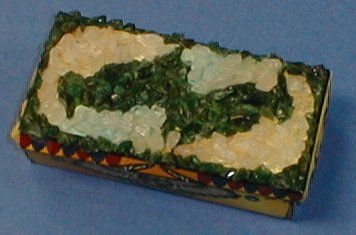
This box was decorated with Egyptian symbols. We made the image with plastic "stones."

This project was completed by a wonderful teacher in our school, Mr. Taylor.
Students brought in their own bars of soap. They drew the outline of the Sphinx on their soap with a pencil. With a plastic knife, they carved off the big chunks that weren't needed. The fine detail was completed with pencil points and paper clips.


To make a life-sized sarcophagus trace fold a large piece of paper in half. Have one student lay on the paper while another traces around the body.

Cut out the mummy shape. You will have two. Draw Egyptian symbols on the sarcophagus, Glue the two pieces of paper together leaving an opening for stuffing. Stuff the mummy with old newspapers. Finish by gluing the opening.


