Man on the Moon
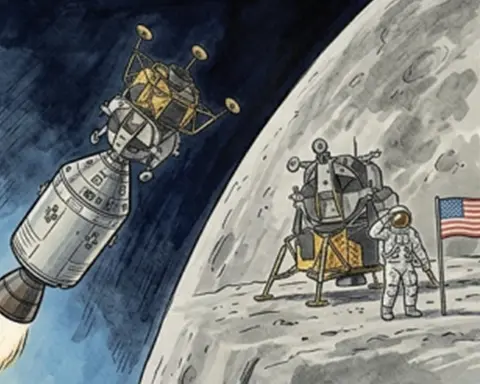
Fast Facts: Space Race Milestones
Space Race Milestones
- First American in Space: Alan Shepard (1961)
- First American to Orbit Earth: John Glenn (1962)
- First American Spacewalk: Edward H. White II (1965)
- First Moon Orbit: Apollo 8 (1968)
- First Moon Landing: Apollo 11 (1969)
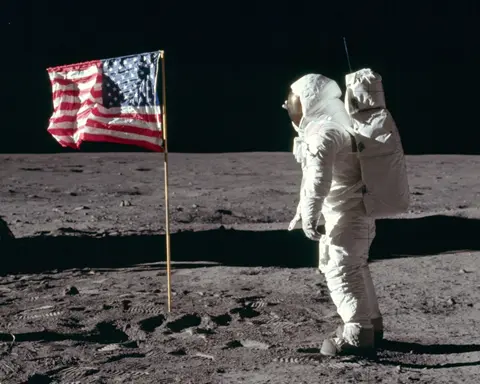
Space Race at a Glance
- The United States and the Soviet Union competed to explore space.
- Alan Shepard became the first American in space in 1961.
- John Glenn orbited Earth in 1962, proving long‑distance spaceflight was possible.
- Apollo 8 became the first mission to orbit the moon in 1968.
- Apollo 11 landed astronauts on the moon on July 20, 1969.
Early Steps in the Space Race
During the 1960s, the United States worked to catch up to the Soviet Union in what became known as the Space Race. On May 5, 1961, astronaut Alan Shepard became the first American in space. Less than a year later, John Glenn became the first American to orbit Earth on February 20, 1962.
New Achievements in Space
As NASA gained experience, astronauts began completing more difficult tasks. From June 3–7, 1965, Edward H. White II became the first American to walk in space. In December 1968, the crew of Apollo 8—Frank Borman, James A. Lovell Jr., and William A. Anders—became the first humans to orbit the moon.
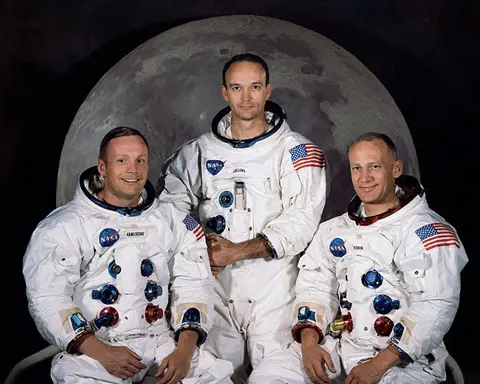
Apollo 11: Landing on the Moon
The most famous mission began on July 16, 1969, when astronauts Neil Armstrong, Michael Collins, and Buzz Aldrin launched aboard Apollo 11. On July 20, Armstrong and Aldrin entered the lunar module, the Eagle, and landed on the moon. Armstrong stepped onto the surface first, saying, “That’s one small step for man, one giant leap for mankind.”
Exploring the Moon
Armstrong and Aldrin collected moon rocks, set up experiments, and planted an American flag. They spent 21½ hours on the moon before lifting off to rejoin Collins in the command module, Columbia.
Did You Know?
The Apollo 11 astronauts left behind a plaque that reads, “We came in peace for all mankind.”
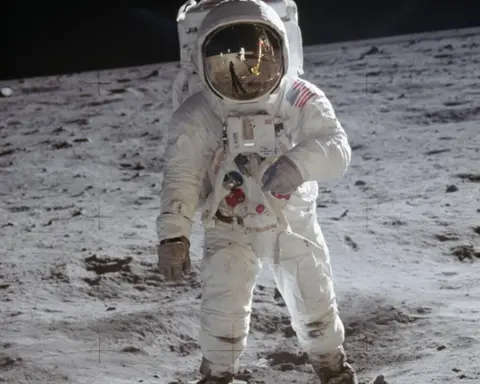
Returning Home
After transferring their samples and equipment, the crew headed back to Earth. On July 24, 1969, Apollo 11 splashed down safely in the Pacific Ocean, completing one of the greatest achievements in human history.
A Giant Leap for Mankind
The moon landing proved what teamwork, determination, and scientific innovation could accomplish. It remains one of the most inspiring moments of the 20th century and a symbol of human exploration.
Word Match
Drag the vocabulary words to their correct definitions!
Vocabulary Words
Definitions
Activities & Extensions
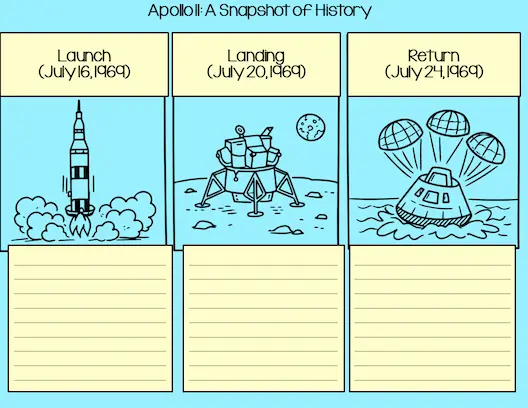
Students create a simple three‑box snapshot of the Apollo 11 mission. This helps them understand the sequence of events from launch to landing to return.
How to Do It: Students draw three boxes labeled: Launch (July 16, 1969), Landing (July 20, 1969), and Return (July 24, 1969). In each box, they write one sentence explaining what happened and add a small sketch such as a rocket, lunar module, or splashdown.
Optional Extension: Students write one sentence at the bottom: “Why was the moon landing important?”
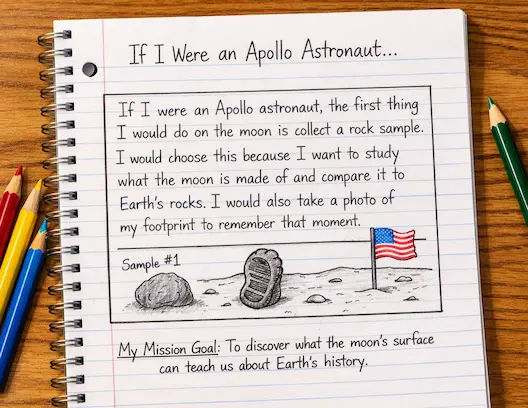
Students imagine themselves as part of the Apollo 11 crew and reflect on what they would do first on the moon. This encourages creativity while staying grounded in the article.
How to Do It: Students title a notebook page “If I Were an Apollo Astronaut…” and write 3–4 sentences explaining what they would do first on the moon, why they would choose that action, and what they hope to learn. They add one simple sketch such as a footprint, flag, or rock sample.
Optional Extension: Students add a caption at the bottom: “My Mission Goal:” and complete it in one sentence.
1960s America Navigation
Explore the Full 1960s America Unit

This complete history unit includes research passages, organizers, writing tasks, quizzes, activities, and website research — all in printable and digital formats. Everything you need to teach the 1960s America with confidence.
View the Full Unit on TPT