Figurative Language
Anchor Charts, Activities & Resources
Make figurative language come alive with anchor charts, hands-on organizers, PowerPoint lessons, and student art projects designed for upper elementary classrooms.

Make figurative language come alive with anchor charts, hands-on organizers, PowerPoint lessons, and student art projects designed for upper elementary classrooms.
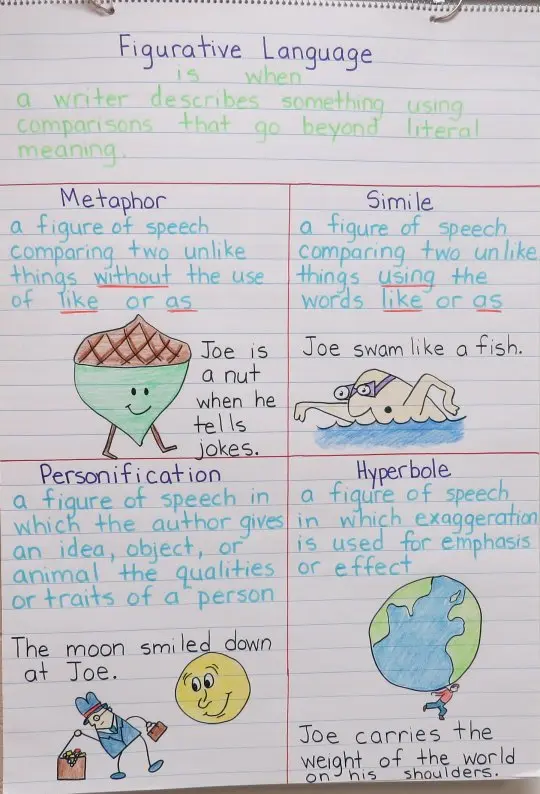
This anchor chart covers four core types of figurative language with definitions, examples, and simple illustrations that help students connect the concept to a visual image. Encourage students to create their own examples and illustrations — the act of drawing a metaphor or simile is one of the most effective ways to cement understanding.
A direct comparison between two unlike things without using "like" or "as."
"Joe is a nut when he tells jokes."
Mentor text idea: In Charlotte's Web, the words Charlotte weaves into her web to describe Wilbur are one of the most famous metaphors in children's literature.
A comparison using "like" or "as."
"Joe swam like a fish."
Mentor text idea: Because of Winn-Dixie is full of "like" and "as" comparisons describing the dog — a great hunting ground for student-found similes.
Giving human qualities to non-human things.
"The moon smiled down at Joe."
Mentor text idea: In The Wind in the Willows, the river is written about as though it has its own moods and will — a classic mentor text for personification.
An extreme exaggeration used for emphasis or humor.
"Joe carries the weight of the world on his shoulders."
Mentor text idea: American tall tales like Paul Bunyan stretch every detail to an impossible scale — a fun, familiar mentor text for hyperbole.
Figurative language helps readers visualize ideas, feel emotions, and understand concepts more deeply. These four foundational devices appear constantly in literature, poetry, and everyday speech, so recognizing them strengthens comprehension and makes student writing more vivid and expressive.
Metaphor: "Joe is a nut when he tells jokes."
Simile: "Joe is like a nut when he tells jokes."
One states the comparison directly; the other signals it with "like" or "as." Same comparison, different tool — this is the confusion nearly every student runs into first.
Usually the easiest device to spot — the exaggeration is often obvious. A good entry point for students who are new to figurative language.
The "like/as" signal word makes similes easy to find in text, though students still need practice explaining exactly what's being compared.
Trickier than simile since there's no signal word — students must recognize that the comparison is implied, not stated outright.
The trickiest device to generate on their own. Students can usually identify it in text well before they can write it confidently.

A partner game that gives students practice identifying figurative language and using context clues. Print and play — no prep required.
Download Free PDF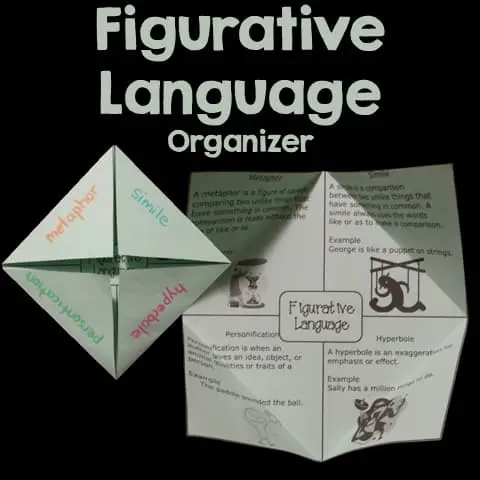
A foldable graphic organizer paired with 45 sentence cards drawn from Peter Pan — each card contains a figurative phrase students identify and analyze.
Download Free PDF
Celebrate the holiday with a full slate of figurative language activities — an original short story rich with similes and hyperbole, a modern "TikTok Frog-Off" tone comparison, an animated short tie-in, and a chart of frog-themed idioms and phrases.
Read Blog Post
Seven activities using winter poems to identify rhyme schemes, figurative language, and poetic elements. Works well for differentiated instruction across ability levels.
Read Blog Post
From the Arbor Day classroom activities roundup: students study 24 tree-themed figurative phrases — like "barking up the wrong tree" — matching each to its meaning, with flexible small-group or memory-match center options.
Read Blog Post
Explore the figurative devices behind classroom humor — irony, sarcasm, understatement, and more — with activities and examples students will actually enjoy.
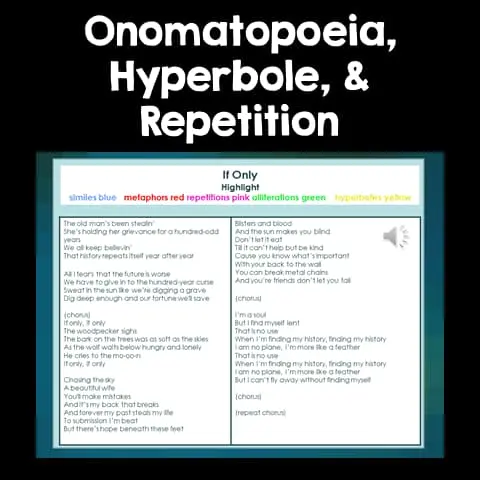
Read Blog PostLouis Sachar's novel Holes has been a classroom favorite since 1998 and made its way to the big screen in 2003. These four PowerPoint lessons weave figurative language into the Holes unit using the film's musical moments as a hook for each device.
The files are editable with no security locks — feel free to customize them for your classroom, swapping out song references for tracks your students will recognize today. All four PowerPoints are bundled in one zip file.



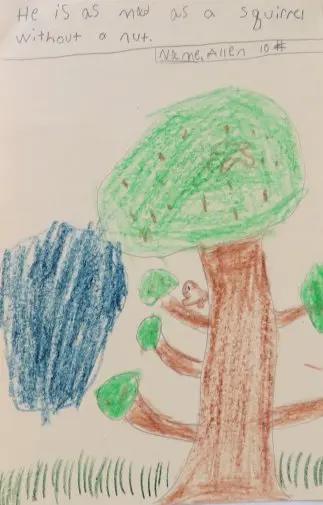
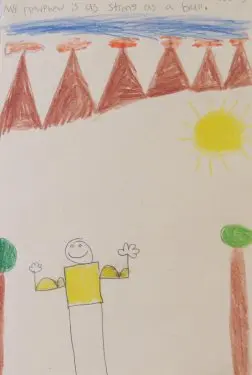
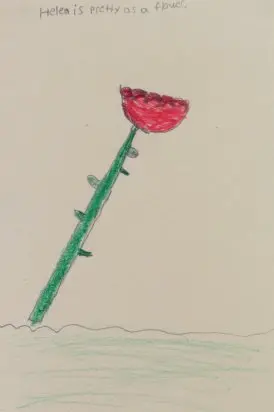
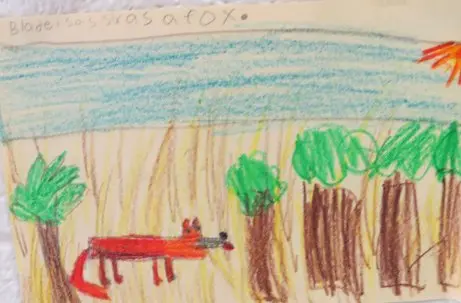
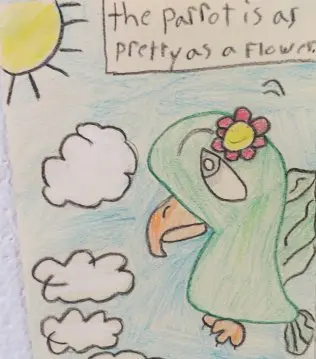
One of the most effective ways to check for understanding is to have students draw a literal interpretation of a metaphor or simile. These student examples show the range of creativity that emerges from a simple prompt.