Early Civilizations of the Americas
Long before Europeans arrived, people in the Americas built cities, pyramids, roads, and calendars. Some of these civilizations lasted for centuries. Others grew into great empires. And the descendants of many of these peoples still live in the Americas today.
As you read, look for three things in each civilization: what people ate, what they built and invented, and who carries on their story today.
Printable comparison chart (PDF)
Timeline
The bars show when each civilization was at its height. The peoples themselves did not end there.
Mexico and Central America
Gulf Coast of MexicoThe Olmec
The Olmec built one of the earliest civilizations in the Americas along the hot, rainy Gulf Coast of Mexico. They are famous for giant stone heads carved from volcanic rock. Seventeen have been found, and the largest are taller than a grown-up and weigh many tons. Many of the heads wear helmets that may have been used in an early ballgame.

| When | about 1200–400 B.C. |
|---|---|
| Food | corn, beans, squash, and fish |
| Achievements | colossal stone heads; fine jade carving; ideas such as the ballgame that later peoples continued |
| Buildings | a large earthen pyramid at La Venta |
| Today | Olmec culture faded around 400 B.C., but many of its ideas lived on in later civilizations of Mexico. |
Southern Mexico and Central America
The Maya
Maya city-states in the rainforests and on the Yucatán Peninsula had stone temples, palaces, and ball courts. Maya scholars wrote books, tracked the movements of the sun, moon, and planets, and used a number system that included zero. Many southern cities were abandoned around A.D. 900, but northern cities continued, and the last Maya kingdom did not fall to Spain until 1697.

| When | villages by 2000 B.C.; great cities about A.D. 250–900 |
|---|---|
| Food | corn, beans, squash, chiles, and cacao, used to make a chocolate drink |
| Achievements | a complete writing system of glyphs; a number system with zero; accurate calendars and astronomy |
| Buildings | stepped pyramids and cities such as Tikal, Palenque, and Chichén Itzá |
| Today | More than 11 million Maya people live in Mexico and Central America, and many speak one of about 30 Maya languages. |
Valley of Mexico
The Aztecs (Mexica)
The Mexica, often called the Aztecs, built their capital, Tenochtitlan, on an island in Lake Texcoco in 1325. Raised roads called causeways connected the city to the shore, and farmers grew food on chinampas, gardens built up from the lake bottom. By 1500, Tenochtitlan was one of the largest cities in the world. In 1521, Spanish soldiers and their Indigenous allies captured it.

| When | arrived in the 1200s; Tenochtitlan founded 1325; conquered 1521 |
|---|---|
| Food | corn, beans, squash, chiles, tomatoes, and cacao |
| Achievements | Chinampa farming; a large empire with busy markets; the famous Sun Stone |
| Buildings | The Templo Mayor, causeways, and canals |
| Today | Mexico City stands where Tenochtitlan stood. About 1.6 million people speak Nahuatl, the Aztec language. The words tomato, chocolate, and avocado come from Nahuatl. |
South America
Andes MountainsThe Inca
From their capital, Cusco, the Inca built the largest empire in the Americas, stretching about 2,500 miles along the Andes Mountains. Thousands of miles of stone roads and rope bridges tied the empire together. Farmers cut terraces into steep mountainsides, and officials kept records on quipus, cords tied with knots. Spanish conquerors captured the Inca ruler in 1532, though Inca resistance continued for forty more years.

| When | Empire about 1438–1533 |
|---|---|
| Food | hundreds of kinds of potatoes, quinoa, and corn; llamas and alpacas |
| Achievements | roads and rope bridges; terrace farming; quipu records; freeze-dried potatoes that kept for years |
| Buildings | Machu Picchu and stone walls fitted so tightly that no mortar was needed |
| Today | about 7 to 10 million people speak Quechua, the language of the Inca. |
North America
Four CornersAncestral Puebloans
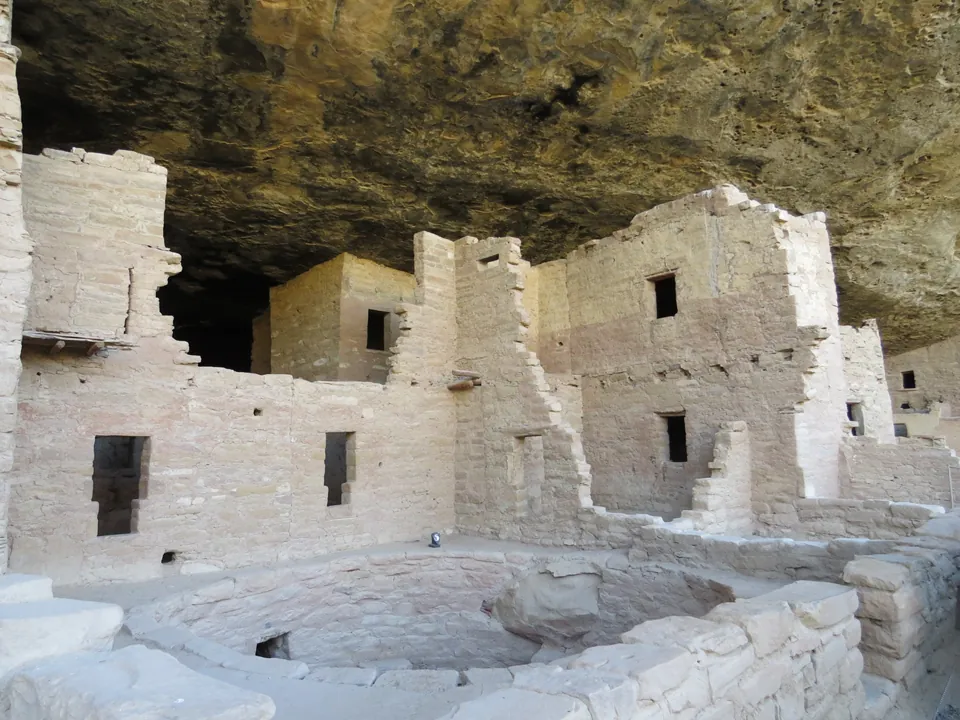
The ancestors of today’s Pueblo people built great houses with hundreds of rooms at Chaco Canyon in New Mexico and cliff dwellings at Mesa Verde in Colorado. Chaco was the center of roads and trade routes that brought shells, copper bells, and macaw feathers from Mexico. Older books use the name “Anasazi,” but Pueblo people prefer “Ancestral Puebloans.”
| When | about A.D. 750–1300 |
|---|---|
| Food | corn, beans, squash, and turkeys |
| Achievements | multistory buildings; long, straight roads; buildings lined up with the sun and moon; turquoise trade |
| Buildings | Pueblo Bonito at Chaco Canyon; Cliff Palace at Mesa Verde |
| Today | The Hopi, Zuni, and other Pueblo nations are their descendants. People have lived at Taos Pueblo for more than 1,000 years. |
Ohio and Mississippi River Valleys
Mound-Building Cultures: Adena, Hopewell, and Mississippian
Over many centuries, peoples in the Ohio and Mississippi river valleys built huge earthworks, some shaped like hills and others like circles, squares, or animals. The Hopewell traded copper from the Great Lakes and shells from the Gulf of Mexico. Around A.D. 1100, about 10,000 to 20,000 people lived at Cahokia, near present-day St. Louis. It was the largest city north of Mexico.

| When | Adena from about 800 B.C.; Hopewell about 100 B.C.–A.D. 500; Mississippian about A.D. 800–1600 |
|---|---|
| Food | corn, squash, and sunflowers; hunting, fishing, and gathering nuts |
| Achievements | giant earthworks; trade networks reaching across much of North America |
| Buildings | Monks Mound at Cahokia, about 100 feet tall, the largest earthwork north of Mexico |
| Today | Many Southeastern nations, including the Muscogee (Creek), Choctaw, and Chickasaw, trace their roots to Mississippian peoples. Cahokia is a UNESCO World Heritage Site. |
Myth or Fact?
Myth!
Many southern Maya cities were abandoned around A.D. 900, but the Maya people never disappeared. More than 11 million Maya people live today.
Myth!
Some writers in the 1800s spread this false story, which made it easier to justify taking Native land. The mounds were built by the ancestors of today’s Native nations.
Compare the Civilizations
| Civilization | Where | When | Known for | Today |
|---|---|---|---|---|
| Olmec | Gulf Coast of Mexico | 1200–400 B.C. | colossal stone heads | ideas carried on by later peoples |
| Maya | Southern Mexico, Central America | Cities A.D. 250–900 | writing, zero, calendars | more than 11 million Maya people |
| Aztec (Mexica) | Valley of Mexico | 1325–1521 | Tenochtitlan, chinampas | 1.6 million Nahuatl speakers |
| Inca | Andes Mountains | 1438–1533 | roads, terraces, quipus | 7–10 million Quechua speakers |
| Ancestral Puebloans | Four Corners | A.D. 750–1300 | great houses, cliff dwellings | Hopi, Zuni, and other Pueblo nations |
| Mound builders | Ohio and Mississippi valleys | 800 B.C.–A.D. 1600 | earthworks, Cahokia | Muscogee, Choctaw, Chickasaw, and others |
Think About It
- Which foods appear in almost every civilization? Why do you think they were so important?
- Choose two civilizations. How were their buildings alike? How were they different?
- Why is it important to know that these peoples’ descendants still live today?
Word Match
Drag each word to its definition, or tap a word and then tap its definition.