Sequoyah
Sequoyah at a Glance
Sequoyah
- Name: Sequoyah (also called George Gist)
- People: Cherokee
- Home: Tuskegee, near the Little Tennessee River
- Known for: Creating the Cherokee syllabary
- Died: about 1843
Key Facts
- Worked as a silversmith.
- Spent about 12 years creating the syllabary.
- His syllabary had 86 symbols, one for each syllable.
- His daughter Ayoka helped prove it worked.
- The Cherokee Phoenix newspaper began in 1828.
Tap or hover over the card to flip it. Students can copy this information into their organizer before reading.
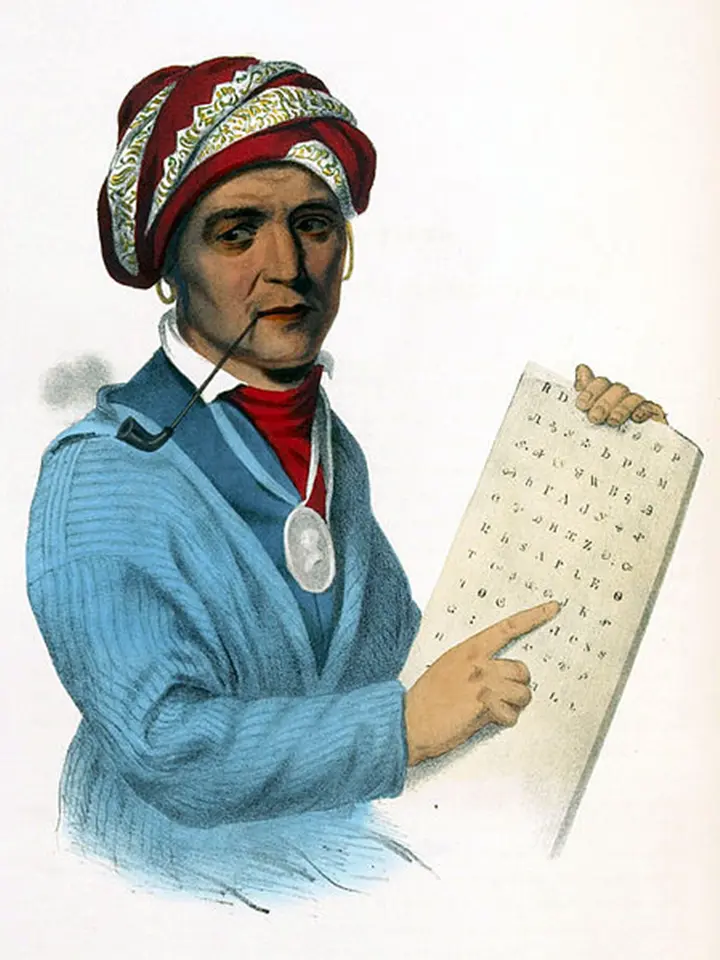
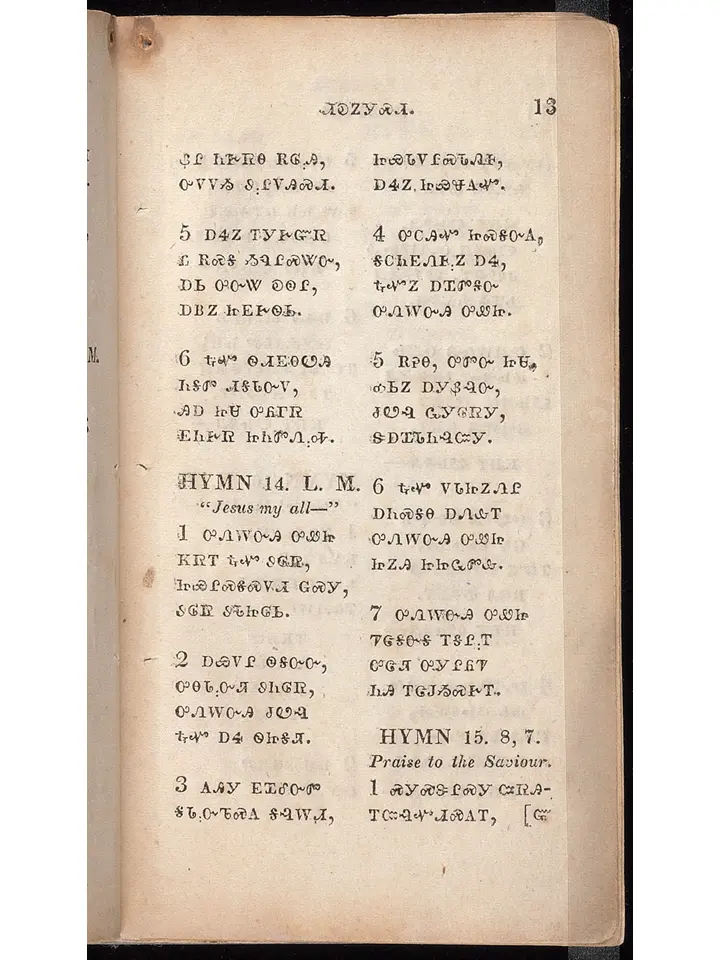
Look Closely: The picture at the top is a print made from a portrait painted in 1828, while Sequoyah was alive. Look closely at the details the artist included. Sequoyah is pointing to a chart of his syllabary. Around his neck hangs the silver medal the Cherokee Nation gave him. Now look at the flip card. It shows a page from a Cherokee hymn book printed with Sequoyah’s symbols. What do these details tell you about what Sequoyah was most proud of? Why do you think the artist made the syllabary chart so easy to see?
Growing Up Cherokee
Sequoyah was born around 1770 in the Cherokee town of Tuskegee, in what is now Tennessee. His mother was Cherokee, and his father was probably a white trader. Sequoyah was raised by his mother in the Cherokee way. He had an injured leg and walked with a limp, so he spent much of his time making things with his hands. He became a skilled silversmith and blacksmith.
“Talking Leaves”
Sequoyah noticed that white settlers could send messages on paper. He called their writing “talking leaves.” Many Cherokee people believed writing was something only white people could do. Sequoyah disagreed. He believed the Cherokee language could be written too. During the Creek War of 1813–1814, he fought alongside American soldiers. Unlike them, he and the other Cherokee soldiers could not write letters home or read orders. That made him even more determined.
Years of Hard Work
At first, Sequoyah tried to make a picture for every word. He soon had thousands of pictures and realized there were far too many to remember. Then he had a better idea. He listened carefully and noticed that all Cherokee words were built from a smaller number of sounds, or syllables. He made one symbol for each syllable. Some of his neighbors thought he was wasting his time or even practicing witchcraft. Still, he kept working for about twelve years.
Proving It Worked
By 1821, Sequoyah had finished his syllabary. It had 86 symbols. To prove it worked, he showed the Cherokee leaders a test. His young daughter, Ayoka, was sent out of the room. The leaders told Sequoyah words to write down. When Ayoka came back, she read the words aloud perfectly. The leaders were amazed.
A Nation Learns to Read
Because each symbol stood for a sound the Cherokee already knew, the syllabary was easy to learn. Many people learned to read in just a few days or weeks. Within a few years, thousands of Cherokee could read and write in their own language. In 1828, the Cherokee Nation began printing a newspaper called the Cherokee Phoenix, in both Cherokee and English. The Cherokee Nation honored Sequoyah with a silver medal.
Hard Times for the Cherokee
Sequoyah moved west to Arkansas and later to Indian Territory, in present-day Oklahoma, where he joined a group called the Western Cherokee. In 1838 and 1839, the U.S. government forced the Cherokee living in the East to leave their homes and walk west to Indian Territory. Thousands died on this terrible journey, which became known as the Trail of Tears. Sequoyah helped bring the Eastern and Western Cherokee together as one nation again.
Sequoyah’s Legacy
Sequoyah died around 1843 while traveling in Mexico to find a group of Cherokee who had moved there. He is one of very few people in history to create a complete writing system on his own. Today, the Cherokee syllabary is still used in books, signs, schools, and even on phones and computers. A statue of Sequoyah stands in the U.S. Capitol.
Word Match
Drag each word to its definition, or tap a word and then tap its definition.