Build a Pueblo
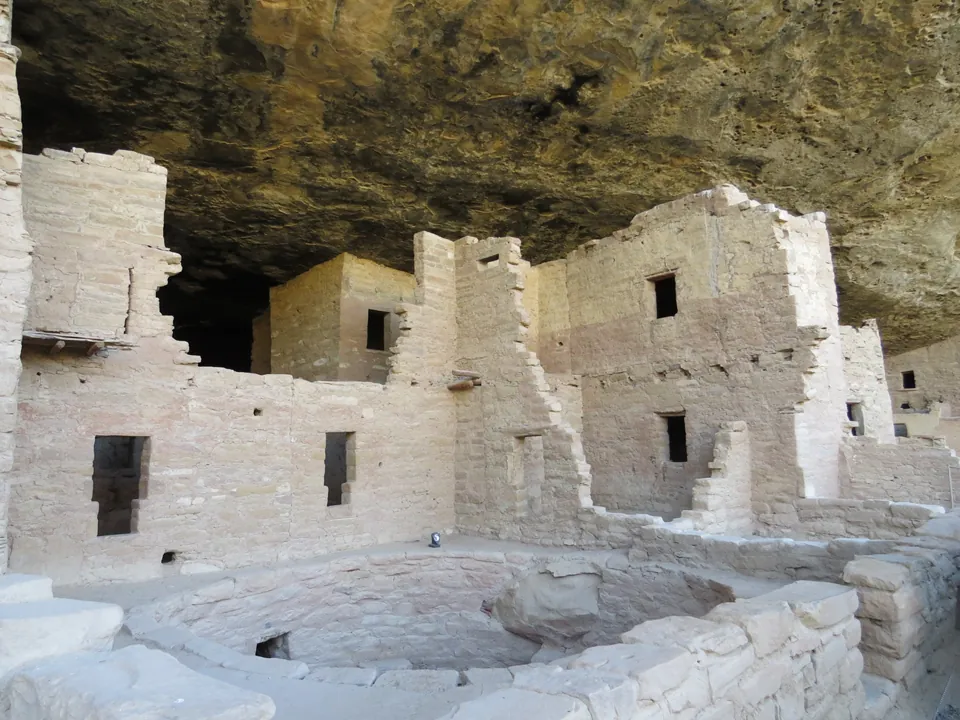
The Spanish word pueblo means "town." When Spanish soldiers came to the Southwest in 1540, they found towns where hundreds of people lived in buildings several stories high, with rooms stacked like blocks. Pueblo builders made thick walls of adobe, bricks of mud and straw dried in the sun, or of stone held together with mud. Each upper story was set back from the one below, so the roof of one room became a porch, or terrace, for the room above.
Doors in the Roof
Long ago, ground-floor rooms had no doors in the walls. People climbed ladders and went in through a hole in the roof. If enemies came, families pulled the ladders up, and the pueblo became a fortress. Thick adobe walls kept the rooms cool on hot days and warm on cold nights.

Design Your Pueblo
Each square is one room. Build Level 1 first. A room on an upper level must sit on top of a room below it.
Floor plan: Level 1
Builder's Challenges
- Build at least 3 levels.
- Step it back: each level has fewer rooms than the level below it.
- Every upper level leaves a terrace (open roof) on the level below.
- Place a ladder up to every level, touching a room on that level. (Level 1 needs one from the ground!)
The Math in Your Pueblo
Look at the floor plan for each level. Each square is one room, so the area of a level is the number of squares it covers. The perimeter is the distance around the outside edge of that level, counted in square sides. Find the area and perimeter of each level, then check your answers.
| Level | Area (rooms) | Perimeter (units) |
|---|
Hint: To find the perimeter, count every edge of a room that does not touch another room on the same level.
Think About It
- Why would a pueblo with ladders and doors in the roof be easy to defend?
- Your top level has the smallest area. Why did Pueblo builders step each level back instead of building straight up like a tower?
- Pueblo rooms shared walls with the rooms next to them. How would shared walls help keep everyone warm in winter?
- Two pueblos can have the same area but different perimeters. Build one that is long and thin, and one that is close to a square. Which has the longer perimeter? Which would need more adobe for its outside walls?
Build a Paper Pueblo
Materials
- small boxes, or sugar cubes and glue
- brown or tan paint, or brown paper
- toothpicks or craft sticks for ladders and roof beams
- graph paper and a cardboard base
Directions
- Plan your pueblo on graph paper, one level at a time. Each square is one room. Each upper level must be smaller and set back.
- Find the area and perimeter of each level.
- Build Level 1 from boxes or cubes. Glue the next levels on top, stepping each one back.
- Paint the pueblo the color of adobe. Glue toothpicks along the tops of the walls for roof beams, called vigas.
- Make ladders from toothpicks or craft sticks and place them so people can climb to every roof.