Shades of Meaning

Anchor Charts, Activities & Resources


Understanding shades of meaning helps students grasp the subtle differences between similar words, enhancing vocabulary and comprehension. These activities help students express themselves more precisely and understand texts more deeply.

Shades of Meaning Anchor Chart

Shades of Meaning Anchor Charts

Two examples of how quickly you can create an effective anchor chart with simple graphics. Both relay the message, but the second — with better clipart and bolder visuals — is the classroom display students notice and talk about.

Shades of Meaning Anchor Chart version 1
Shades of Meaning Anchor Chart version 2

Teaching Ideas & Activities

Teaching Idea 1

Shades of Meaning Color Word Wall

One of the most effective ways to introduce shades of meaning is through different shades of color. The color word wall makes this concept concrete and visual.

Activity

Print all the words for various shades of one color — for example, midnight blue, cobalt, indigo, Duke blue, federal blue, Yale blue, denim, oxford blue, sky blue, and azure. Have students organize these from the darkest shade to the lightest. Then use this as an analogy: just as colors can be arranged from stronger to milder, many words can be ordered by the intensity of their meaning.

Teaching Idea 2

Synonyms and Antonyms Chart — Synonym Gradient

Synonyms and Antonyms Chart

Create a chart listing common words alongside their synonyms and antonyms. This helps students see the full range of meanings and understand how to choose the best word for their writing.

Synonym Gradient Activity

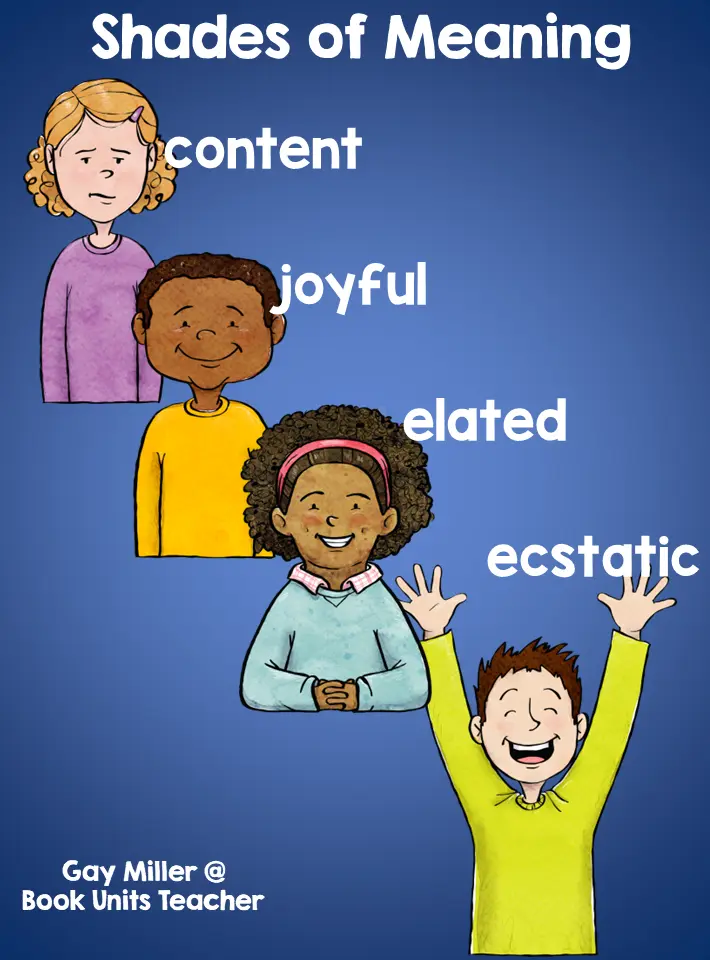
Select a common word like "happy." List synonyms: content, pleased, joyful, elated, ecstatic. Have students arrange these in order of intensity from mildest to strongest. This visual activity makes the gradient of meaning tangible — students can see how the same emotion ranges from quiet satisfaction all the way to overwhelming delight.

Teaching Idea 3

Contextual Sentences — Sentence Transformation

Contextual Sentences Activity

Providing sentences that use synonyms with different shades of meaning gives students practice choosing words that fit the tone and context of a piece of writing.

Sentence Transformation Activity

Shades of Meaning in Description

Objective: Help students see how synonyms shift tone, mood, and imagery in writing.

Warm-Up:

Display the emotion ladder image with the words: content, joyful, elated, ecstatic. Briefly review how each word shows a different intensity of feeling.

Then introduce a neutral sentence:

"The sky was dark."

Ask students to rewrite the sentence using different synonyms, such as:

  • dim
  • gloomy
  • shadowy
  • murky
  • pitch-black

Discuss how each word shifts the tone and mental image of the sentence. For example, dim might feel calm, while pitch-black feels more intense or scary.

Guided Practice

Have students choose one version of the sentence and expand it into a short paragraph. Encourage them to add sensory details that match the tone of their chosen word.

Example:

"The gloomy sky pressed down on the playground, and the swings creaked in the wind."

Ask students to share a few sentences or paragraphs and briefly discuss which word choices made the mood strongest or most vivid.

Extension Ideas

  • Intensity Ladder: Ask students to rank the sky words from least intense to most intense, just like content, joyful, elated, ecstatic.
  • Contrast Writing: Give a neutral idea (for example, "The room was quiet.") and have students write one positive version and one negative version using different synonyms.
  • Quick Group Challenge: In small groups, give each team a neutral sentence and have them rewrite it with the most dramatic tone shift they can create.

Teaching Tip: This activity works well as a quick warm-up, a writing workshop mini-lesson, or a small-group vocabulary lesson focused on shades of meaning.

Teaching Idea 4

Word Ladder Game

Word Ladder Activity

A word ladder is a visual tool where each rung represents a word with a slightly different shade of meaning — students can literally see the intensity increase as they climb.

Word Ladder Activity

Shades of Meaning: Temperature Words

Objective: Help students understand how temperature-related synonyms show different levels of intensity.

Warm-Up:

Display the temperature ladder image with the words: chilly, cool, cold, frosty, frigid, icy. Explain that each rung represents a step in how intense the cold feels.

Introduce a base word:

"cold"

Ask students to think about how each word on the ladder feels slightly different:

  • cool – a little cold, often comfortable
  • chilly – a bit colder, maybe needs a light jacket
  • cold – clearly not warm, needs a coat
  • frosty – very cold, like early winter mornings
  • frigid – extremely cold, harsh and biting
  • icy – freezing cold, like ice or snow

Guided Practice

Give students a blank ladder on paper or the board. Have them place the words from the image in order from least intense to most intense. Encourage them to talk through their choices with a partner.

Then, ask students to write a sentence using one of the words that matches its intensity. For example:

"A frigid wind whipped across the playground, stinging our faces."

Partner Game

  • Call and Place: One student calls out a word from the ladder (for example, chilly or icy), and the other student points to or marks the correct rung on a class ladder chart.
  • Justify the Choice: The student who placed the word explains why they chose that rung: “I put chilly near the bottom because it’s only a little cold, not freezing.”

Repeat with several words so students get comfortable comparing intensity and explaining their thinking.

Teaching Tip: This activity works well as a vocabulary warm-up, a small-group lesson on shades of meaning, or a quick review before descriptive writing.