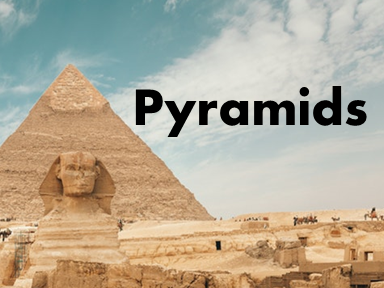
Ancient Egypt Art
On the walls of the pyramids are pictures. They show scenes from every action of life. Some are of people having fun, working, and worshipping. The scenes show everything from children playing leap frog to workers cutting grain. Cattle grazing and monkeys picking figs can be seen in some of the scenes.
Much of the art shows figures that are part-human and part animal. They represent the gods and goddesses.
Egyptian Symbols
-
The Anhk - represented the power of the sun god - Egyptians believed that carrying it was good luck.
-
Taweret - goddess with a hippopotamus head, lion limbs, and big belly - protector of pregnant women and babies
-
Kephri - scarab beetle which pushes a ball of dirt - stood for the way life started - the ball of the sun being pushed into the world.
-
Aten - way of drawing the sun god - it has hands and ankhs to bring life to everyone.
-
Apophis - fancy snake - thought to eat up the sun when it disappeared every evening.
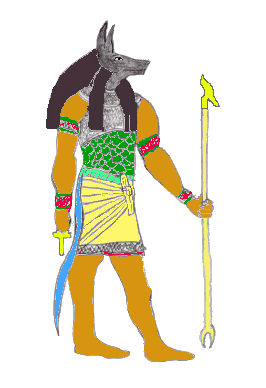
Anubis - jackal-headed god - helped people move into the afterlife when they first die.
Craftsmen
Craftsmen made pottery. They used a wheel to make bowls, platters, jugs, jars, and small cosmetic pots. Some had handles. Others did not.
Basket Weaver - Basket makers worked in the marshes. They cut papyrus reeds that were six to eight feet tall. The men cut the stalks and tied them into bales. The stalks were then sorted by size. The outer rind of the reeds was woven into baskets, ropes, clothes, bedding, floor mats, and even combs. The long flexible stalks were made into papyrus skiffs.
Paper Maker - To make paper the papyrus stems were cut lengthwise into very narrow strips. They were then flattened with a wooden mallet. Next strips were placed side by side to form a solid sheet. The first layer ran horizontally. Next a second layer was placed on top running vertically. The papyrus was covered with a layer of linen. The pieces were pounded. This made the sap escape from the papyrus. The sap worked as a glue to stick the stripes together. When this dried pieces of papyrus were glued to other sheets with resin to form a scroll.
Carpenter - Cedar, cypress, and juniper were used to build furniture, sturdy boats, statues, coffins, and supporting structures of the pyramids. Carpenters knew how to inlay ivory, stone, or glass to decorate chests or caskets. The strong woods had to be imported from Lebanon and Syria. The native trees of sycamore and palm were of low quality. This made owning wooden objects a luxury for the rich.
Sculptors - Sculptors worked with copper and bronze. They were experts at cutting and carving stone. They used basic tools made of wood, flint, stone, copper, or bronze. They polished the statues with sand. Sculptors carved details with pointed tools. Some of these statues were huge. They represented the gods and goddesses as well as rulers and nobility. Some statues were of ordinary men and women in family scenes. There were even statues of animals.
Painters - The walls and ceilings inside the temples were painted. Some were even gold-covered. The painters added details to the statues after the sculptors were finished.
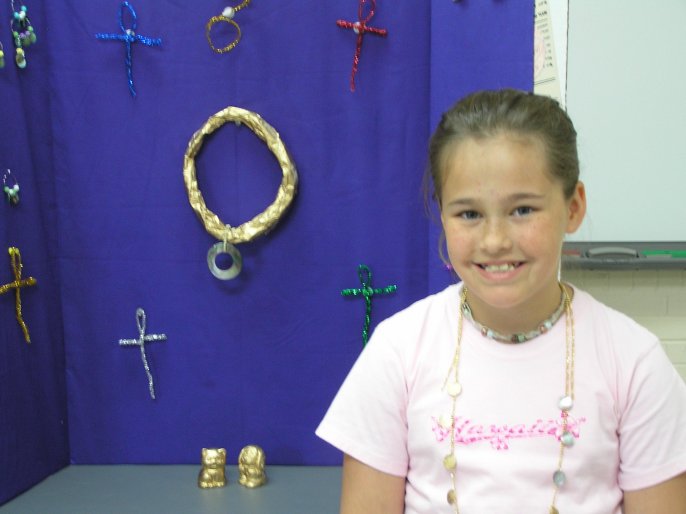
Jewelers - Turquoise, white ivory, green malachite, and dark blue lapis lazuli were used by the jewelers. They melted gold to make beautiful jewelry. They made headbands, earrings, necklaces, bracelets, and rings.
Click the images to go to the individual pages.