Time-Twisted Words: Vocabulary That Shifted

Vocabulary-Games

Some words don’t just change spelling; they flip their meaning entirely. These time‑twisted vocabulary words fascinate students because they reveal how language evolves. Awful once meant “full of awe.” Silly used to mean “blessed.” Nice was an insult. Language evolves, and students love discovering how.

That’s why I created a vocabulary game that works with any word list, including words that have changed in meaning over time. Whether you’re teaching etymology, tone, or just having fun with language, this Scramble-style activity makes vocabulary practice feel like play.

Visit all the posts in this series.

Time‑Twisted Vocabulary Words

Vocabulary That Did a 180

Each of the following time-twisted vocabulary words includes both then and now definitions, along with a brief origin story, to keep things authentic and engaging.

Word Then Now Story
clue a ball of yarn (clew) a hint or piece of evidence In Greek mythology, Theseus used a thread to escape the labyrinth. The metaphor stuck.
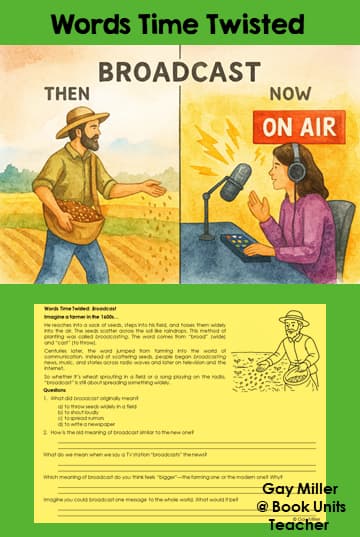
broadcast to scatter seeds by hand to transmit information widely Farmers “broadcast” grain—later used to describe radio and TV signals reaching many people.
egregious remarkably good, standing out shockingly bad From Latin *ex grege* (“out of the flock”)—once a compliment, now a criticism.
artificial skillfully made, artful fake or unnatural Originally praised for craftsmanship—now often implies cheap imitation.
bachelor a young knight-in-training an unmarried man From chivalry to relationship status—later adopted by universities for first-degree students.

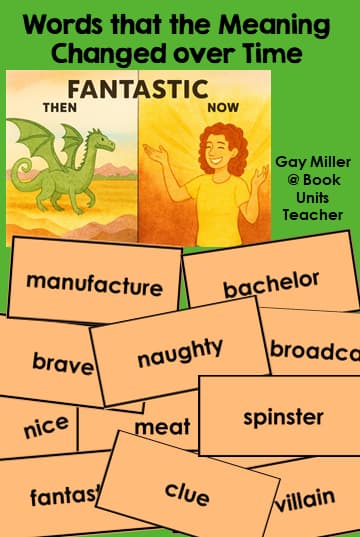
Want more time-twisted words? Download the free handout for 18 examples with classroom tips and printable cards.

Time‑Twisted Vocabulary Words Classroom Ideas

Want to stretch the learning even further? Try these:

  • Use the game with a themed word list (e.g., “Words That Time Twisted”)
  • Create a “Word of the Week” box and track how meanings shift over time
  • Challenge students to write a short story using both versions of a word
  • Use the spinner prompts to explore grammar, tone, and figurative language

Vocabulary Game: Twist Words into Play

This Scrabble-inspired vocabulary game adds a twist—perfect for practicing “Words Time Twisted” or any custom word list you choose. Instead of starting with a secret set of seven letters, students can use any letter from the board to build their words. Large stacks of draggable letters make setup easy and gameplay smooth.

Teachers provide the word list – whether it’s quirky vocabulary from your novel study, essential terms from science or history, or time-twisted words like broadcast, villain, and fantastic. Students build words on the board and use the embedded video spinner to determine what they must share before placing a word:

  • Definition
  • Synonym
  • Antonym
  • Syllable count
  • Sentence use

This free Google Slides activity works well for upper elementary and middle school students, whether they’re in the classroom or working remotely. It’s a playful way to reinforce vocabulary, deepen understanding, and spark curiosity about how words evolve.

Want to try it with your own vocabulary list? Just sign up below and the game’s yours!

Free Interactive Vocabulary Practice Game for Google Slides

Join Our Mailing List!


By joining the mailing list, you will receive a weekly email highlighting free resources and notifying you of special events.

You’ll also receive the fun Google Slides Scrabble game just for signing up.

 10 Time‑Twisted Vocabulary Words Practice Ideas

Students can research original meanings, compare tone shifts, or write short stories using both old and new definitions. It’s a great way to blend history, language, and creativity.

Then & Now Sort

  • Create word cards with the old meaning on one side and the modern meaning on the other.
  • Students sort them into two columns: “Past Meaning” and “Modern Meaning.”
  • Extension: Challenge them to connect the old meaning to how it shifted.

Context Clue Time Travel

  • Provide short sentences using the “old” meaning in historical-style passages.
  • Students guess what the word means in that context, then compare with today’s meaning.
  • Example: “The farmer broadcast seeds in the field.” → not about TV!

Debate or Discussion

  • Pick words like egregious, artificial, brave, nice, silly.
  • Have small groups discuss: “Which meaning is more powerful or useful — the old or the new?”
  • This builds argumentation skills and vocabulary ownership.

Rewrite a Sentence Challenge

  • Give students a modern sentence with one of the words.
  • Their task: rewrite it so it makes sense with the old meaning.
  • Example: Modern: “He is a brave firefighter.” → Old: “He wore a brave, glittering suit.”

Mini Skits

  • In pairs, students act out one meaning of a word.
  • The class guesses: “Old meaning or modern meaning?”
  • Works especially well with awful, broadcast, clue, villain, spinster, silly.

Word Histories Journal

  • Students pick one word each week and research how its meaning shifted.
  • They write a short entry: definition, example, why the shift might have happened.
  • You can scaffold with a chart or sentence stems.


Words Time Twisted Printables

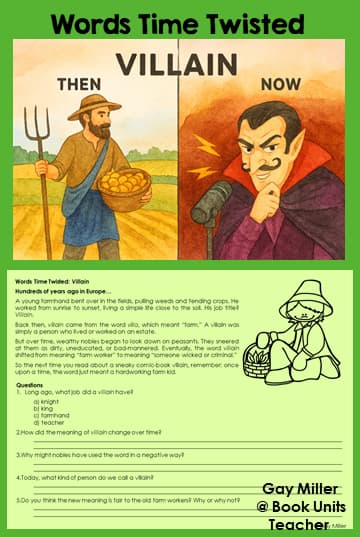
Discover how everyday words once had very different meanings with these Words Time Twisted mini-stories. Each one blends a bit of history with engaging questions to spark student curiosity. Want ready-to-use materials? The set, which includes three printables with teacher instructions and answer keys, can be found in the handout.

Vocabulary Game: “Back in My Day…”

  • Teacher calls out a word (e.g., nice).
  • One student gives the modern definition, another student gives the historical one.
  • If they can both explain correctly, their team gets a point.

Etymology Detective

  • Give students clues about a word’s origin (e.g., Latin root, historical usage, cultural shift).
  • They research and present a mini “word biography.”

Flip-a-Word Bulletin Board

  • Display a rotating “Word That Changed” with its old and new meanings, student sentences, and illustrations.
  • Encourage students to nominate new words each week.

Want more time-twisted vocabulary words? Download the free handout for 18 exampels with classroom tips and printable cards.

Check out the full collection here:

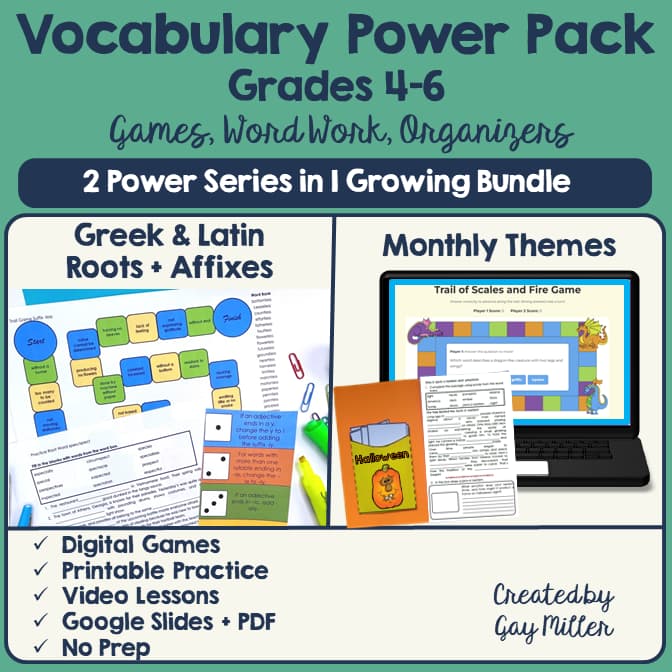
Vocabulary Activities Bundle Grades 4–6 | Games, Word Work, Roots, Monthly Theme

Yearlong Vocabulary Practice Growing Bundle Printable & Digital Grades 4–6

Gay Miller

Permanent link to this article: https://bookunitsteacher.com/wp/?p=8514