Ever tried explaining the difference between reptiles and amphibians, or helping students sort out which characters in a novel are brave vs. sneaky vs. downright confusing? If you’ve watched your kids’ notes turn into doodles of dragons instead of actual connections, it might be time to pull out a Semantic Feature Analysis (SFA) grid.
Fancy name, simple idea: it’s just a chart that helps students see relationships between topics. Instead of juggling random facts in their heads, kids place them in a neat grid and—voilà—patterns start to pop. Think of Semantic Feature Analysis as the spreadsheet of student thinking (but way more fun). It helps learners visually organize how topics relate to each other. The result? Clearer connections, better predictions, and fewer blank stares when you say “compare and contrast.”
Semantic Feature Analysis gives students a visual way to organize information, spot patterns, and make meaningful comparisons. It’s one of those simple strategies that quietly strengthens comprehension across almost every reading lesson.
By the end of this lesson, students will be able to:
use Semantic Feature Analysis (SFA) to compare and contrast related concepts
identify similarities and differences using a visual matrix
analyze vocabulary, characters, and genre features using SFA
interpret patterns that emerge from the grid
use SFA as a comprehension tool across subjects
discuss findings and make predictions based on feature relationships
⭐ Mini‑Lesson: What Is Semantic Feature Analysis?
Semantic Feature Analysis (SFA) is a visual strategy that helps students organize information and see relationships clearly. Instead of juggling random facts, students place items in a grid and evaluate whether certain features apply. Patterns begin to emerge — and suddenly, comparing and contrasting becomes concrete and manageable.
Explain to students that SFA:
organizes information visually
highlights similarities and differences
supports deeper comprehension
works for vocabulary, literature, science, and social studies
turns abstract thinking into a logic‑puzzle‑style activity
Model the basic structure:
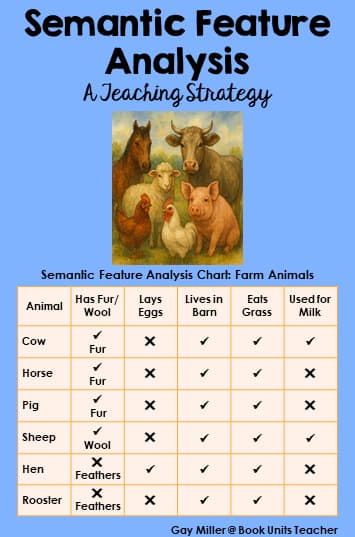
Items or vocabulary words go down the left side,
Features go across the top.
Students mark each box with +, –, A/S/N, or emojis.
The completed matrix becomes a springboard for discussion.
This quick demonstration helps students “get it” within minutes.
The printable handout includes three ready‑to‑use SFA activities:
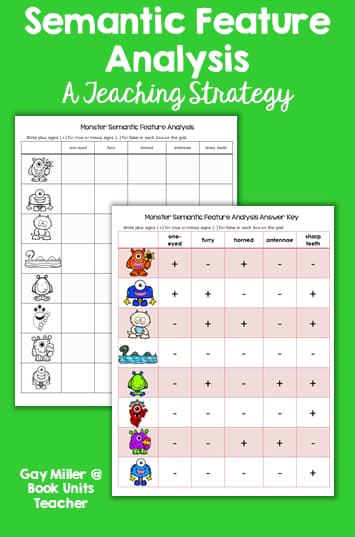
Monster Semantic Feature Analysis — a fun, low‑stakes introduction
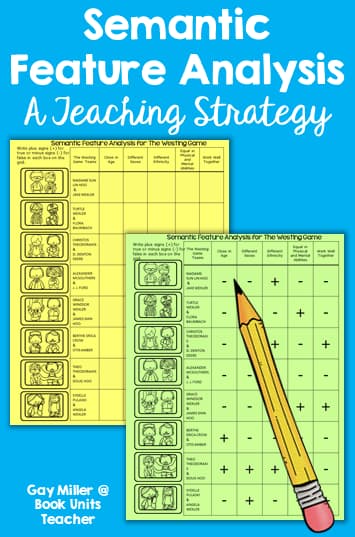
The Westing Game Teams — analyze character traits and predict outcomes
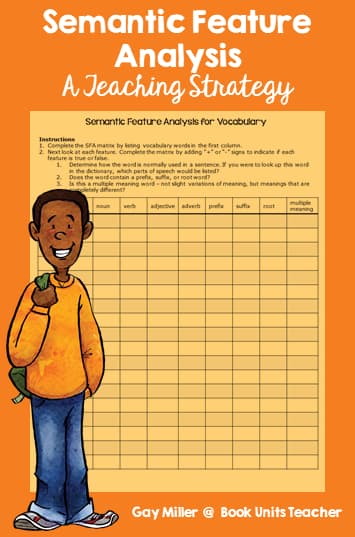
Vocabulary Matrix — explore parts of speech, affixes, roots, and multiple meanings
Each activity includes a blank version and an answer key.
Students begin with a playful warm‑up using cartoon creatures. They analyze features such as:
horns
fur
antennae
sharp teeth
number of eyes
This introductory activity helps students understand how the matrix works before applying the strategy to academic content. It’s high‑engagement, low‑pressure, and perfect for modeling.
Activity 2 — The Westing Game Teams
Students use SFA to compare character pairs from The Westing Game. Features include:
same age
different gender
different occupation
work together
Students mark the grid, look for patterns, and predict which teams have the traits needed to succeed. This activity strengthens comprehension, inference, and text evidence skills.
Activity 3 — Vocabulary Semantic Feature Analysis
Students analyze vocabulary words using features such as:
noun / verb / adjective / adverb
prefix
suffix
root
multiple meanings
This activity helps students break down word structure, identify parts of speech, and understand how words function in sentences. It’s ideal for tier‑two vocabulary and test prep.
⭐ Teacher Information
Differentiation
Begin with concrete features (color, size, physical traits).
Reduce the number of features.
Use checkmarks instead of symbols.
Complete full matrices independently.
Compare two completed matrices.
Discuss patterns and predictions.
Create their own SFA charts.
Analyze abstract features (motivation, theme, purpose).
Apply SFA to paired texts or research topics.
Common Misconceptions
Students may:
think every feature must apply to at least one item
confuse “sometimes” with “always”
treat the matrix as a fill‑in‑the‑blank instead of a thinking tool
forget to use the matrix during discussion
Modeling and guided practice help clear these up quickly.
Teacher Tips
Build one matrix together on the board before independent work
Use emojis (✔️, ❌, 🤔) for younger learners
Encourage students to explain why they marked each box
Use SFA during literature circles, vocabulary lessons, or science classification
Pair SFA with writing tasks (“Explain the patterns you noticed…”)
Free Handouts to Try
🆓 Free Handouts to Try
This free download includes three activities:
Basic SFA Matrix – Use as a whole-class model or independent practice.
The Westing Game Teams – Analyze character traits and predict outcomes.
Vocabulary Grid – Apply to any word list for grammar and meaning analysis.
Each activity includes a blank version and an answer key, so you can teach, not troubleshoot.