If you’re looking for City of Ember teaching ideas, Jeanne DuPrau’s dystopian adventure is an excellent choice for exploring problem‑solving, courage, and the consequences of a society built on limited resources. Students are immediately drawn into the mystery of a failing underground city and the determination of two young protagonists who refuse to accept that darkness is their destiny.
Reading Level
Lexile 680L
Interest Level
Grades 3-7
Length
144 pages
Award
ALA Notable Children’s Book
Jump to Section
⭐ About the Book
The City of Ember takes place more than two hundred years in the future, deep underground, where the Builders created a city meant to sustain human life when the surface world became unsafe. But Ember is dying. The lights flicker more often, blackouts last longer, and supplies are running dangerously low. Outside the city lies only darkness, known as the Unknown Regions, making escape seem impossible.
Lina Mayfleet discovers a tattered set of instructions she believes could lead the people of Ember to safety. Unfortunately, her baby sister chewed holes in the paper, leaving only fragments of the message intact. Lina and her friend Doon Harrow team up to decode the damaged instructions, racing against time as Ember’s power failures worsen and the corrupt mayor hides valuable supplies for himself.
Together, Lina and Doon uncover long‑buried secrets, face dangerous obstacles, and push beyond the limits of what they’ve been taught to believe.
⭐ Book Details
| Publication Date | May 31, 2003 |
| Reading Level | Lexile 680L • Scholastic Guided Reading Level W |
| Interest Level | Grades 3–7 (Age Range 8–12) |
| Major Awards | 2009 ALA Notable Children's Book |
| Length | 144 pages (approx. 107,360 words) |
| Estimated Reading Time | About 7 hours and 9 minutes (at 250 words per minute) |
| Audiobook Length | 7 hours, 6 minutes |
| Genre | Doomsday dystopia |
| Setting | Underground city — Our world, 200+ years in the future |
| Point of View | Third person, limited omniscient |
| Themes | Friendship • Greed • Family • Dreams • Power |
| Memorable Quote | “The trouble with anger is, it gets hold of you. And then you aren't the master of yourself anymore. Anger is. And when anger is the boss, you get unintended consequences.” |
| First Line | “When the city of Ember was just built and not yet inhabited, the chief builder and the assistant builder...” |
The City of Ember Activities
Book Unit Samples
This sample contains all activities for Chapters 3-4 including:
- vocabulary practice
- comprehension questions
- constructed response questions on perspective
- foods in Ember
- direct quotations
- answer keys
Teaching Idea #1 ~ Moth Life Cycle Craft
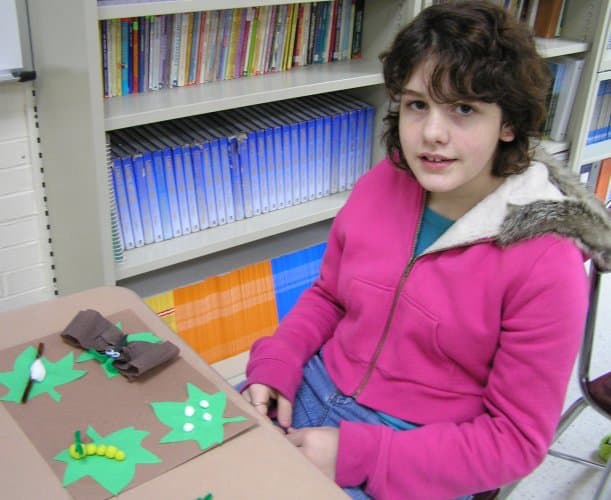
The author, Jeanne DuPrau, includes a storyline about Doon finding a caterpillar that turns into a moth. Our students created the life cycle of a moth as part of this integrated science-art project.
Students built each stage of the life cycle on a die-cut leaf.
- caterpillar -pompoms and a pipe cleaner
- eggs and larvae – cotton balls and pipe cleaner
- butterfly – crepe paper streamers and a construction paper body with wiggly eyes
Teaching Idea #2 ~ Pineapple Treat
Granny remembers eating pineapple as a special treat when she was a young girl. Students created this pineapple treat with Twinkie’s Hostess Cakes, vanilla pudding, pineapple, cherries, and whip cream.
Teaching Idea #3 ~ Lina’s Dream City
Students had a lesson on perspective drawing as they created cities from Lina’s dreams. Their finished drawings were colorful and made a great display.
Teaching Idea #4 ~ Character Maps
Students really enjoyed this character mapping activity.
First, each student selected a character from the novel. Next, students drew pictures of the characters. To quickly turn the drawings into digital images, we took pictures of the drawings using a digital camera.
To create the character maps, students used the SmartArt template in PowerPoint. This template can be found under the “Relationship” section in SmartArt. The template was formatted by adding an additional shape. Students changed the circles to rounded rectangles. Next, students selected a color for their maps. The middle rectangle was filled with the jpg of the drawing.
Finally, students typed five character traits in the “bubbles” around the characters. Creating these maps was both fun for students and a great learning exercise.
This activity not only covers several Common Core Literature Standards, but it also taught students how to create a graphic in PowerPoint. This knowledge can be used again when building visual displays for presentations.
Teaching Idea #5 ~ Bulletin Board Idea
Create a “Growing Bulletin Board” that develops alongside your class’s reading of The City of Ember. Start with a mostly empty board, then add pieces as students uncover new information in the story.
What to add as the novel progresses:
Character Drawings & Descriptions
Students sketch characters and add short notes about traits, motivations, and changes.
Vocabulary Words
Post new words as they appear in the text. Encourage students to add definitions or illustrations.
Memorable Quotes
Let students choose lines that feel important, mysterious, or meaningful and add them to the board.
Student Questions
As students read, they write questions they hope the novel will answer. These can be revisited later.
Emberite Jobs
Create a section listing the different jobs in Ember as they are revealed in the story.
This interactive board becomes a visual timeline of learning, helping students track characters, themes, and world‑building while keeping engagement high.
Teaching Idea #6 ~ Story Map and More
This free printable includes 7 half-pages. The City of Ember Story Map asks students to write about a number of topics from the book, including the theme, characters, point of view, setting, etc.
See the product that inspired this post.
The City of Ember Novel Study includes vocabulary practice, comprehension questions, constructed response writing, and skill practice.