Some word pairs aren’t true homophones, but they’re close enough in sound and meaning to trip up even strong writers. Words like advice/advise, conscious/conscience, and effect/affect show up in student writing all year long, and they’re often confused because they sound similar, look similar, and sometimes even function similarly. Instead of teaching these pairs through long lists or isolated drills, I’ve found that students learn them best through active, playful, high‑engagement practice. Below are homophone activities I use to help students master six of the most commonly confused near‑homophone pairs:
-
- Advice / Advise
- Conscious / Conscience
- Elicit / Illicit
- Emigrate / Immigrate
- Desert / Dessert
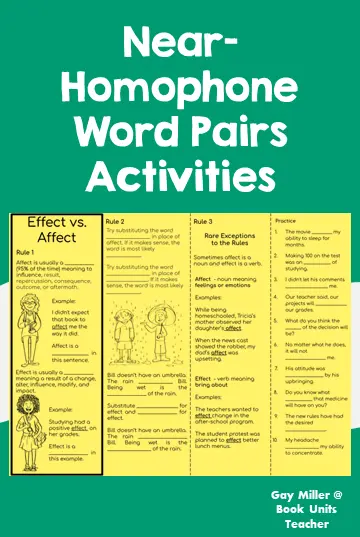
- Affect / Effect
These activities work beautifully in centers, small groups, partner practice, or whole‑class games.
Looking for ways to help your students master these tricky word pairs? Here are three print-and-go handouts and three zero-prep games your class will love!
Looking for ways to help your students master these tricky word pairs? Be sure to download the free lesson handout, which includes the activities and printables from this post.
Near-Homophone Activities
Step 1 — Start with an Organizer
Before students jump into games, sorting, or proofreading, they need a clear reference sheet. I begin with a simple organizer where students complete:
- Pronunciation guides
- Definitions
- Quick tips or memory hooks
- Sample sentences
This organizer becomes their anchor for the rest of the unit. Students refer back to it constantly — especially when proofreading their own writing.
Activity #1 — “Sound It Out” Word Sort
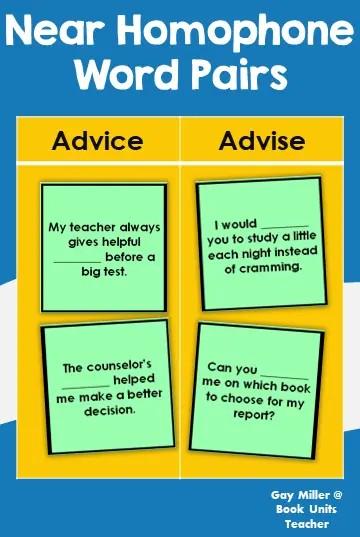
This activity helps students connect pronunciation to meaning, which is essential for pairs like advice/advise or desert/dessert.
How It Works
Create a printable worksheet with two columns labeled by sound, such as:
- Advice /s/
- Advise /z/
or
- Desert /DEZ‑ert/
- Dessert /dih‑ZERT/
Provide students with the bank of short cloze sentences found in the handout. Each sentence has a blank where one of the two words belongs.
The Game Element
Students:
- Read each sentence aloud.
- Listen for the pronunciation clue.
- Sort the sentence into the correct “Sound Bucket.”
- Glue or place the sentence under the correct column.
Teaching Tip
- Begin with individual sets for focused practice.
- Once students are confident, combine all six pairs into a mixed review deck. This is perfect for centers or partner sorting.
Activity #2 — Online Homophone Activities
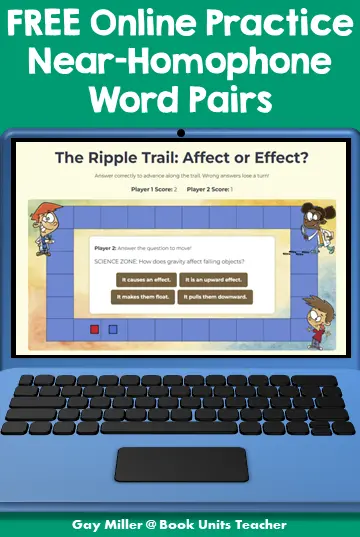
Students LOVE digital practice, especially when it feels like a game. Here are three interactive ways they can strengthen their understanding of troublesome word pairs:
1. The Ripple Trail: Affect or Effect
This self‑checking trail game (hosted right here on Book Units Teacher) reinforces the difference between affect (verb) and effect (noun) through a fun, visual path students follow. They get instant feedback, which helps them self‑correct quickly and stay engaged.
2. Google Slides Organizer (Affect vs. Effect)
If students need a quick refresher before playing, they can review the digital organizer. It walks them through pronunciation, definitions, and sample sentences. This is perfect for warm‑ups or independent practice.
3. Boom Learning Deck (Affect vs. Effect)
This 30‑slide Boom Deck gives students additional practice with immediate feedback. It’s fast‑paced, self‑checking, and ideal for centers or early finishers.
Links for the Google Slides and Boom activities are included in the handout.
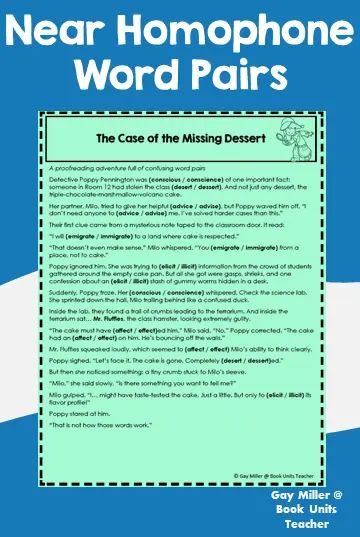
Activity #3 — “The Case of the Missing Dessert” Proofreading Mystery
Create a T‑chart labeled Formal and Informal. Ask students to brainstorm texts or situations that belong in each column. You can start with a list like:
- Possible formal situations/texts:
- legal documents
- reports
- talking to superiors
- informational pamphlets
- public speaking
- Possible informal situations/texts:
- personal emails
- social media posts
- text messages
- conversation with friends
- advertising (depending on tone)
⭐ Zero‑Prep Classroom Games
These quick games require no printing and no setup — just your voice and your students’ energy.
🎉 Stand Up / Sit Down Pronunciation Battle
How It Works: Assign one movement to Word A and another to Word B.
Examples:
- Stand up for advice /s/.
- Sit down for advise /z/.
or
- Touch your nose for elicit.
- Tap your head for illicit.
The Game Element: You read a sentence aloud (or just the definition). Students must react instantly with the correct movement. It’s fast, funny, and surprisingly effective.
🎭 “Act It & Say It” Partner Charades
How It Works: Partner A receives a word pair (e.g., desert/dessert or conscious/conscience).
The Game Element: Partner A acts out one of the words using exaggerated gestures:
- wiping sweat → desert
- rubbing tummy happily → dessert
- looking around alertly → conscious
- holding heart dramatically → conscience
Partner B must guess the correct word and pronounce it correctly before switching roles.
⏱ The 60‑Second Sentence Sprint
How It Works: Write a word pair on the board (e.g., affect/effect or emigrate/immigrate).
The Game Element: Groups have 60 seconds to write one silly, grammatically correct sentence using both words correctly.
Example:
“The bad weather will affect our plans, but the effect will just be more video games.”
Groups read their sentences aloud, and the class votes on the funniest or most creative.
⭐ Why This Approach Works
Students learn troublesome word pairs best when they:
- Hear them.
- Say them.
- Sort them.
- Act them out.
- Use them in context.
- See them in stories.
- Apply them in their own writing.
This multi‑modal approach builds confidence and retention, and it makes grammar genuinely fun.
Check out the full collection here:
Vocabulary Activities Bundle Grades 4–6 | Games, Word Work, Roots, Monthly Theme

2 comments
Fabulous grammar help
Author
Thank you