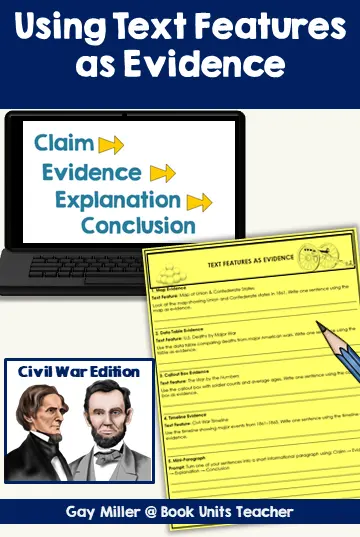
Text features are powerful tools that help students understand nonfiction. Maps, charts, timelines, tables, and callout boxes give readers quick access to information. They also provide strong evidence students can use in informational writing.
This lesson uses a Civil War magazine‑style page filled with real maps, data tables, timelines, and historical facts. Students learn how to read these features and turn them into clear, accurate evidence.
Grade Level4th–6th
Skill Focus Text Features
Activities3
FormatPrintable & Video
Jump to
Informational Text
Understanding how to read graphic organizers is a foundational skill for informational text. When students know what each organizer represents, such as relationships, comparisons, sequences, causes, or categories, they can interpret information more accurately and use visuals to support comprehension across all subjects.
This lesson prepares students to learn about text structures, in which they’ll use these same organizers to analyze chronological order, compare and contrast, cause and effect, and problem and solution.
⭐ What Students Learn
By the end of this lesson, students will be able to:
✔ identify common text features
✔ explain how text features support comprehension
✔ pull evidence from maps, charts, tables, and timelines
✔ write evidence‑based sentences using text features
✔ apply the skill to real historical content
⭐ Mini‑Lesson: What Are Text Features?
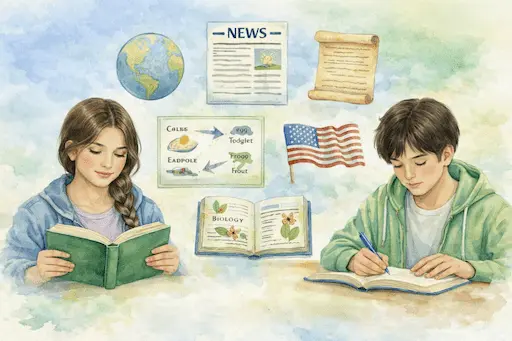
Text features are visual tools authors use to organize information. They help readers understand:
where something happened
when it happened
how many or how much
how ideas connect
Common text features include:
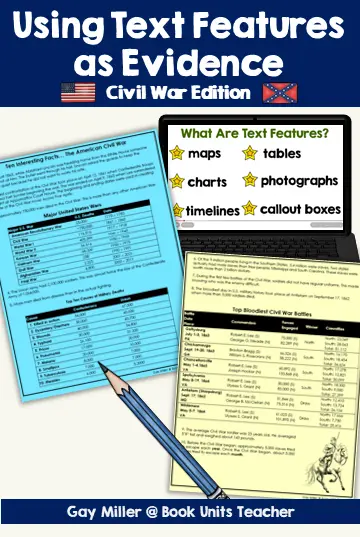
maps
charts
tables
timelines
photographs
callout boxes
When students learn to read these features, nonfiction becomes easier to navigate, and writing becomes more accurate.
Using Text Features as Evidence
Example 1 — Maps
Using Maps as Evidence
Hover or tap to flip 🔄
Using Maps as Evidence
A map of Union and Confederate states shows how the nation was divided in 1861.
“The map shows that the country was split between Union and Confederate states, which increased tension and made conflict more likely.”
Maps provide geographic evidence.
Example 2 — Data Tables
Using Tables as Evidence
Hover or tap to flip 🔄
Using Data Tables as Evidence
A table comparing deaths from major American wars shows that the Civil War caused around 750,000 deaths.
“According to the data table, the Civil War caused more deaths than any other American war.”
Tables provide numerical evidence.
Example 3 — Callout Boxes
Using Callout Boxes as Evidence
Hover or tap to flip 🔄
Using Callout Boxes as Evidence
A callout box titled The War by the Numbers highlights soldier counts and average ages.
“The callout box shows that over two million men served in the Union Army, and most soldiers were around 23 years old.”
Callout boxes provide high‑impact evidence.
Example 4 — Timelines
Using Timelines as Evidence
Hover or tap to flip 🔄
Using Timelines as Evidence
A timeline shows how the war progressed from Fort Sumter to Appomattox.
“The timeline shows that the war lasted four years, beginning in April 1861 and ending when Lee surrendered in April 1865.”
Timelines provide sequence evidence.
Be sure to download the handout that includes the printable article and timeline organizer.
The video lesson provides a walkthrough of maps, data tables, charts, and timelines. The video then shows how to use this information to construct an informative paragraph that follows the claim > evidence > explanation > conclusion structure.
Play Video about Civil War Video Writing Lesson for Upper Elementary
📘 The Webpage Companion
Select either the printable 10 Interesting Facts and Timeline from the handout or the webpage on Book Units Teacher featured in the video lesson. You can go to the webpage by clicking the button below.
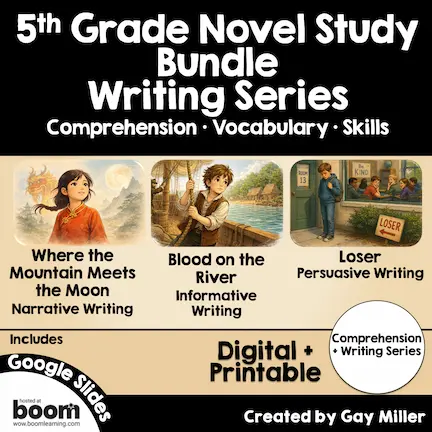
Do you need a full step-by-step informative writing unit? Check out the 5th Grade Novel Study+ Writing Series.
5th Grade Novel Study Bundle Writing Series includes vocabulary practice, comprehension questions, constructed response writing, and skill practice, plus step-by-step writing lessons for narrative, informative and persuasive writing.
I would like to start by telling you how much I absolutely love using your novel studies to teach my 5th grade class. We just finished Charlie and the Chocolate Factory and are getting ready to start City of Ember. I recommend you to all of my colleagues as well and my principal is amazed by your work! I was wondering if you have any plans of doing any historical based novel studies. There is a really great book called Jeffersons Sons that I would love to teach to tie in the social studies curriculum but I can not find a unit on it anywhere and quite honestly at this point in my career and life I am not comfortable creating my own. Any chance you could help me out?
 Be sure to download the handout that includes the printable article and timeline organizer.


4 comments
Skip to comment form
Hi Ms. Miller,
I would like to start by telling you how much I absolutely love using your novel studies to teach my 5th grade class. We just finished Charlie and the Chocolate Factory and are getting ready to start City of Ember. I recommend you to all of my colleagues as well and my principal is amazed by your work! I was wondering if you have any plans of doing any historical based novel studies. There is a really great book called Jeffersons Sons that I would love to teach to tie in the social studies curriculum but I can not find a unit on it anywhere and quite honestly at this point in my career and life I am not comfortable creating my own. Any chance you could help me out?
Thank you so much! This Civil War Organizer is a life saver, and you are a saint to provide it for free.
I would love a copy of your Civil War foldable for my 5th grade class.
Thank you,
Charlotte
Author
Just click on the image of the foldable organizer and it will download.