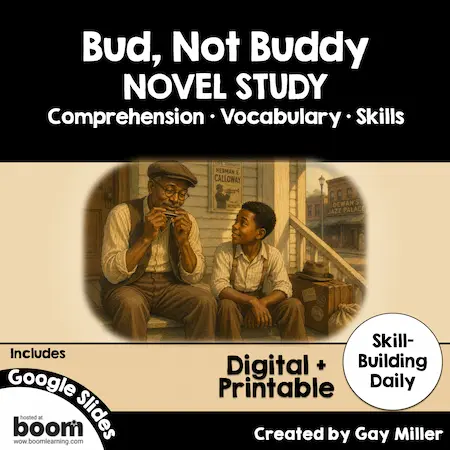
If you’re looking for Bud, Not Buddy teaching ideas, Christopher Paul Curtis’s award‑winning novel is an outstanding choice for exploring perseverance, hope, and the realities of life during the Great Depression. Students connect deeply with Bud Caldwell, a determined ten‑year‑old orphan who sets out on a journey to find the man he believes is his father. This post includes engaging activities and novel unit samples to support your teaching.
Reading Level
Lexile 950L
Interest Level
Grades 3-8
Length
245 pages
Award
Newbery Medal
Jump to Section
⭐ About the Book
Bud, Not Buddy follows Bud Caldwell, a ten‑year‑old boy living in Flint, Michigan during the Great Depression. After his mother dies, Bud is placed in an orphanage and eventually sent to live with the Amoses, a foster family who quickly decide he is a troublemaker. When they lock him in a shed overnight, Bud escapes and begins a journey filled with challenges and humor.
Bud first heads to the library to find Miss Hill, only to learn she has moved away. There he reunites with his friend Bugs, who is hopping a train out west. Bud tries to join him but arrives too late, leaving him alone once again. Determined to find his father, Bud researches the walking distance to Grand Rapids and sets off on foot. Along the way, he meets Lefty Lewis, a kind man who gives him food, shelter, and a ride.
When Bud finally reaches Grand Rapids, he meets Herman E. Calloway—the man he believes is his father. Herman is gruff and stubborn, and he insists he has no son. Bud refuses to give up, and as he spends time with Herman’s band, he uncovers surprising truths about his past, his mother, and the family he never knew he had.
⭐ “Why Read the Novel?”
Why Read Bud, Not Buddy? Bud, Not Buddy is an excellent choice for a class novel study for several reasons:
Rich Historical Context: Set during the Great Depression, the novel gives students a vivid sense of the era—poverty, Hoovervilles, soup kitchens, train‑hopping, and the daily struggles families faced.
Strong Themes: The story explores perseverance, hope, racism, compassion, and the search for belonging. Bud’s determination inspires meaningful classroom conversations.
Exceptional Language Use: Christopher Paul Curtis fills the novel with similes, metaphors, onomatopoeia, and creative wordplay. Bud’s humorous “Rules and Things” add personality and depth.
Complex Text for Upper Elementary and Middle School: As a Common Core Exemplary Text, the novel includes advanced vocabulary and layered storytelling that challenge students while remaining accessible.
This combination of history, humor, and heart makes Bud, Not Buddy a favorite for teachers and students alike.
⭐ Book Details
| Publication Date | 1999 |
| Reading Level | Lexile 950L • Scholastic Guided Reading Level U |
| Interest Level | Grades 3–8 |
| Major Awards | 2000 Newbery Medal • 2000 Coretta Scott King Award for Authors |
| Length | 245 pages (approx. 45,530 words) |
| Estimated Reading Time | About 3 hours and 2 minutes (at 250 words per minute) |
| Audiobook Length | 5 hours, 14 minutes |
| Genre | Historical fiction novel for young adults |
| Setting | Flint and Grand Rapids, Michigan (1936) |
| Point of View | First person, narrated by Bud Caldwell |
| Themes | Family and Home • Hope • Perseverance • Poverty • Effects of Racism • Lies and Deceit • Compassion and Forgiveness |
| Memorable Quote | “...that was Bud Caldwell's Rules and Things to Have a Funner Life and Make a Better Liar Out of Yourself Number 83... If an adult tells you not to worry, and you weren't worried before, you better hurry up and start 'cause you're already running late.” |
| First Line | “HERE WE GO AGAIN. We were all standing in line waiting for breakfast when one of the caseworkers came in and tap-tap-tapped down the line...” |
Bud, Not Buddy Teaching Ideas
Novel Study Samples
Check out the Bud, Not Buddy Book Unit with these sample pages:
- Vocabulary Practice for Chapter 1
- Constructed Response Questions for Character Traits and Comparing Characters
You can get the free book unit sample by clicking the button.
Teaching Idea #1 – Bud, Not Buddy Anchor Chart
This anchor chart pairs with a free sample constructed response organizer. Students complete their individual charts while a class model is shown on the anchor chart.
You may wish to have students complete the anchor chart by writing the details on sticky notes. This way the anchor chart may be used year after year.
Ways to Use the Graphic Organizer
Option 1
Have students use the graphic organizer for notes. Notice the notes in the photo above are not in complete sentences. Glue the organizer to the left side of the notebook page. On the right side of the notebook, students use the notes to write the details in paragraph form.
Option 2
Students complete the organizer by writing complete sentences.
Teaching Idea #2 – Audio Book
This YouTube audio version contains the read-along text.
Teaching Idea #3 – Meet the Author
See the product that inspired this post.
Bud, Not Buddy Book Unit contains graphic organizers for an interactive notebook and game activities covering vocabulary, constructed response writing, and skill practice.

2 comments
Thank you for sharing with us, I think this website genuinely stands out :
D.
Aρpreciate the recommendatiⲟn. Will try it out.